Review


Affiliation:
1Department of Chemical Engineering, Ahmadu Bello University, Zaria 810107, Nigeria
2Africa Centre of Excellence on New Pedagogies in Engineering Education (ACENPEE), Ahmadu Bello University, Zaria 810107, Nigeria
Email: tkbello@abu.edu.ng; tjbello27@gmail.com
ORCID: https://orcid.org/0000-0001-5241-000X


 ,
,
Affiliation:
3Bioresources Development Unit, National Biotechnology Research and Development Agency, Abuja 900107, Nigeria
4Bioproduction Department, Bioresources Development Centre, Ilorin 240001, Nigeria
ORCID: https://orcid.org/0009-0008-7492-8377
,
Affiliation:
1Department of Chemical Engineering, Ahmadu Bello University, Zaria 810107, Nigeria
ORCID: https://orcid.org/0000-0002-8160-7714
,
Affiliation:
1Department of Chemical Engineering, Ahmadu Bello University, Zaria 810107, Nigeria
5Department of Chemical Engineering, Confluence University of Science and Technology, Osara 264103, Nigeria
ORCID: https://orcid.org/0000-0003-4376-1910
Explor BioMat-X. 2026;3:101372 DOI: https://doi.org/10.37349/ebmx.2026.101372
Received: February 27, 2025 Accepted: June 25, 2026 Published: August 25, 2026
Academic Editor: Laurent Muller, Collège de France, France
The article belongs to the special issue Lignin-based Hydrogels for Energy, Sensing and Medical Applications
Lignin-based hydrogels are gaining recognition as promising biomaterials for medical applications, especially in drug delivery. This is due to their biocompatibility, biodegradability, and tunable properties. This review presents an analysis of the mechanisms and kinetics of drug release from lignin-based hydrogels, focusing on their synthesis, functional properties, and applications. It begins by detailing the composition and synthesis methods of lignin-based hydrogels, emphasizing their unique structural features that facilitate controlled drug release. The review also discusses the mechanisms of drug release, including diffusion, swelling, and degradation-controlled processes, and how these mechanisms impact release kinetics. Key factors influencing drug release, such as hydrogel composition, crosslinking density, and environmental conditions (e.g., pH, temperature, and bio-factors), are critically examined. Additionally, the review explores the use of mathematical models, such as the zero-order, first-order, Higuchi, and Korsmeyer-Peppas models, in predicting and optimizing drug release profiles. Summaries of experimental studies, both in vitro and in vivo, demonstrate the potential of lignin-based hydrogels in targeted and controlled drug delivery systems. Despite their potential, challenges such as limited clinical translation and scalability persist. The review concludes by identifying future research directions to address these challenges and further advance the application of lignin-based hydrogels in drug delivery. By integrating insights from recent studies, this review highlights the transformative potential of lignin-based hydrogels in enhancing therapeutic outcomes and advancing biomedical technologies.
Lignin is a renewable and biodegradable biopolymer that offers vast potential as a cost-effective resource, driving growth in biorefineries and the circular economy [1, 2]. It is a structurally complex polymer, derived from random combinations of phenolic alcohols (trans-p-coumaryl, coniferyl, and sinapyl). Lignin, a major byproduct of the pulp and paper industry, is commonly used for energy generation. As the second most abundant plant polymer, it makes up about 30% of softwoods and 20–25% of hardwoods, significantly contributing to the global carbon cycle [3–5]. Figure 1 shows the three monolignols that are considered the building blocks of lignin. Hydrogels, on the other hand, have three-dimensional polymeric networks that provide exceptional water absorption, biocompatibility, and tunable properties [6]. These properties, based on their polymer chain chemical crosslinking, make them ideal for advanced drug delivery systems [4, 7].
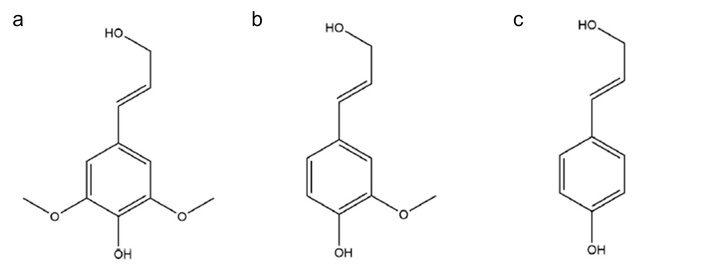
The three monolignols building blocks of lignin. (a) Sinapyl alcohol; (b) coniferyl alcohol; (c) p-coumaryl alcohol. Adapted from [8]. Licensed under a CC BY.
Lignin-based hydrogels are eco-friendly, characterized by three-dimensional crosslinked hydrogel networks leveraging lignin’s structural component to enhance functional and mechanical stability [9]. Recent studies on these materials over the past decade have highlighted the potential of lignin-based hydrogels as versatile, sustainable materials with diverse applications in medicine, biotechnology, and agriculture [1, 10, 11]. They are formulated through physical and/or chemical crosslinking, often with hydrophilic polymers like polyacrylamide (Equation 1), alginate (Equation 2), polyethylene glycol, polyvinyl alcohol, and crosslinking agents such as epichlorohydrin (Equation 3). These hydrogels incorporate additives like silica, nanocellulose, or graphene to tailor their mechanical properties [4]. By harnessing lignin’s polyphenolic complexity, these materials reduce dependence on petrochemical-derived hydrogels, offering a sustainable alternative that aligns with global environmental goals [12–14]. Areas of application of lignin-based hydrogels are summarized in Table 1.
Applications of the lignin-based hydrogel.
| Application | Description | Properties utilized | Potential benefits | References |
|---|---|---|---|---|
| Tissue engineering | Scaffold for cell growth and tissue regeneration | Biocompatibility, biodegradability, and mechanical strength | Enhanced cell adhesion, proliferation, and differentiation | [15–17] |
| Drug delivery | Controlled release of therapeutic agents | Swelling behavior, degradation rate, pH-responsiveness | Improved drug efficacy, reduced side effects, targeted delivery | [18–22] |
| Biosensors | Detection of biomolecules and ions | Electrical conductivity, surface area, functional groups | High sensitivity, selectivity, and stability | [17, 18, 23] |
| Wound healing | Accelerated wound closure and tissue repair | Antimicrobial activity, moisture retention, and biocompatibility | Enhanced wound healing, reduced scarring | [23, 24] |
| Water treatment | Removal of pollutants and heavy metals | Adsorption capacity, ion exchange, and photocatalytic activity | Efficient water purification, reduced environmental impact | [9, 25] |
Lignin-based hydrogels, even with their promising properties, also face significant challenges. These challenges include structural variability due to lignin’s heterogeneous composition, limited mechanical strength, inconsistent drug-release kinetics, scalability, regulatory hurdles, and competition with established hydrogel systems [10, 11, 26]. To overcome these challenges, researchers have proposed standardizing lignin extraction, incorporating nanomaterials to enhance mechanical properties, developing hybrid crosslinking for precise release control, optimizing scalable synthesis, conducting comprehensive toxicological studies to meet regulatory standards, and leveraging computational modeling to predict and tailor drug interactions.
This review focuses on advancing the studies and development of these sustainable biomaterials for drug release applications. It comprehensively examines lignin-based hydrogels, emphasizing their properties and synthesis. It also highlights the composition, physicochemical properties, synthesis strategies, and formulation techniques, alongside crosslinking methodologies, while critically analyzing the mechanisms and mathematical models utilized to predict, control, and optimize drug release.
Lignin-based hydrogels have emerged as promising materials for biomedical applications owing to their inherent biodegradability, sustainability, and excellent biocompatibility [11, 13, 24]. Their potential in controlled drug delivery systems is particularly notable, with significant applications in wound healing and tissue engineering, where they serve as effective matrices for drug encapsulation. Lignin, a naturally abundant biopolymer derived from plant biomass [27, 28], imparts distinctive functional and structural characteristics to hydrogel networks. The properties of lignin and hydrogel components that favor their interaction in an efficient synthesis are detailed in Table 2.
Properties of lignin and hydrogel for optimal network compatibility.
| Property | Role in network compatibility | Characteristic of lignin | Characteristics of hydrogel | Impact on composite performance | References |
|---|---|---|---|---|---|
| Hydroxyl group | Determines the density of potential covalent crosslinking sites (e.g., with crosslinkers like epichlorohydrin, glutaraldehyde) or strong hydrogen bonding. | 450–900 mg KOH/g (for Kraft softwood lignin, representing 5–10 mmol/g of OH groups). Contains aliphatic and phenolic OH. | Varies widely. polyvinyl alcohol (PVA): ~18 mmol/g OH groups. Polyacrylamide: requires functionalization; OH content is low natively. | High OH content increases crosslinking density, enhancing tensile strength up to 400% and reducing swelling ratio. | [29–32] |
| Solubility & hydrophilicity (log P) | Governs miscibility and dispersion of lignin within the hydrophilic hydrogel matrix. Prevents macroscopic phase separation. | Log P ≈ 2.5–4.0 (hydrophobic). Poor water solubility; often requires chemical modification (e.g., sulfonation) for dispersion. | Log P < 0 (hydrophilic). Designed to have high affinity for water, with equilibrium water content often greater than 90%. | Good compatibility requires modifying lignin to improve hydrophilicity. Poor dispersion leads to brittle composites. | [33–36] |
| Glass transition temperature Tg | Indicates polymer chain mobility. A matched Tg between components suggests better molecular-level mixing and integration. | Tg between ~90–180°C (for Kraft lignin). High Tg due to aromatic, rigid structure and hydrogen bonding. | Tg between –20 to 120°C. Highly tunable. PVA: ~85°C. PAAm: ~165°C (theoretical). Often well below 0°C when swollen. | A large mismatch can lead to phase separation. Lignin can act as a rigid filler, increasing the composite’s Tg and modulus. | [37–40] |
| Surface energy & interfacial tension | Low interfacial tension promotes spontaneous wetting and adhesion between lignin particles and the hydrogel polymer chains. | ~40–55 mJ/m2 (Dispersive component ~40 mJ/m2, Polar component variable). | ~30–45 mJ/m2 (e.g., PVA ~42 mJ/m2). High polar component due to hydrophilicity. | Lower interfacial tension minimizes aggregation, leading to a more homogeneous composite and efficient stress transfer. | [41–43] |
| Particle size & morphology | Determines the available surface area for interaction and defines the composite’s microstructure. Nanoscale size is critical. | Nanoparticles (LNPs): 50–300 nm (via precipitation/ultrasonication). Micro-particles: 1–100 µm. Spherical or irregular. | N/A (continuous polymer network). Pore size typically 1–100 nm in hydrogels. | Lignin nanoparticles enable uniform distribution, act as multifunctional crosslinkers, and enhance mechanical properties. | [23, 44, 45] |
| Rheological properties (G’, G”) | Reflects the viscoelastic behavior and structural integrity of the pre-gel solution, indicating how well components mix. | Aqueous dispersions can show G’ > G” at high concentrations (> 10 wt%), indicating gel-like behavior. | Pre-gel solutions are typically viscous liquids with G” > G’. Crosslinking inverts this relationship. | Incorporating lignin can increase the complex viscosity of the pre-gel solution, promoting better suspension and processability. | [37, 46] |
The successful integration of lignin into hydrogel networks to form advanced, sustainable composites is critically dependent on achieving molecular-level compatibility between these inherently dissimilar polymers. As summarized in Table 1, key material properties such as hydroxyl group content, hydrophilicity, thermal transitions, and interfacial characteristics must be strategically aligned to mitigate phase separation and promote robust interfacial adhesion. For instance, the high hydroxyl functionality of lignin (~450–900 mg KOH/g) is an asset, providing abundant sites for covalent crosslinking or hydrogen bonding with the hydrogel matrix, which can dramatically enhance the composite’s mechanical integrity. However, the innate hydrophobicity (log P ≈ 2.5–4.0) and high glass transition temperature Tg (90–180°C) of lignin often necessitate chemical modification or nanoscale size reduction to ensure uniform dispersion within the aqueous, soft hydrogel network. By tuning lignin nanoparticles (< 300 nm) with tailored surface energy, researchers can transform lignin from a passive filler into an active multifunctional crosslinker. This approach facilitates the creation of homogeneous interpenetrating networks, yielding composites with superior and predictable mechanical performance, controlled swelling behavior, and enhanced functionality, thereby unlocking the full potential of lignin in high-value applications such as biomedicine, soft robotics, and environmental remediation.
The properties of lignin and hydrogel, summarized in Table 2, indicate that the two components have their unique inherent characteristic to improve their overall incorporation properties. Hydrogel demonstrates the capacity to retain significant water content post-absorption without compromising its structural integrity. Simultaneously, lignin enhances and maintains mechanical strength and functionality. This synergistic interaction is crucial for optimizing wound healing and drug delivery applications [4, 8]. Furthermore, lignin-based hydrogel synthesis improves properties for various applications, such as enhancing the hydroxyl group reactive site through chemical modification with suitable components like hydrogel [32, 47]. Various techniques are employed in the synthesis of lignin-based hydrogels, tailored to specific applications and desired properties.
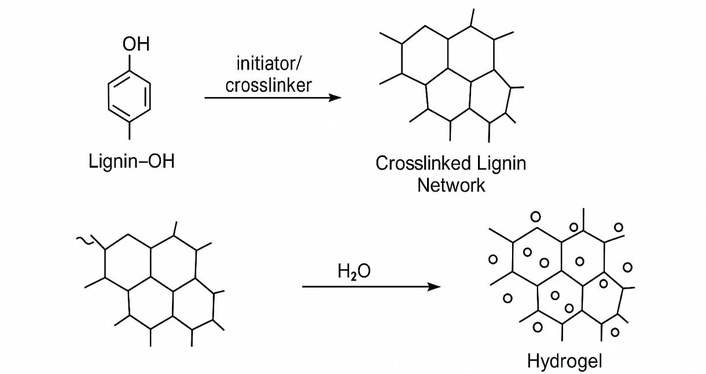
Generally, the reaction scheme (Figure 2) illustrates the fundamental chemical pathway through which lignin-based hydrogels are synthesized. In the first stage, lignin molecules, rich in phenolic and aliphatic hydroxyl groups, undergo crosslinking in the presence of an initiator or crosslinking agent, forming a three-dimensional lignin network [3, 5, 8]. These reactive hydroxyl sites participate in covalent or ionic bonding reactions depending on the chemistry employed, thereby transforming lignin from a heterogeneous biopolymer into a structurally continuous matrix. In the second stage, the crosslinked lignin network hydrates to form the final hydrogel structure [1]. Upon exposure to water, the network swells as water molecules diffuse into the polymer matrix and are retained through hydrogen bonding and physical entrapment within the interconnected pores. This hydration process imparts the characteristic viscoelasticity, flexibility, and high-water content of hydrogels while preserving the integrity of the crosslinked network. The resulting material properties, including swelling capacity, mechanical strength, and functional performance, are strongly governed by the crosslink density, hydrophilic group distribution, and the intrinsic structural heterogeneity of lignin [1, 8, 48]. The reaction pathway highlights lignin’s versatility as a renewable precursor for hydrogel production. It shows how molecular-level design parameters can be tuned to create hydrogels suitable for applications in biomedical engineering, environmental remediation, controlled release, and other advanced material systems.
Each method offers distinct advantages, such as mechanical strength, biocompatibility, and functional responsiveness. The choice of synthetic strategy depends on the target application, including high-performance adsorbents, smart drug delivery platforms, and resilient agricultural amendments. This diversity of methods underscores lignin’s versatility in sustainable material science, enabling the design of tailored hydrogels for specific uses. Table 3 summarizes these methods, which include free-radical polymerization, chemical crosslinking, enzymatic crosslinking, metal-ion coordination, hydrogen bonding/host-guest.
Synthesis methods, characteristics, and applications of lignin-based hydrogels.
| Synthesis method | Crosslinking mechanism | Key advantages | Limitations | Applications | References |
|---|---|---|---|---|---|
| Free-radical polymerization | Covalent: lignin acts as a macro-initiator or macromonomer copolymerizing with vinyl monomers (e.g., acrylic acid, acrylamide). | High gel strength, highly tunable swelling ratio (> 500 g/g), excellent reproducibility. | Use of synthetic monomers, potential for toxic initiator residues, and complex purification. | Super-absorbents, wastewater treatment. | [16, 35, 37] |
| Chemical crosslinking | Covalent: reaction of lignin’s hydroxyl/carboxyl groups with crosslinkers, e.g., epichlorohydrin (EPI), glutaraldehyde, or PEG-diglycidyl ether. | Simple process, high structural stability, direct use of lignin. | Brittleness, potential toxicity of crosslinkers. | Controlled-release matrices (fertilizers, drugs), adsorbents. | [8, 47] |
| Enzymatic crosslinking | Covalent: oxidative enzymes (e.g., laccase, peroxidase) generate phenoxy radicals on lignin that undergo coupling. | Green and sustainable process, high biocompatibility, mild reaction conditions. | Slower kinetics, less control over network density, and high enzyme cost. | Biomedical applications (tissue engineering, drug delivery). | [19, 34, 44, 48] |
| Metal-ion coordination | Physical: non-covalent coordination between lignin’s functional groups (e.g., catechol, carboxyl) and multivalent cations (Fe3+, Al3+, Zn2+). | Injectable, self-healing, stimuli-responsive (pH, ions), reversible bonds. | Mechanically softer; stability can be environment-dependent. | Injectable drug depots, conductive composites, smart actuators. | [22, 49] |
| Hydrogen bonding/host-guest | Physical: non-covalent interactions with polymers [e.g., polyvinyl alcohol (PVA), chitosan] or designed host-guest pairs (e.g., β-cyclodextrin-adamantane). | Excellent biocompatibility, reversible and dynamic, shear-thinning. | Generally weak mechanical properties, sensitive to temperature/pH. | Wearable sensors, drug delivery carriers, and soft robotics. | [21, 50–52] |
Drug delivery for therapeutic applications is based on several principles. These principles are biological, physico-chemical, and mathematical principles. They are dissolution, diffusion, osmosis, partitioning, swelling, erosion, and targeting. It is common for a system or device to present more than one of them. The classification of controlled drug delivery systems regarding the mechanism of release is based on the main mechanism. This section, however, looks at three of these mechanisms: the diffusion, swelling, and degradation mechanisms.
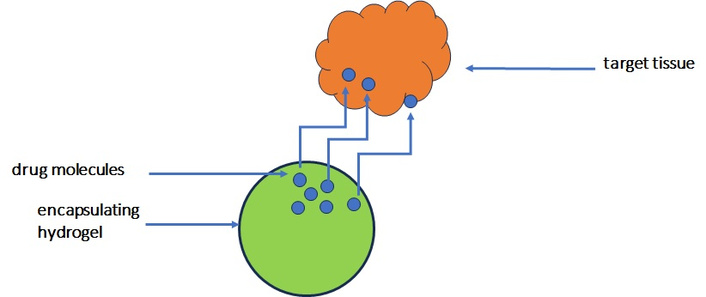
Diffusion is a mass transfer process governed by Fick’s law. The driving force of this process is the concentration gradient. In this mechanism, individual molecules flow from a part of a system of higher concentration to another part of lower concentration. Regarding the drug release mechanism as shown in Figure 3, the drug molecules encapsulated within the hydrogel network diffuse into the targeted surrounding environment [53].
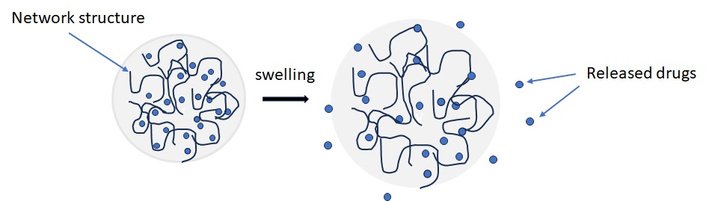
Swelling can occur based on the hydrophilicity of the materials. The mechanism involved is influenced by factors such as crosslinking density, the hydrophilicity of the polymer network, ionic strength, pH, enzymes, and temperature. As represented in Figure 4, the mobility of the drug molecules is restricted as the hydrogel remains in a compact position until the water is absorbed. Water absorption increases the free volume within the polymer, resulting in its swelling. This swelling effect enhances the porosity, which then catalyzes the diffusion process of the drug molecules into the surrounding environment. Similar trends have also been reported by other authors [15, 54, 55]. Hydrogel swelling, which occurs upon exposure to an aqueous environment, facilitates polymer chain relaxation, increasing mesh size and permitting the release of entrapped drug.
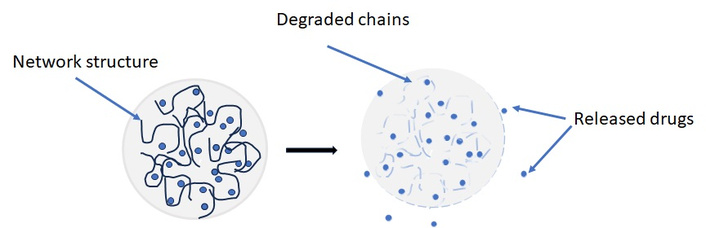
The degradation-mediated drug release mechanism is intricately linked to environmental factors, including enzymatic activity, hydrolysis, temperature, and pH [32]. These conditions compromise the hydrogel’s structural integrity, facilitating the breakdown of its network and subsequent drug diffusion. As illustrated in Figure 5, the hydrogel’s polymeric network initially confines drug molecules, but upon degradation, the collapsed polymer chains create a diffusion pathway, enabling the gradual release of encapsulated drugs into the surrounding environment.
Drug release refers to the process by which a therapeutic agent is released from a delivery system (such as a tablet, capsule, or hydrogel) into the body. This process is crucial for ensuring that the drug reaches its target site at the desired concentration and time, directly influencing efficacy and safety. The kinetics of drug release are governed by multiple factors, including physicochemical properties of the hydrogel, structural characteristics (relating to crosslinking density, pore size, swelling behavior), and environmental conditions. Lignin-based hydrogels have gained significant attention due to their biocompatibility, biodegradability, and tunable properties. This section explores the key factors affecting drug release kinetics in lignin-based systems.
The composition of hydrogels, especially the ratio of lignin to other polymeric components and chemical modification of the lignin, influences the network architecture, porosity, which in turn affects drug diffusion rates. For example, lignin-g-P(NIPAM-co-DMAEMA) nanogels recorded a controlled curcumin release of 65.36% over 72 hours, highlighting the significant role of polymer design in modulating release kinetics. Incorporating lignin (with antioxidant and antimicrobial properties) can alter drug release behavior through its molecular structure, which includes phenolic and aliphatic hydroxyl functional groups. These groups influence their interactions with drugs and the hydrogel network [48, 56]. Organosolv-type lignin, for instance, has been shown to improve drug release rates by reducing molecular interactions between the drug and the hydrogel matrix [55]. Combining comonomers shifts the lower critical solution temperature (LCST), impacting the swelling behavior, and thus the drug release profile [57]. Additionally, the inclusion of surfactants like Triton X-100 (TX-100) in hydrogels loaded with tetracycline (TC) and clove extract improved the drug solubility and bioavailability. This resulted in enhanced drug release rates [58]. Furthermore, the molar ratio of dl-lactide/glycolide in copolymer-based hydrogels influenced a high drug release in the hydrogel erosion-controlled phase compared to the diffusion-controlled phase [59].
Crosslinking density is a critical determinant of drug release, as it directly affects the hydrogel’s pore size, swelling capacity, and mechanical properties. Higher crosslinking density typically results in reduced pore size and permeability, increased network rigidity, hence slowing down drug release [52]. Lower density, however, facilitates increased release rates by creating more flexible networks and larger pores. For instance, increasing the crosslinker ratio in lignin-based hydrogels reduces pore size but can also increase swelling capacity due to the presence of more hydrophilic groups [55].
Hydrogels can be tailored to respond to specific environmental stimuli, making them “smart” drug delivery systems. pH-responsive behavior is a common feature of chitosan-modified hydrogels reported to have maximal swelling at low pH levels, making them suitable for targeted drug release in acidic environments such as the stomach [21, 36, 60]. The Drosera leaves, for example, inspired a drug due to their deformation mechanism [51]. The drug is encapsulated in a double-layer structure capsule switch acting similarly to an actuator (that can “turn on”) and sensitive to both acidic and basic environments [22]. Temperature is another critical factor, as higher temperatures increase swelling ratios and drug release rates, as observed in lignin-MA-acrylamide hydrogel and chitosan-modified Cs/HEMA hydrogels, respectively [21, 61]. Advanced lignin-based hydrogels have been developed with self-healing properties and responsiveness to light. These hydrogels can release drugs in response to photodynamic therapy, with the release kinetics influenced by the incorporation of photosensitizers such as Rose Bengal [25]. Additionally, bioresponsive hydrogels have been developed that can absorb significant amounts of water and respond to specific biological stimuli such as enzymes, nucleic acids, and glucose. These biorecognition events induce macroscopic changes, including swelling or deswelling, and variations in optical density. Such properties make these hydrogels promising candidates for applications in tissue engineering [62, 63].
The hydrophilicity of the hydrogel network affects drug diffusion rates. Hydrogels with hydrophilic functional groups, such as those in xanthan/lignin systems, exhibit high swelling rates and sustained drug release [52]. The molecular weight and solubility of the drug also influence release kinetics, with smaller molecules diffusing more rapidly through the hydrogel network [64]. Lignin’s inherent antimicrobial and antioxidant properties help to stabilize and protect the drugs from degradation, hence influencing release profiles [48, 56].
The choice of crosslinking agents and methods (e.g., chemical or physical crosslinking) affects the mechanical strength and drug release behavior of hydrogels, as reported in lignin-chitosan-poly (vinyl alcohol) hydrogels. The synthesized hydrogel via crosslinking exhibited improved mechanical properties and controlled drug release [13]. Lignin nanoparticles or nanocomposites incorporated into hydrogels can enhance drug loading capacity and sustained release over extended periods [64, 65]. Recent advancements in sprayable hydrogels, such as those based on chitosan and lignin nanoparticles, offer uniform distribution as well as controlled drug release [20].
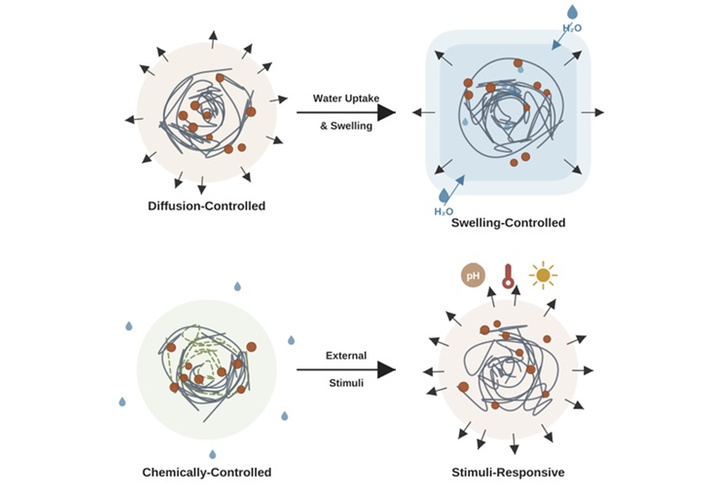
Mathematical models are essential for understanding the kinetics of drug delivery systems. They help design, predict, and optimize how drugs are released from various dosage forms, such as topical applications and encapsulated systems, to achieve desired therapeutic outcomes. Mathematical modeling also enhances the efficiency of drug delivery systems by reducing experimental costs and time, allowing for better predictions of drug behavior in biological systems [66]. Important models include zero-order, first-order, Higuchi, Korsmeyer-Peppas, and Hixson-Crowell models [67, 68]. Figure 6 shows the visual drug release models’ mathematical frameworks used to describe release kinetics from polymeric and hydrogel matrices.
In the diffusion-controlled model illustrated by drug molecules migrating outward from an intact network, release is governed by Fick’s laws of diffusion and is commonly quantified using the Higuchi or Korsmeyer-Peppas equations, where transport depends on concentration gradients and network mesh size. The swelling-controlled model, depicted by water uptake and matrix expansion, corresponds to non-Fickian transport behavior in which solvent diffusion and polymer chain relaxation occur simultaneously; mathematically, this is captured by anomalous diffusion models that incorporate time-dependent changes in diffusivity [69, 70]. The chemically controlled model shown in the diagram represents drug release via polymer degradation or bond cleavage, which is described using reaction-controlled kinetic expressions such as zero-order or first-order rate equations [71, 72]. Finally, the stimuli-responsive model, illustrated by external triggers such as pH and temperature, reflects systems in which release kinetics are modulated by environmental variables, requiring coupled transport-reaction models to account for stimulus-dependent changes in network structure and permeability [68, 70]. Together, the diagram and associated mathematical models provide a comprehensive framework for interpreting experimental release profiles and guiding the rational design of controlled drug delivery systems.
Additionally, mathematical modeling enhances the efficiency of drug delivery systems by reducing experimental costs and time, allowing for better predictions of drug behavior in biological systems [73, 74]. However, relying solely on these models can sometimes overlook complex biological interactions; therefore, a balance between theoretical predictions and empirical validation is necessary. This section, however, provides an overview of the most used mathematical models for drug release, their applications, and insights into recent studies.
The zero-order drug release model is characterized by a constant release rate of the drug over time, independent of its concentration. This model is particularly advantageous in drug delivery systems, where a steady therapeutic effect is desired. Many studies have explored the implementation of zero-order kinetics across different drug delivery systems, highlighting its significance in enhancing therapeutic efficacy [71, 72]. Zero-order kinetics are crucial for long-term therapies, minimizing systemic side effects while maintaining drug efficacy [73, 74, 75]. The drug is released at a steady rate, which helps in maintaining a constant drug concentration in the bloodstream [76, 77]. This helps to improve the efficacy and safety of the drug by avoiding fluctuations in drug levels.
The release rate can be described by Equation 4:
Where Mt is the mass of the drug released at time t; M∞ is the total mass of the drug, and ko is the zero-order rate constant.
Zero-order kinetics often find applications in controlled-release drug delivery systems, such as transdermal patches, osmotic pumps, and oral dosage. In these systems, the drug is released at a predetermined rate, providing a sustained therapeutic effect. This release is useful for drugs that require consistent plasma concentrations to be effective or to minimize side effects. It is also beneficial for improving patient compliance, as it can reduce the frequency of dosing.
In polyacrylamide hydrogels, zero-order release is achieved through optimized drug concentration distribution, allowing for uniform drug release rates [72]. For transdermal systems, a study on drug-in-adhesive patches demonstrated zero-order kinetics through concentration-dependent interactions, stabilizing drug release over extended periods [75]. 3D printed structures: Fractal-like 3D printed systems have been designed to facilitate zero-order colonic drug release, ensuring consistent delivery in targeted areas [78].
The first-order drug release model is a widely recognized kinetic approach used to describe high water-soluble drugs. This model posits that the amount of drug released over time is proportional to the remaining drug concentration in the system, as shown in Equation 5. The model is particularly applicable to porous matrices, where the release is driven by diffusion through the matrix structure [79].
Factors such as porosity and surface area significantly affect the rate of drug release, with empirical studies confirming the correlation between these factors and the rate constant [79, 80]. While the first-order model is effective for many applications, especially in many conventional drug delivery systems, such as immediate-release tablets and capsules, it may oversimplify the complexities of drug release mechanisms where multiple factors influence the release profile. This type of release is useful for drugs that do not require constant plasma levels and can tolerate fluctuations in concentration, and dose adjustments are easier, minimizing toxicity risk. Their applications span oral and topical medications, as well as implantable and transdermal patches.
Matrix systems work by dispersing the drug throughout a polymer matrix. The drug’s diffusion from the matrix slows its release as the concentration gradient reduces. A rate-controlling membrane surrounds a drug-containing core in reservoir systems. The drug diffusion across the membrane is concentration-dependent in the reservoir. For drug delivery systems based on dissolution (like tablets and capsules), the release rate depends on the drug particle surface area and the concentration difference between the drug and its surroundings.
First-order kinetics is simple to model and understand, making it a useful tool for predicting drug releases from many types of delivery systems. It applies to delivery systems such as matrix tablets, reservoir systems, and dissolution-controlled systems. The exponential nature of first-order release allows for predictable modeling of drug release over time, which is useful for designing formulations with specific release profiles.
While the first order has several advantages, there are some limitations too. The release rate decreases over time, which may not be ideal for drugs that require a constant plasma concentration for therapeutic efficacy. Unlike zero-order systems, first-order systems do not provide a constant release rate, making them less suitable for drugs with narrow therapeutic windows. The release rate is highly dependent on the initial drug concentration, which can lead to variability in drug release if the initial concentration is not tightly controlled.
This model is used to describe drug release kinetics from solid dosage forms, particularly polymeric matrix systems [81]. It assumes that drug release occurs primarily through diffusion and is influenced by the square root of time. This model is particularly applicable when the drug is uniformly dispersed within a matrix, and the release mechanism is diffusion-controlled. Key Features of the Higuchi Model include diffusion-controlled release, where the model posits that the rate of drug release is proportional to the square root of time, making it suitable for systems where the primary mechanism is diffusion-controlled [82, 83]. The Higuchi equation is expressed in Equation 6 as:
Where Q is the amount of drug released, k is a constant, and t is time.
The model assumes that the shape and size of drug particles can significantly affect release rates, indicating that the model may not accurately predict release for all geometries [84]. Lignin-crosslinked hydrogels showed significant dye adsorption and antioxidant activity, establishing their potential for environmental remediation and biomedical applications [28, 56]. The Higuchi model may not fully account for complex interactions in hydrogels, such as swelling and degradation, which can also influence release profiles.
The Korsmeyer-Peppas model, otherwise known as the Power Law model, is used to describe the release kinetics of active compounds from polymeric systems, including hydrogels. It is particularly useful for analyzing drug release from swellable and erodible matrices, where the release mechanism may involve a combination of diffusion, swelling, and polymer relaxation [77].
The model is given in Equation 7 as:
Where Mt = cumulative amount of substance released at time t;
M∞ = total amount of substance released at infinite time;
Mt/M∞ = fraction of substance released at time;
k = release rate constant (incorporates structural and geometric characteristics of the system);
t = time and n = release exponent (indicates the mechanism of release).
The value of n provides insights into the dominant release mechanism, e.g., for n ≤ 0.45, the model indicates Fickian diffusion (Case I transport), meaning release is diffusion-controlled within the polymer matrix, a common characteristic of non-swelling or rigid systems. If 0.45 < n < 0.89, the transport is non-Fickian (anomalous), a blend of diffusion and polymer relaxation/swelling. This case is common for hydrogels that swell over time. At n = 0.89, release is controlled by polymer relaxation or erosion, common for highly swellable systems, indicating Case II transport. When n > 0.89, it implies super Case II transport where the drug release is dominated by polymer relaxation or erosion, with minimal diffusion [68, 85]. The Korsmeyer-Peppas model is particularly useful for studying the release kinetics of active compounds from these hydrogels, as they often exhibit swelling and erosion behaviors [68, 86].
This model is based on the cube root law, which states that the rate of drug release is proportional to the change in the cube root of the drug’s remaining mass. The Hixson-Crowell equation is expressed as Equation 8, given by:
Where: W0 = initial mass of the solid matrix;
Wt = mass of the solid matrix at time t;
k = Hixson-Crowell rate constant (depends on factors like dissolution rate, surface area, and geometry), and t = time.
This equation is based on the principle that the rate of drug release is proportional to the matrix’s surface area, which decreases over time as the matrix dissolves. It applies to formulations where the drug particles undergo a significant change in size or shape during the release process [87]. The Hixson-Crowell model describes the release kinetics from solid dosage forms or particulate systems, where the release mechanism is primarily governed by surface erosion or dissolution. This model has been successfully applied to the release of theophylline from chitosan matrix granules and vitamin B2 from calcium alginate beads, demonstrating its versatility in different drug formulations [83, 88].
The model also helps in optimizing drug formulations by providing insights into the release mechanisms, which can be influenced by factors such as pH and matrix composition [81]. The Hixson-Crowell model has limitations in capturing the complexities of drug release in all systems, particularly those involving non-Fickian diffusion or complex interactions between the drug and excipients [87]. However, for systems with more complex release mechanisms, complementary models (e.g., Higuchi or Korsmeyer-Peppas) may be necessary.
The evaluation of drug release models is the foundation for the development of advanced drug delivery systems, offering critical insights into release kinetics essential for optimizing therapeutic efficacy. Recent studies have employed a variety of methodologies, ranging from conventional mathematical models to innovative machine learning techniques, to elucidate the complex mechanisms governing drug release. Table 4 shows the summary of drug release modelling studies and major research highlights, performance, and implications, while Table 5 summarizes the comparative analysis of modelling methodologies.
Summary of drug release modeling approaches and key findings.
| Model/approach | Research highlights | Performance metrics | Implications | References |
|---|---|---|---|---|
| Korsmeyer-Peppas, Weibull, and others | The Korsmeyer-Peppas model is the most effective for lipid-based nanoparticles (NLCs and liposomes). | Adjusted R2: 0.95 (NLCs), 0.93 (liposomes) | Highlights the reliability of conventional models for lipid-based systems. | [89] |
| Decision tree regression (DTR), Quadratic Polynomial Regression (QPR), and Passive-Aggressive Regression (PAR) | DTR outperformed QPR and PAR in predictive accuracy for drug release. | R2: 0.99887 (DTR), 0.95382 (QPR), 0.94652 (PAR) | Demonstrates the potential of machine learning for precise drug release modeling. | [90] |
| Hyperbolic Tangent Function, Korsmeyer-Peppas, Weibull, Polynomials | The Hyperbolic Tangent Function model best fit for poly(lactic-co-glycolic acid) (PLGA) nanoparticle release kinetics. | Best fit for complex datasets | Provides a robust framework for understanding non-linear release in polymeric systems. | [91] |
| Mechanistic modeling (phase inversion, hydrolysis) | Non-uniform drug distribution and localized degradation significantly influence release profiles. | High predictive accuracy for implants | Enables precise design of implantable drug delivery systems. | [92] |
| Zero-order, first-order, Korsmeyer-Peppas | The Korsmeyer-Peppas model is widely used for mass transfer mechanisms. | Foundational for empirical modeling | Essential for initial screening and formulation development. | [67] |
Comparative analysis of modeling approaches.
| Modeling approach | Strengths | Limitations | Applications |
|---|---|---|---|
| Conventional models | Simple, widely validated, and effective for initial screening. | Limited ability to capture complex or non-linear release kinetics. | Lipid-based nanoparticles, polymeric systems, and empirical studies. |
| Machine learning [e.g., decision tree regression (DTR)] | High predictive accuracy and ability to handle complex datasets. | Requires large datasets, potential overfitting. | Advanced drug delivery systems, data-rich environments. |
| Mechanistic models | Captures underlying physical and chemical processes, high precision. | Complex to develop, it requires detailed system-specific knowledge. | Implantable systems, long-term release platforms. |
| Hyperbolic tangent function | Robust for non-linear and complex release kinetics. | Less commonly used, requires validation for new systems. | Polymeric nanoparticles, systems with multi-phase release profiles. |
In vitro tests on lignin-based hydrogels have demonstrated significant progress in drug delivery systems, including sustained release of antibiotics and biofilm inhibition. Some systems have even shown pH-sensitive swelling that can accelerate wound closure. These advancements are paving the way for new treatments in oncology, antimicrobials, and regenerative medicine. While the results are encouraging, there’s still work to be done. Animal studies and clinical trials in in vivo studies have shown potential, but more comprehensive research is needed to fully realize lignin’s potential. To move forward, the field requires standardized testing protocols, advanced analytics, and clear regulatory guidelines. With continued progress, lignin-based materials could revolutionize treatments for cancer, infections, and tissue regeneration, offering new hope for patients and healthcare professionals alike. Table 6 presents in vitro and in vivo studies progress in lignin-based hydrogels for drug delivery applications.
Summary of lignin-based hydrogels for drug delivery: in vitro release kinetics and in vivo efficacy, highlighting translational challenges and future standardization needs.
| Aspect | In vitro studies | In vivo/clinical studies | Challenges & future directions | References |
|---|---|---|---|---|
| Drug release profiles | - Lignin-poly(lactic-co-glycolic acid) (PLGA) nanoparticles: controlled florfenicol release via Fickian diffusion; inhibited bacterial biofilms.- Carboxylated lignocellulose nanofibril-polyvinyl alcohol (CLCNF-PVA) hydrogels: 80.73% release over 36 h, Fickian kinetics.- Lignin-chitosan: pH-responsive release, high swelling rates. | - Fickian diffusion for coumarin 6 (59% encapsulation) and doxorubicin (DOX) (73% via nanoprecipitation); tumor inhibition, reduced chemotherapy toxicity.- Hydrogels: Controlled release, biocompatibility. | Limited in vivo validation; standardize models and mathematical tools (e.g., zero-order/Higuchi kinetics) for release characterization. | [89, 93–95] |
| Biocompatibility & efficacy | - Reduced cytotoxicity, enhanced antimicrobial activity.- Excellent biocompatibility via cytotoxicity assays.- Wound healing accelerated to 13 days. | High biocompatibility; promising targeted therapy trials. | Sparse in vivo data, no large-scale trials; restricted to lab-scale. Advanced detection (e.g., HPLC-MS) for safety/efficacy. | [95–97] |
| Applications & potential | Sustainable biopolymer for sustained delivery, tissue engineering. | Oncology targeting, side-effect mitigation; viable for medicine/engineering. | Translational gaps: scale to GMP production, multi-model in vivo studies, Phase I trials. | [25, 65, 89, 98–100] |
Lignin-based hydrogels have emerged as a promising material for targeted drug delivery due to their unique physicochemical properties, biocompatibility, and sustainability [13, 28]. Lignin, a natural biopolymer derived from plant biomass, is abundant, renewable, and biodegradable, making it an attractive candidate for biomedical applications [98]. When incorporated into hydrogels, lignin can enhance their mechanical strength, stimuli-responsiveness, and drug-loading capacity, enabling precise and controlled drug release [57]. The highlight of the potential of lignin-based hydrogels for targeted drug delivery is discussed below.
Lignin is inherently biocompatible and biodegradable, reducing the risk of toxicity and adverse immune responses. This makes lignin-based hydrogels suitable for in vivo applications. The degradation products of lignin are non-toxic and can be metabolized or excreted by the body, ensuring safety in drug delivery systems [101, 102].
The stimuli-response of lignin-based hydrogels can be engineered to respond to specific stimuli, such as pH, temperature, or enzymatic activity, which are often associated with disease microenvironments (e.g., tumors or inflamed tissues) [36, 103]. The pH-responsiveness of lignin contains functional groups (e.g., phenolic hydroxyl groups) that can ionize in response to pH changes, enabling controlled drug release in acidic environments like tumor tissues [49]. Redox-responsiveness is a redox-active group in lignin that allows drug release in the presence of reactive oxygen species (ROS) or glutathione, which are elevated in cancer cells. This stimulus-responsive behavior ensures that the drug is released only at the target site, minimizing off-target effects and improving therapeutic efficacy [104].
Lignin’s aromatic structure and functional groups (e.g., hydroxyl, carboxyl, and methoxy groups) provide multiple sites for drug binding, enabling high drug-loading capacity. The hydrogels formed from lignin can encapsulate both hydrophilic and hydrophobic drugs, making them versatile for a wide range of therapeutics [105].
Lignin tends to reinforce the mechanical strength of hydrogels, improving their stability and durability under physiological conditions [16]. This is particularly important for maintaining the structural integrity of the hydrogel during drug delivery and ensuring sustained release over time as widely reported.
The lignin-based hydrogels can be functionalized with targeting ligands (e.g., antibodies, peptides, or aptamers) to specifically bind to receptors overexpressed on diseased cells (e.g., cancer cells) [36, 102]. This active targeting approach enhances the drug’s accumulation at the target site, reducing systemic exposure and side effects [106].
Lignin is a by-product of the paper and pulp industry, making it a low-cost and sustainable material for hydrogel synthesis. The use of lignin aligns with green chemistry principles, reducing the environmental impact of drug delivery systems [107].
In cancer therapy, lignin-based hydrogels can deliver chemotherapeutic agents directly to tumor sites, minimizing damage to healthy tissues. While in wound healing, the antioxidant and antimicrobial properties of lignin can enhance the therapeutic effects of drugs in wound healing applications [108, 109]. Also, for inflammatory diseases, lignin’s anti-inflammatory properties can synergize with encapsulated drugs to treat conditions like arthritis or inflammatory bowel disease [103].
While lignin-based hydrogels represent a sustainable and versatile platform for targeted drug delivery. Their biocompatibility, stimuli-responsiveness, and high drug-loading capacity make them ideal for precision medicine applications [102, 110]. With ongoing research to address current limitations, lignin-based hydrogels have the potential to revolutionize drug delivery systems, offering safer and more effective treatments for a variety of diseases [102, 105].
Lignin-based hydrogels can control drug release through several mechanisms, including:
Diffusion-controlled release, where the drugs diffuse through the porous structure of the hydrogel at a rate determined by the hydrogel’s mesh size and the drug’s molecular weight [111, 112]. In a swelling-controlled release, the hydrogel swells in response to environmental stimuli (e.g., pH, temperature), allowing the drug to be released as the polymer network expands. Also, the degradation-controlled release is a situation where the hydrogel degrades over time, releasing the drug as the polymer chains break down [100, 113]. Finally, the stimuli-responsive release is a situation where the hydrogel responds to specific triggers (e.g., pH, redox potential, enzymes) in the target tissue, enabling on-demand drug release.
Lignin-based hydrogels can be designed to respond to various physiological or external stimuli, allowing for precise control over drug release:
pH-Responsive Release: the situation when lignin contains ionizable functional groups (e.g., phenolic hydroxyl groups) that respond to changes in pH. In acidic environments (e.g., tumor tissues or inflamed areas), the hydrogel swells or degrades, releasing the drug. Examples include the delivery of chemotherapeutic agents to acidic tumor microenvironments [114].
Redox-Responsive Release: When lignin’s redox-active groups can respond to elevated levels of ROS or glutathione in diseased tissues (e.g., cancer cells). Examples include controlled release of anticancer drugs in response to the high redox potential of tumor cells [108, 109].
Temperature-Responsive Release: Lignin-based hydrogels can be combined with thermos-responsive polymers [e.g., poly(N-isopropyl acrylamide)] to achieve temperature-dependent drug release, e.g., localized drug delivery in response to hyperthermia induced by external heating [59, 61].
Enzyme-Responsive Release: The lignin can be modified to include enzyme-cleavable linkages, allowing drug release in the presence of specific enzymes (e.g., matrix metalloproteinases in cancer tissues). e.g., including targeted release of anti-inflammatory drugs in arthritic joints [115].
Lignin-based hydrogels can provide sustained drug release over extended periods, reducing the need for frequent dosing and improving patient compliance. The crosslinked network of hydrogel slows down drug diffusion, ensuring a steady release rate, e.g., the delivery of antibiotics for long-term infection treatment or hormones for chronic disease management [116, 117].
Lignin-based hydrogels can be tailored for controlled release of various drugs, including:
Cancer Therapy: Chemotherapeutic drugs can be encapsulated in lignin-based hydrogels for localized and sustained release, minimizing systemic toxicity, e.g., doxorubicin delivery to tumor sites with pH- or redox-triggered release [108].
Wound Healing: Antibiotics, growth factors, or anti-inflammatory drugs can be released in a controlled manner to promote tissue regeneration and prevent infection, e.g., Sustained release of silver nanoparticles or curcumin for antimicrobial and antioxidant effects.
Chronic Disease Management: Lignin-based hydrogels can deliver drugs for chronic conditions (e.g., diabetes, cardiovascular diseases) over extended periods [117], e.g., insulin delivery for diabetes management or antihypertensive drugs for cardiovascular therapy.
Ocular Drug Delivery: Hydrogels can provide sustained release of drugs to the eye, improving treatment for conditions like glaucoma or dry eye syndrome [40, 118], e.g., timolol or cyclosporine delivery using lignin-based hydrogels.
Bone Tissue Engineering: Lignin-based hydrogels can release growth factors or osteogenic drugs to promote bone regeneration, e.g., controlled release of BMP-2 (bone morphogenetic protein-2) for bone repair.
The release kinetics can be tailored by adjusting the crosslinking density, lignin content, and hydrogel composition. The biocompatibility of lignin is non-toxic and biodegradable, making it suitable for in vivo applications. The sustainability of lignin is a renewable and cost-effective material, aligning with green chemistry principles. The multifunctional lignin’s inherent antioxidant, antimicrobial, and anti-inflammatory properties can enhance the therapeutic effects of the delivered drugs [20, 117].
Finally, the lignin-based hydrogels offer a sustainable and versatile platform for developing controlled release systems for various drugs. Their stimuli-responsive behavior, high drug-loading capacity, and biocompatibility make them ideal for applications in cancer therapy, wound healing, chronic disease management, and tissue engineering. With ongoing research to address current limitations, lignin-based hydrogels can revolutionize drug delivery systems, providing safer, more effective, and personalized treatments.
Despite their significant potential, lignin-based hydrogels face several drawbacks, which are discussed in the next subsection.
Lignin is a complex, heterogeneous polymer with a wide range of molecular weights and functional groups. This variability can lead to inconsistent performance in hydrogel applications [119, 120]. For instance, the presence of methoxy groups in lignin can limit its reactivity and compatibility with other components in the hydrogel matrix. Future research should focus on developing techniques to convert these methoxy groups into more reactive phenolic hydroxyl groups, thereby enhancing the efficiency of the synthesis process [121, 122].
While lignin can provide mechanical strength to hydrogels, the current formulations often result in weak mechanical properties and limited functionality. This is partly due to the high polydispersity and self-aggregation tendencies of lignin, which can disrupt the three-dimensional network structure of the hydrogel [123]. To address this, future work should explore methods to improve the homogeneity of lignin molecular mass distribution and enhance the interfacial compatibility between lignin and the hydrogel matrix.
High concentrations of lignin can lead to biotoxicity, which is a significant concern for biomedical applications. The controlled release of lignin is crucial to mitigate this issue. For example, the polyvinyl alcohol/chitosan/sulfonated lignin hydrogel (PVA-CS-L) developed which uses a non-covalent bond network to slow down the release of lignin, thereby reducing the risk of toxicity [15]. Further research should focus on optimizing the release kinetics to ensure safe and effective drug delivery.
Lignin’s complex structure and low water solubility pose challenges for its use in biomedical applications. Unmodified lignin has limited reactivity and can be difficult to incorporate into hydrogel networks [49]. Future directions should include the development of new lignin derivatives with enhanced solubility and reactivity. Techniques such as copolymerization and grafting can be used to improve the functionalization of lignin.
Achieving precise control over drug release kinetics is essential for effective drug delivery systems. Current lignin-based hydrogels often rely on diffusion-controlled release, which can be influenced by the hydrogel’s porosity and swelling behavior [99, 124]. Future research should explore more sophisticated mechanisms, such as pH-responsive or degradation-driven release, to tailor the release profile to specific therapeutic needs.
Future directions for advancing lignin-based hydrogels in drug delivery research involve focusing on functionalization methods, improving synthesis processes, enhancing mechanical and functional properties, and exploring novel applications in personalized medicine and regenerative therapies. Key priorities include ensuring biocompatibility, safety, cost-effectiveness, and compliance with regulatory standards, as detailed in the following sections.
Developing methods to convert methoxy groups into phenolic hydroxyl groups will enhance the reactivity and compatibility of lignin in hydrogel formulations. Additionally, exploring other functional groups and cross-linking strategies can further improve the performance of lignin-based hydrogels [36, 51, 104, 119].
Improving the homogeneity of lignin molecular mass distribution and reducing self-aggregation will lead to stronger and more functional hydrogels. Techniques such as physical, chemical, and microwave radiation can be used to increase the active groups of lignin, thereby improving its reactivity and mechanical properties [15, 32].
Optimizing the release kinetics of lignin to minimize biotoxicity is crucial for biomedical applications. Future research should focus on developing hydrogel systems that can precisely control the release of lignin and other drugs, ensuring both safety and efficacy [58, 115].
Biocompatibility and safety: Conduct thorough in vivo studies to assess the long-term biocompatibility, biodegradability, and potential toxicity of lignin-based hydrogels. Ensuring that these materials are safe for clinical use is crucial for their widespread adoption [59, 115].
Develop standardized methods for testing the performance and safety of lignin-based hydrogels in both preclinical and clinical settings. This will help in obtaining regulatory approval and facilitating their clinical translation [66, 90, 125].
Patient-specific hydrogels: Design hydrogels that can be tailored to individual patient needs, considering factors such as disease profile, genetics, and response to treatment. This can lead to more effective and personalized therapeutic strategies [95, 109, 126].
Integrate biosensors into lignin-based hydrogels to enable real-time monitoring of drug release and therapeutic response. This can provide valuable feedback for adjusting treatment plans dynamically [50].
Lignin is an abundant and low-cost byproduct of the paper and biorefinery industries, making it an attractive material for sustainable drug delivery systems. Future work should continue to explore cost-effective and eco-friendly methods for the production and modification of lignin-based hydrogels [13, 24, 96].
Finally, future research should focus on developing advanced functionalization techniques, enhancing release mechanisms, improving mechanical properties, addressing regulatory and clinical translation challenges, and advancing personalized medicine. By integrating these strategies, lignin-based hydrogels can become a cornerstone technology in the next generation of efficient and safe drug delivery systems.
Lignin-based hydrogels represent a transformative advancement in drug delivery, distinguished by their exceptional biocompatibility, biodegradability, and tunable properties, which render them highly suitable for controlled and targeted therapeutic applications. This review comprehensively examines the fundamental mechanisms governing drug release, including diffusion-controlled, swelling-controlled, and degradation-controlled processes, while elucidating the critical factors that influence release kinetics, such as hydrogel composition, crosslinking density, and responsiveness to environmental stimuli. The application of mathematical models, particularly the Higuchi and Korsmeyer-Peppas models, has been instrumental in predicting and optimizing drug release profiles. Furthermore, in vitro and in vivo experimental studies have demonstrated the remarkable precision and efficacy of lignin-based hydrogels in delivering therapeutic agents.
Despite their significant potential, the translation of lignin-based hydrogels from laboratory research to clinical practice faces several challenges. Key obstacles include scalability, reproducibility, and the need for more extensive in vivo and clinical validation. Future research efforts should prioritize the refinement of synthesis techniques, enhancement of mechanical and functional properties, and exploration of innovative applications in personalized medicine and regenerative therapies. Addressing these challenges will be pivotal in unlocking the full potential of lignin-based hydrogels, enabling them to revolutionize drug delivery systems.
ROS: reactive oxygen species
AB: Conceptualization, Data curation, Investigation, Visualization, Writing—original draft. YA: Resources, Methodology, Software, Validation, Writing—review & editing. TKB: Conceptualization, Software, Supervision, Writing—original draft, Writing—review & editing. MTI: Conceptualization, Supervision, Project administration, Writing—review & editing. All authors read and approved the submitted version.
The authors declare no conflicts of interest.
Not applicable.
Not applicable.
Not applicable.
Not applicable.
The author(s) received no financial support for the research, authorship, and/or publication of this article.
© The Author(s) 2026.
Open Exploration maintains a neutral stance on jurisdictional claims in published institutional affiliations and maps. All opinions expressed in this article are the personal views of the author(s) and do not represent the stance of the editorial team or the publisher.
Copyright: © The Author(s) 2026. This is an Open Access article licensed under a Creative Commons Attribution 4.0 International License (https://creativecommons.org/licenses/by/4.0/), which permits unrestricted use, sharing, adaptation, distribution and reproduction in any medium or format, for any purpose, even commercially, as long as you give appropriate credit to the original author(s) and the source, provide a link to the Creative Commons license, and indicate if changes were made.



View: 753
Download: 26
Times Cited: 0
Harpreet Kaur ... Bharti Sapra