 Review


Affiliation:
1Department of Anesthesia, Critical Care and Pain Medicine, Massachusetts General Hospital, Boston, MA 02114, USA
Email: shrishti_singh@alumni.brown.edu
ORCID: https://orcid.org/0009-0009-2993-2323


 ,
,
Affiliation:
2Nanotech Lab, Department of Zoology, Institute of Science, Banaras Hindu University, Varanasi 221005, Uttar Pradesh, India
ORCID: https://orcid.org/0000-0002-2044-6021
,
Affiliation:
3Vascular Surgery Unit, Hospital of Belluno, 32100 Belluno, Italy
Affiliation:
4Smt. Nathoba Hargovandas Lakhmichand, Municipal Medical College (NHLMMC), Ahmedabad 380006, India
Affiliation:
5Department of Environmental and Prevention Sciences, University of Ferrara, 44121 Ferrara, Italy
Affiliation:
6Department of Microbiology, Central University of Rajasthan NH-8, Dist-Ajmer 305817, Rajasthan, India
Affiliation:
7Department of Translational Medicine, University of Ferrara, 44121 Ferrara, Italy
8Centre Hemostasis & Thrombosis, University of Ferrara, 44121 Ferrara, Italy
9University Strategic Centre for Studies On Gender Medicine, University of Ferrara, 44121 Ferrara, Italy
Affiliation:
10BioPharma Division, GALAB Laboratories GmbH, 21029 Hamburg, Germany
ORCID: https://orcid.org/0009-0008-6700-2437
,
Affiliation:
7Department of Translational Medicine, University of Ferrara, 44121 Ferrara, Italy
8Centre Hemostasis & Thrombosis, University of Ferrara, 44121 Ferrara, Italy
9University Strategic Centre for Studies On Gender Medicine, University of Ferrara, 44121 Ferrara, Italy
Explor BioMat-X. 2026;3:101370 DOI: https://doi.org/10.37349/ebmx.2026.101370
Received: December 23, 2025 Accepted: June 21, 2026 Published: August 03, 2026
Academic Editor: Marco Tatullo, University of Bari “ALDO MORO”, Italy
The article belongs to the special issue Bioinspired Material for Regenerative Medicine
This study explores bioinspired anesthetic delivery systems as an emerging approach to integrate pain management with tissue regeneration. It highlights limitations of conventional anesthetics by short half-lives, narrow therapeutic windows, and the risk of systemic toxicity, highlighting the need for safer and longer-acting alternatives. Drawing inspiration from natural biological systems, including cell membrane-derived nanocarriers and self-assembling peptides, bioinspired platforms offer innovative approaches for controlled and targeted drug delivery. Significantly, growing evidence demonstrates that the nervous system actively participates in tissue repair processes, necessitating anesthetic strategies that alleviate pain without impairing regeneration. In this context, the development of dual-functional delivery systems, particularly hydrogel nanoparticle composites, represents a promising solution, enabling sustained analgesia while concurrently promoting tissue healing. The review further addresses key translational barriers, including manufacturing scalability, regulatory complexities associated with combination products, and technical challenges such as burst release. By outlining strategic pathways for clinical translation, this work underscores the transformative potential of multifunctional, bioinspired delivery platforms in advancing chronic pain therapy and regenerative medicine.
A worldwide public health emergency and clinical constraints are driving a significant shift in the field of pain management. Traditional local anesthetics (LAs), which reversibly block the conduction of pain signals by inhibiting voltage-gated sodium ion channels in nerve membranes, are essential for delivering quick, localized pain relief [1, 2]. However, their brief duration of action typically from minutes to a few hours depending on the agent and dose is a major drawback [3]. For extended pain management in the post-operative or chronic pain context, this short-term efficacy frequently necessitates frequent re-dosing or, more frequently, the prescription of systemic opioid analgesics [4, 5].
The dependence on opioids has resulted in a serious overdose and addiction epidemic, raising serious public health issues [6]. Therefore, the creation of long-acting, non-opioid painkillers is not only a technical breakthrough but also a vital strategic endeavor to radically change the patient care process that can result in opioid dependence. To overcome this obstacle, new developments in controlled-release drug delivery systems (DDS) have surfaced. One prominent example is the FDA-approved multivesicular liposomal formulation of bupivacaine, EXPAREL® (bupivacaine liposome injectable suspension), as a prominent example. This system provides postsurgical analgesia for up to 72 hours with a single injection, helping to reduce reliance on systemic opioids and changing the way perioperative care is delivered [7–9]. By localizing pain management and minimizing the initial and ongoing dependence on narcotic medications, this innovation transforms the way that perioperative care is provided [10].
Regenerative medicine is a rapidly developing field that aims to replace, engineer, or regenerate human tissues and organs in order to restore function [11]. It leverages stem cell technologies, tissue-engineering strategies, and an in-depth understanding of endogenous repair mechanisms to functionally restore previously irreparable tissues [12, 13]. Rather than only treating symptoms, regenerative approaches seek to address the root causes of disease. For example, by targeting degenerated tissues in joint and spinal disorders, regenerative therapies such as platelet-rich plasma (PRP) and stem cellbased interventions are being actively investigated and used to treat chronic pain [14].
A crucial area of convergence for these two disciplines is the basic connection between tissue deterioration and chronic pain. In conventional practice, regenerative therapies and pain management are often approached as distinct problems, with one focusing on longterm structural repair and the other on symptomatic relief [15, 16]. A more integrated perspective suggests that optimal pain therapy should support, rather than suppress, the body’s intrinsic healing capacity. The conceptual challenge is therefore to achieve synergy in which tissue regeneration and pain relief are delivered through a single, cohesive therapeutic platform rather than being treated as competing objectives [17, 18].
On this basis, the central hypothesis of this manuscript is that bioinspired anesthetic delivery systems can be engineered as dual-purpose platforms that provide sustained local analgesia while simultaneously supporting tissue regeneration, thereby better aligning pain control with long-term functional recovery than anesthetic formulations designed for analgesia alone. In particular, we argue that hydrogels, nanoparticle-hydrogel composites, and self-assembling peptide (SAP) scaffolds offer clinically relevant opportunities to co-deliver LAs and regenerative cues in formats compatible with existing perioperative workflows (e.g., perineural infiltration, intra-articular injection, or wound-site depots), with the potential to reduce opioid exposure and improve patient outcomes.
A comprehensive and structured literature review was conducted across prominent databases, including PubMed, Scopus, and Web of Science. The search protocol spanned publications from the last decade (2015–2025) to prioritise contemporary advancements in bioinspired anaesthetic delivery, tissue engineering, and nanomaterials. Search strings were constructed using Boolean operators (AND/OR) with keywords such as ‘bioinspired drug delivery,’ ‘biomimetic anesthetic systems,’ ‘nerve regeneration,’ and ‘nanocarriers.’ Studies were screened based on predefined inclusion criteria: (i) focus on bioinspired or biomimetic architectures, (ii) discussion of local anesthetic release kinetics, and (iii) relevance to regenerative medicine. Conversely, studies were excluded if they lacked quantitative data on drug loading/release or focused solely on traditional, non-modified delivery modalities. This rigorous selection ensured that only high-quality, methodologically sound studies contributed to the thematic development of this review.
The objective of this review is to provide a mechanistic and translational overview of bioinspired anesthetic delivery systems that are designed to bridge pain management and regenerative medicine. Specifically, we (i) summarize current sustained-release and bioinspired local anesthetic platforms; (ii) discuss how hydrogels, nanoparticle-hydrogel composites, and SAP scaffolds can be engineered for dual analgesic-regenerative action; and (iii) analyze key translational hurdles, including burst release, in vitro–in vivo mismatch, manufacturing scalability, and regulatory classification of combination products. The review is structured to move from foundational design principles to specific platform examples and finally to clinical and regulatory considerations, with a focus on how these systems can be realistically implemented in perioperative and chronic pain settings.
Although recent reviews have summarized advances in local anesthetic DDS and in bioinspired materials for drug delivery or tissue repair, these works generally treat prolonged analgesia and regeneration as separate therapeutic goals. They focus either on extending the duration and safety of LAs or on designing bioinspired scaffolds for tissue healing, but rarely examine how a single delivery platform can be purposefully designed to integrate both functions in clinically realistic perioperative or chronicpain settings. This review addresses that specific knowledge gap by synthesizing current evidence on bioinspired anesthetic systems intended for dual analgesic-regenerative action and by discussing the key translational challenges—such as burst release, in vitro–in vivo mismatch, manufacturing scalability, and regulatory classification—that must be overcome for their successful clinical implementation.
Exosomes and other natural nanocarriers are relevant to anesthetic delivery because their membrane proteins and lipid composition can be mimicked to improve local retention and cell-specific uptake of LAs, thereby enhancing perineural or intra-articular targeting and reducing off-target exposure [19]. Similarly, ECM-inspired hydrogels and scaffolds provide a hydrated, viscoelastic environment that can act as a depot for LAs, allowing tunable diffusion and degradation-controlled release over 24–72 hours while maintaining tissue compatibility. In the context of analgesia, these exosome- and ECM-inspired designs are not used abstractly; they are engineered to optimize key anesthetic-delivery metrics such as depot residence time, release kinetics, and local tissue tolerance [19, 20]. From a technical standpoint, key performance metrics for these systems are: (i) drug loading capacity (mg of anesthetic per g of carrier), (ii) release kinetics, including the magnitude of the initial burst and the subsequent sustainedrelease phase, (iii) depot stability and retention at the injection or application site, (iv) injectability or ease of administration through standard needles or catheters, and (v) biocompatibility with nerves, surrounding soft tissues, and immune cells [21, 22]. Bioinspired strategies such as cell-membrane coating, receptor-mimicking ligands, and ECM-like polymer networks are employed to improve these metrics by enhancing local retention, targeting specific tissue interfaces, and enabling tunable degradation and diffusion [23]. In practice, membrane-coated particles and liganddecorated carriers are used to increase localization and reduce off-target exposure, while biodegradable polymer and hydrogel matrices are engineered to match the desired analgesic duration and to minimize risks of Local Anesthetic Systemic Toxicity (LAST) or delayed healing associated with uncontrolled release or prolonged high local concentrations of anesthetic [24–26]. This transition towards bioinspired engineering aims to address the long-standing limitations of conventional anesthetics, such as short half-lives and systemic toxicity, as summarized in Figure 1.
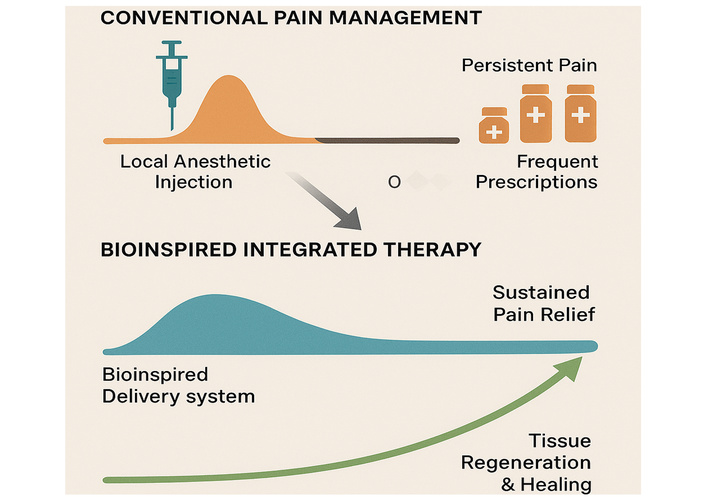
The paradigm shift in pain management: from episodic relief to sustained, integrated healing. This conceptual figure illustrates the paradigm shift from traditional pain management to an integrated, bioinspired approach. The upper path demonstrates the limitations of conventional local anesthetics, which provide temporary relief but fail to address long-term pain, often leading to a reliance on systemic opioids. The lower path depicts the ideal therapeutic outcome of a bioinspired system, providing a single-dose, long-lasting analgesic effect that is synchronized with the body’s natural regenerative process, thereby circumventing the need for opioid intervention and promoting genuine healing.
A number of fundamental design principles are used in the engineering of bioinspired DDS. Making membrane-coated nanoparticles or altering surfaces with ligands like polyethylene glycol (PEG) are important tactics [27–29]. PEGylation is a common procedure used to lengthen a nanoparticles bloodstream circulation time. Grafting PEG chains onto the surface creates a hydrophilic “anti-fouling” brush layer that protects the nanoparticles from blood components and decreases the mononuclear phagocyte systems (MPS) ability to remove them, extending their half-life [27, 30].
Even though PEGylation is frequently used because it lowers toxicity and immunogenicity, research suggests that there may be a disadvantage: Repeated administration may cause an unwanted immune response and the development of anti-PEG antibodies, which could speed up clearance and cause hypersensitivity reactions [27]. This implies that a single-mechanism stealth coating might not be an adequate long-term solution for applications involving repeated or chronic dosing. More dynamic, multi-layered bioinspired strategies that adjust to the physiological environment must be explored in future designs [28].
The use of biodegradable polymers is another crucial component of the design. Because their rate of degradation can be precisely matched to the rate of new tissue formation, materials like poly(lactic acid) (PLA) and poly(glycolic acid) (PGA) are commonly used for tissue engineering scaffolds [31]. Because of its biomimetic degradability, the scaffold can fulfill its short-term function of offering a microenvironment and structural template for cell growth without leaving a permanent foreign body in the tissue [32, 33]. The ability of these systems to replicate the natural extracellular matrix role in promoting cell attachment, proliferation, and differentiation is critical to their success [26, 34].
Effective membrane-stabilizing medications known as LAs work by reversibly blocking sodium influx via voltage-gated sodium channels in the membrane of neurons. By blocking the production of an action potential and preventing membrane depolarization, this action inhibits the conduction of pain signals. Although this mechanism reliably reduces pain during local surgical procedures and operations 19, its non-selective nature may have unfavorable consequences [1, 2, 35].
LAs are widely used, but they have a lot of drawbacks. Since they usually only take effect for a few hours, frequent re-dosing or the use of other analgesics, such as opioids, are frequently required for long-term pain management. Beyond duration, an excessive dose or an unintentional intravascular injection may cause LAST, a risk of systemic toxicity [35, 36]. Furthermore, LAs may impact other critical systems, such as the cardiovascular and central nervous systems, and can result in local tissue damage. This underscores the limited therapeutic window and the essential trade-off between safety and efficacy [36]. The difficulty lies in designing systems that minimize the possibility of the drug reaching harmful systemic levels while offering localized, long-lasting relief [37]. To overcome these challenges, various bioinspired delivery vehicles have been developed, the structural diversity of which including liposomes and hydrogels is illustrated in Figure 2.
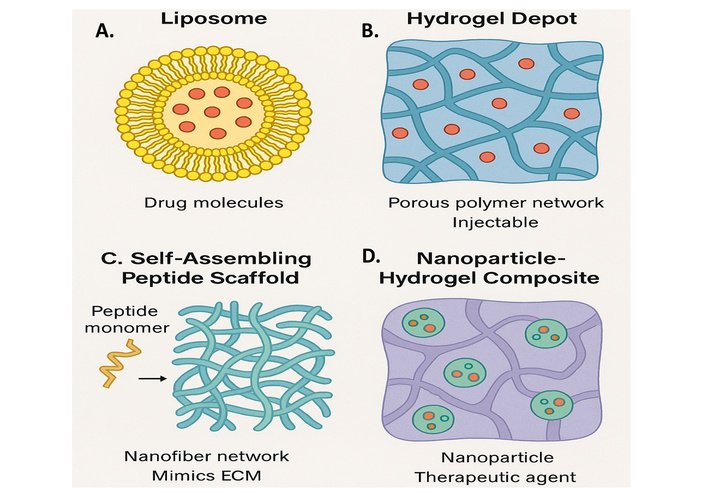
Architectural diversity of bioinspired delivery systems. This figure illustrates the distinct structures and mechanisms of key bioinspired platforms for sustained drug delivery. (A) Liposomes, multi-layered lipid vesicles, release their payload through gradual membrane erosion. (B) Hydrogels act as highly hydrated, polymer-based depots, releasing drugs via diffusion or matrix degradation. (C) Self-assembling peptides (SAPs) form a dynamic nanofiber scaffold, mirroring the natural extracellular matrix, which can localize and slowly release bioactive agents. (D) A composite system combines a hydrogel with encapsulated nanoparticles, providing a multi-stage release profile for co-delivering different therapeutic agents.
Liposomes have become a viable option for the delivery of sustained-release anesthetics. The phospholipid bilayer that makes up these biodegradable, non-toxic nanovesicles can encapsulate both hydrophilic and hydrophobic medications [38, 39]. Because of their structural adaptability, they can act as an advantageous carrier for a range of LAs, allowing for controlled, gradual drug release to increase the duration of the anesthetic effect while lowering the possibility of systemic toxicity [40, 41]. The FDA-approved multivesicular liposomal formulation of bupivacaine, EXPAREL®, is a perfect illustration of this technology [7, 38]. The duration of postsurgical analgesia that this formulation can provide is up to 72 hours, which is significantly longer than that of traditional bupivacaine [9, 41].
However, there are many difficult obstacles in the way of liposomal anesthetics clinical translation. Although the drug’s ability to prolong its effects technically is evident, its clinical significance is still up for debate. Although there were statistically significant decreases in pain scores at 48 and 72 hours, meta-analyses on the use of perineural liposomal bupivacaine for orthopedic surgery have revealed that these differences fell short of the established thresholds for clinical relevance [42, 43]. In a similar vein, a meta-analysis on its application in brachial plexus blocks discovered that although the decrease in pain scores was statistically significant, it had little clinical significance [42]. According to this research, a systems technical effectiveness such as its capacity to offer a sustained release profile does not always equate to a significant improvement in patient outcomes. The need for next-generation platforms that provide a more significant or multifaceted advantage is further supported by the possibility that the marginal clinical benefit of these formulations does not justify their high cost and complicated production [43, 44]. While liposomal formulations prolong local anesthetic action and can reduce early opioid requirements, their clinical impact is not uniformly positive. Several randomized trials and meta-analyses have reported only modest or procedure-dependent improvements in pain scores and functional recovery compared with standard bupivacaine, sometimes not meeting thresholds for clinical relevance [4]. Additionally, high cost, complex manufacturing, and batch-to-batch variability raise questions about cost-effectiveness and scalability. These mixed outcomes indicate that “sustained release” alone is insufficient and that future formulations must provide clearly superior patient-centred benefits to justify widespread adoption [45]. Despite these advantages, liposomal formulations alone do not fully resolve challenges such as burst release, site‑specific retention, and fine‑tuning of mechanical properties at the injection site. These limitations have driven interest in hydrogel‑based depots, which can provide a structurally stable, highly hydrated matrix for localized delivery of LAs and, potentially, co‑delivered regenerative agents [9].
Building on the need for better control over depot localization and release profiles, hydrogels have emerged as versatile carriers for LAs. A very flexible and promising platform for localized, long-term anesthetic delivery is hydrogels. Compared to particulate-based formulations, these biocompatible, highly hydrated polymer networks can create a localized drug depot at the injection site, offering sustained and site-specific drug release [46]. Because of their great degree of customization and ability to be stimuli-responsive, they can be made to modify drug release in response to physiological factors like pH, temperature, or enzymatic activity [47]. Compared to conventional sustained-release carriers, this precision enables more control over drug delivery [3, 48].
The issue of “burst release” is still a major technical barrier in spite of these benefits. This phenomenon undermines the intended prolonged action and reintroduces the risk of systemic toxicity when a significant amount of the encapsulated drug is released uncontrollably at the beginning [49]. This difficulty draws attention to a crucial discrepancy between hydrogels theoretical potential and real-world use. In order to avoid this initial burst and guarantee a genuinely sustained, predictable release profile, future research must concentrate on optimizing hydrogel formulations [3, 49].
Hydrogel depots enable localized, tunable release of LAs, but they are hampered by issues such as initial burst release, mechanical instability at the injection site, and sensitivity to local pH or enzymatic milieu [4]. In many studies, in vitro release profiles do not reliably predict in vivo exposure, complicating dose selection and safety assessment. Moreover, few hydrogel‑based anesthetic systems have advanced beyond early clinical or preclinical stages, underscoring the need for robust pharmacokinetic-pharmacodynamic correlations and standardized testing protocols [50].
A new paradigm in anesthetic delivery is provided by nanoparticles, which provide previously unheard-of control and precision. Liposomes, polymeric nanoparticles such as PLGA, and solid lipid nanoparticles (SLNs) are examples of nanotechnology-based systems that act as drug delivery vehicles by encasing analgesic agents [51, 52]. These systems main advantages are their capacity to improve drug stability and enable controlled drug release, which results in more prolonged analgesia and fewer systemic side effects [51].
The basic trade-offs between the safety and effectiveness of conventional anesthetics can be addressed by designing nanocarriers with precise physicochemical characteristics, which allow for highly accurate control over drug loading and release [51, 53]. A microscopic innovation can have a large-scale societal impact by reducing the necessary dosage and improving drug accumulation at the intended site, which leads to a significant reduction in post-operative pain and opioid use [52, 54]. The potential of this technology is demonstrated by the successful clinical use of PLGA microparticles impregnated with bupivacaine and meloxicam, which provided prolonged pain relief for 72 hours [14, 54, 55]. Importantly, nanoparticle systems are inherently compatible with co-delivery of regenerative cues such as growth factors, chemokines, or pro-regenerative peptides. When designed accordingly, these platforms can function not only as long-acting analgesic depots but also as vehicles that modulate the local healing microenvironment, providing a mechanistic link between sustained pain control and regenerative medicine [50, 56]. This dual-purpose design concept is further elaborated in Bioinspired platforms for dual-purpose delivery. Nanoparticle-based anesthetic systems offer precise control over particle size, surface chemistry, and drug loading, but they also introduce challenges including complex manufacturing, scale-up, potential immunogenicity, and uncertainty regarding long-term tissue accumulation [57, 58]. Most available evidence still comes from preclinical models or small clinical series, and comprehensive meta-analyses are lacking, so the true clinical value of these platforms remains unclear. In addition, improvements in surrogate endpoints such as pharmacokinetic profiles or the duration of sensory block have not yet been consistently linked to better functional recovery, opioid-sparing, patient satisfaction, or quality-of-life outcomes [58]. A critical next step is to align nanoparticle design choices with robust clinical endpoints and comparative effectiveness studies, while also considering practical constraints such as cost and ease of use in the perioperative setting [59]. These bioinspired carriers offer a versatile toolkit for drug delivery, with each system providing unique advantages and limitations tailored for specific clinical needs (Table 1).
Key platform, their enabling mechanism, advantages, limitations and clinical status.
| Platform | Mechanism | Key advantages | Key limitations | Clinical status | References |
|---|---|---|---|---|---|
| Liposomes | Multivesicular encapsulation | Long duration (up to 72 h), reduced systemic exposure | High cost, inconsistent release, and manufacturing scalability | FDA-approved (EXPAREL®) | [7] |
| Hydrogels | Localized polymer depot | Localized delivery, customizable release profiles | Burst release, mechanical instability, high variability in formulation | Pre-clinical/early clinical | [3] |
| Nanoparticles (PLGA) | Polymeric matrix erosion | Controlled release, enhanced drug stability, reduced systemic exposure | Lack of clear in vitro-in vivo correlation, manufacturing challenges | Early clinical/FDA-approved (Posimir™, Zynrelef™) | [4] |
The realization that the nervous system is an active and essential player in tissue repair rather than a passive sensory network represents a fundamental conceptual shift in contemporary medicine [60]. Studies have shown that nerves especially those of sensory and sympathetic origin are essential for fostering tissue regeneration, particularly in bone and cartilage [61]. Numerous signaling molecules, such as neurotransmitters, neuropeptides, and growth factors, are released by nerves that innervate bone and synovial tissue. These molecules actively control osteogenesis, angiogenesis, and cell differentiation [61–63]. Studies on denervated bone fractures, for instance, reveal a marked decrease in calli size and density when compared to control groups, suggesting that the nervous system plays a critical role in a successful healing response [61].
This finding reinterprets the core issue of pain. It is now necessary to determine how to alter the nervous system to reduce pain and activate the body’s natural healing processes, rather than simply numbing the pain [64]. The conceptual connection that unites pain management and regenerative medicine into a single, coherent field is the fact that regenerative medicine seeks to restore damaged tissues that cause chronic pain, and nerves actively participate in this very repair process [65]. The bidirectional interaction between the nervous system and the healing environment, where pain modulation and tissue repair are intrinsically linked, is schematically depicted in Figure 3.
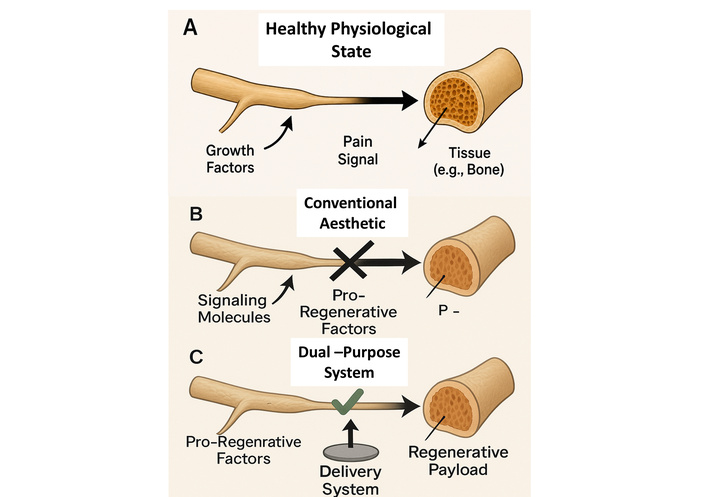
The bi-directional nexus of pain and regeneration. This diagram illustrates the conceptual and functional relationship between nerves, pain, and tissue regeneration. (A) In a healthy state, nerves actively participate in tissue repair by releasing critical signaling molecules. (B) Conventional anesthetics, while blocking pain, can inadvertently inhibit these vital pro-regenerative processes, creating a conflict between pain relief and healing. Whereas P – represents the inhibition of pain-signaling molecules. (C) An advanced dual-purpose delivery system overcomes this limitation by actively and simultaneously blocking pain signals while delivering a separate regenerative payload, thereby ensuring a synergistic therapeutic effect.
This section focuses on LAs; most cited anti-proliferative effects derive from general anesthetics (volatile agents) or sedatives (intravenous) studied at concentrations/exposure patterns unlike local anesthetic depots [66]. The potential for conventional anesthetics to directly and negatively impact tissue healing is an important and frequently disregarded feature [67]. While the primary purpose of these medications is to block pain signals, some studies suggest they may interfere with cellular functions essential for regeneration. However, it is crucial to note that much of the current evidence is derived from in vitro models or specialized cancer cell lines, which may not directly reflect the complex environment of healthy, regenerating human tissue [68]. Research has demonstrated that commonly used inhalational anesthetics such as desflurane and sevoflurane can modulate cancer cell proliferation and migration through alterations in microRNA pathways, including miR-138 and miR-210 [69]. Propofol has been observed to limit proliferation in pancreatic cancer models, whereas etomidate has shown neutral effects at comparable concentrations, suggesting that these responses are highly drug-specific and context-dependent [70].
These findings in oncological models raise interesting questions about cell signaling, extrapolating these results to clinical tissue repair requires caution. A clinician administering an anesthetic for post-operative pain must balance effective analgesia with the theoretical though not yet clinically proven risk of slowed regenerative processes. This conundrum highlights the need for “regenerative-friendly” delivery systems. Such systems should be designed to maintain therapeutic efficacy while ensuring they do not adversely interfere with the signaling pathways that control healthy tissue repair [71]. Therefore, findings from general anesthetics and sedatives cannot be directly extrapolated to local anesthetic formulations without careful consideration of drug class, dose, and exposure duration. Our focus in this review is on LAs, and any implications drawn from systemic agents are discussed as theoretical or mechanistic analogies rather than direct clinical evidence.
From a translational perspective, a key question is whether the anti‑proliferative or signaling effects observed in vitro for certain anesthetics actually occur at therapeutic concentrations and exposure durations used in clinical practice. Current data suggest that many in vitro studies employ higher concentrations or prolonged exposures compared with typical perioperative dosing regimens, making direct clinical extrapolation uncertain. Clinically, this uncertainty translates into a precautionary principle: When developing long‑acting depots or dual‑purpose regenerative platforms, formulations should be designed and tested to avoid sustained exposure of regenerative cells to potentially anti‑proliferative levels of anesthetic, and early‑phase trials should incorporate tissue‑level and functional healing endpoints—not only analgesic outcomes—to ensure that pain relief does not come at the expense of impaired repair. This framework can guide ethical risk-benefit assessment and regulatory evaluation of next‑generation regenerative anesthesia systems.
A multi-modal therapeutic approach is required due to the intricacy of tissue regeneration, which depends on a coordinated sequence of biological events such as osteogenesis and angiogenesis [72, 73]. Dual-drug delivery platforms have emerged as a result of the inefficiency of single-drug delivery in complex healing processes [72]. These platforms are intended to supply additional bioactive substances that speed up the regenerative process, such as unique medications and growth factors [72]. Depending on the needs of the healing cascade, these systems can be configured to release various agents at particular times or over extended periods of time. They are designed to replicate the local microenvironment [72, 74]. A dual-purpose anesthetic-regenerative platform is conceptualized as one that delivers a regenerative molecule and a long-acting analgesic simultaneously, each with its own programmed release kinetics.
Because of their adaptability and biocompatibility, hydrogels make an especially good platform for combination therapies. They can be designed to create a localized, injectable depot that acts as a matrix for the addition of additional therapeutic agents in addition to offering sustained analgesic release [75]. By combining LAs with growth factors, regenerative molecules, or anti-inflammatory agents, these systems allow for a multifunctional approach [76]. In keeping with the contemporary, all-encompassing approach to pain management, this not only improves pain relief but also speeds up tissue recovery [3, 77]. Hydrogel-based formulations are versatile for a variety of acute and chronic pain conditions because they can be made for a variety of administration routes, such as transdermal patches, intra-articular administration, and perineural injections [77]. They are perfect for targeted pain management and tissue repair because they can localize therapeutic action at the site of injury, reducing systemic exposure and the risks that come with it [5, 78].
A promising clinical example is the nanoparticle anesthetic tilapia dressing (NPD) for burn wounds, currently in porcine safety/dosing studies. This lyophilized hydrogel system delivers lidocaine for 5–7 days while promoting healing via tilapia skin matrix, designed for battlefield use with portable reconstitution [79, 80]. Practical implementation challenges include balancing injectability (G' < 100 Pa for 25 G needles) with mechanical stability (G' > 1 kPa post-injection), controlling degradation (7–30 days target), minimizing batch variability (± 10% release profile), and ensuring terminal sterilization without compromising cross-linking or drug stability. These engineering hurdles explain why only ~5% of preclinical hydrogel systems reach clinical evaluation [81]. The kinetics of this drug release, particularly the strategies used to manage the initial burst release and achieve a steady therapeutic concentration, are illustrated in Figure 4.
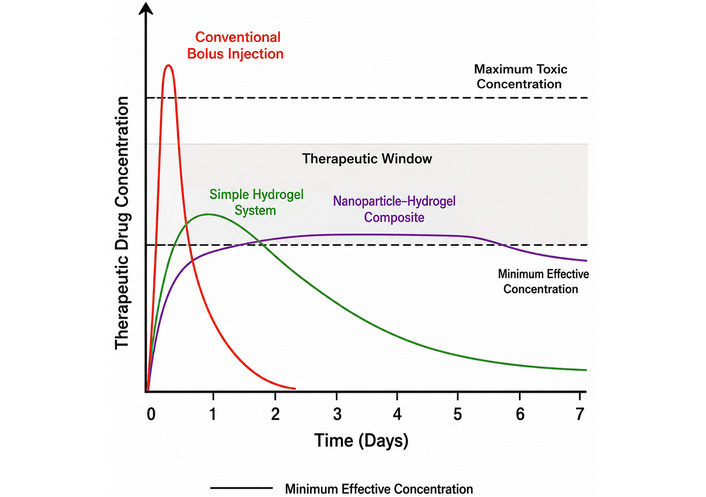
Overcoming “burst release”: the kinetics of advanced delivery. This figure demonstrates the comparative release kinetics of different anesthetic delivery methods. A conventional bolus injection provides immediate but fleeting relief, quickly dropping below the therapeutic window. A simple hydrogel system is prone to “burst release,” where an uncontrolled initial spike in drug concentration risks systemic toxicity. In contrast, the innovative nanoparticle-hydrogel composite achieves a precisely controlled, sustained release profile, maintaining the drug concentration within the optimal therapeutic window over a prolonged period, thereby ensuring both safety and long-term efficacy. Note: The data curves are representative schematic illustrations based on release kinetics reported in existing literature [68, 70] and do not represent a single specific experimental dataset.
A significant development in dual-purpose drug delivery is the integration of hydrogels and nanoparticles into a single composite system [82, 83]. This method offers synergistic benefits by combining the improved stability and targeted ability of nanoparticles with the high loading capacity and adjustable release characteristics of hydrogels [84]. For the release of an anesthetic agent which may be required for instant pain relief the hydrogel in a composite system can offer a bulk, diffusion-controlled environment [84, 85]. At the same time, growth factors and other more costly and delicate regenerative agents can be encapsulated in nanoparticles scattered throughout the hydrogel matrix [84]. This design tackles important issues in drug delivery by offering a multi-layered control mechanism. While the hydrogel offers a quick-onset analgesic effect and a structural scaffold, the nanoparticles shield the regenerative molecules from premature degradation and enable their sustained, stimuli-sensitive release over an extended period of time [84, 86]. This results in a multi-stage therapeutic platform that is genuinely programmable and capable of adjusting to the intricate kinetics of tissue healing.
Self-assembling peptides (SAPs) and other bioactive scaffolds are used in a more complex bioinspired method. In order to support axons and Schwann cells and encourage nerve regeneration, SAPs can create nanohydrogels that closely resemble the natural extracellular matrix [87, 88]. By promoting granulation tissue formation, angiogenesis, and epithelial regeneration, growth factors such as PDGF-BB can be incorporated into bioactive scaffolds to accelerate chronic wound healing [87]. The ability of these scaffolds to non-covalently bind and localize growth factors helps minimize rapid burst release and uncontrolled diffusion commonly observed in conventional delivery systems [89]. This approach goes beyond merely carrying a therapeutic agent and is third-order bioinspired. Rather, the substance itself takes on an active role in the healing process, directing and encouraging tissue formation while also offering a structural scaffold for cellular attachment [25, 90]. The ultimate objective is to transition from “drug delivery” to “bioactive material integration,” in which the delivered drug is just as much a therapeutic agent as the delivery system itself.
Dosing/timing conflicts: Analgesics require high initial concentrations (1–2% bupivacaine) for rapid onset, while regenerative agents (growth factors: ng/mL range) need sustained low-dose delivery. Core-shell nanoparticles address this by rapid outer-layer analgesic release + slow inner-core regenerative release [42].
Local concentration trade-offs: High anesthetic levels may inhibit fibroblast proliferation (IC50 ~0.5–1 mM), while growth factors lose bioactivity above 100 ng/mL. Zwitterionic coatings and sequential-release matrices maintain optimal concentration windows [91].
Potential failure modes in regenerative delivery platforms include uncontrolled burst release, scaffold degradation mismatch, drug-biomaterial incompatibility, and heterogeneous degradation leading to nonuniform release kinetics [92, 93].
There are many technical obstacles in the way of clinically implementing bioinspired anesthetic delivery systems. The biological variability of starting materials and the challenge of guaranteeing consistent quality and efficacy from batch to batch are the main obstacles to the large-scale manufacturing of these complex therapies. There are still serious technical problems in preclinical research. For example, the “burst release” phenomenon for hydrogels reintroduces the risk of systemic toxicity and compromises the basic objective of prolonged drug action [3]. The impoverished are a major issue.
Many of these controlled-release products have an in vitro-in vivo correlation, which means that even a system that works perfectly in a lab setting might not be able to produce a concentration that is clinically useful in a living system [4, 94]. To go beyond a trial-and-error method, it is necessary to fill the knowledge gap regarding the fundamental interactions between these engineered systems and the dynamic and complex biological environment [95]. Furthermore, the translational status of these systems varies widely, with some, like liposomes and certain hydrogels, being closer to clinical application, while others such as nano-hydrogel composites and SAPs remain primarily conceptual or in early preclinical stages. While hydrogel-nanoparticle composites and SAPs have demonstrated promising results in preclinical models, their translational application in clinical settings remains at an early or conceptual stage [58]. Further studies are needed to validate safety, efficacy, and manufacturing scalability before clinical trials can be initiated.
Case Study 1: Liposomal Bupivacaine (EXPAREL®)—Despite FDA approval, orthopedic meta-analyses show only modest pain score reductions (0.5–1 point on 10-point scale) vs. plain bupivacaine, failing cost-effectiveness thresholds in ambulatory surgery [42].
Case Study 2: Ropivacaine Hydrogel—Phase II trials terminated due to unacceptable 40% burst release causing LAST events, despite promising 96 h in vitro profiles (poor IVIVC) [96].
Case Study 3: MSC-loaded fibrin sealants—Clinical studies have demonstrated that MSCs delivered through fibrin-based matrices can enhance chronic wound healing and angiogenesis. However, chronic wound environments are characterized by excessive protease activity, inflammation, and ECM degradation, which may reduce matrix persistence and MSC retention, thereby limiting sustained therapeutic efficacy in some patients [92, 97].
Bioinspired anesthetic platforms present unique regulatory hurdles because they qualify as combination products (drug + device + biologic). For dual-purpose hydrogel-nanoparticle composites delivering anesthetics + growth factors, the FDA’s Center for Drug Evaluation and Research (CDER) vs. Center for Devices and Radiological Health (CDRH) jurisdiction remains ambiguous, delaying approval pathways [98]. The Regenerative Medicine Advanced Therapy (RMAT) designation offers accelerated review but requires manufacturing consistency for complex biological materials (e.g., cell membranes for exosome-mimicking coatings) [99]. This lack of defined regulatory processes for combination products significantly hinders clinical translation [98]. Ethical concerns are system-specific: Development costs (~$50–100 M) may limit access to well-resourced centers [100], while unregulated clinics offer unproven stem cell-anesthetic combinations [99]. Dual-purpose platforms raise non-maleficence considerations regarding the balance between sustained anesthetic delivery and optimal tissue healing [101]. These systems show promise across surgical applications (Table 2), but hydrogel-nanoparticle composites and SAPs remain early preclinical. Further validation of safety, efficacy, and scalability is required before clinical trials (Figure 5 illustrates the roadmap) [81–84].
Technical and regulatory challenges in bioinspired materials based anesthetic development for regenerative medicine.
| Challenge category | Specific challenge | Proposed mitigation strategy | References |
|---|---|---|---|
| Technical/manufacturing | Burst release | Use of composite systems (e.g., nanoparticle-hydrogel) to provide multi-layered, controlled release | [84] |
| Technical/manufacturing | Scalability & consistency | Standardization of protocols and starting materials; investment in robust manufacturing infrastructure | [98] |
| Regulatory | Unclear mechanisms | Comprehensive efficacy assessment and interdisciplinary collaboration to clarify mechanisms of action | [100] |
| Regulatory | Regulatory ambiguities | Establishment of clear and harmonized regulatory frameworks and pathways (e.g., RMATs) | [98] |
| Clinical/ethical | High costs & access | Development of flexible reimbursement models and policies to bridge transportation and financial gaps | [100] |
| Clinical/ethical | Unproven therapies | Public education and transparent guidelines from regulatory bodies to combat misinformation and rogue operators | [99] |
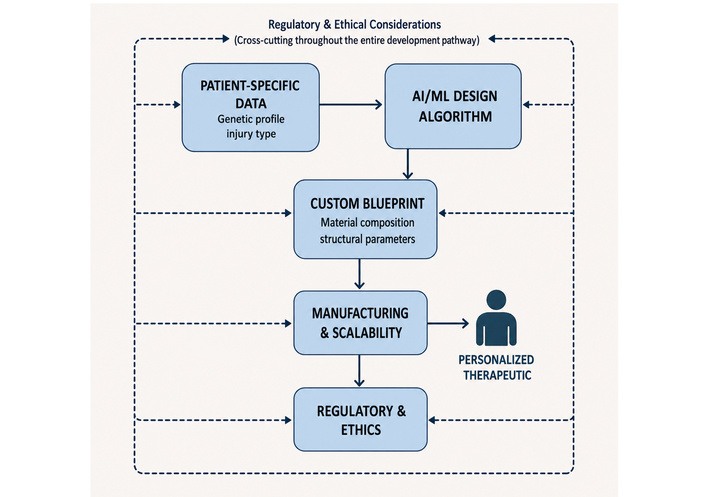
A strategic roadmap for personalized regenerative anesthesia. This figure outlines a future-forward, AI-driven framework for designing and delivering bioinspired therapeutics. The process begins with the comprehensive analysis of a patient’s unique biological and injury-specific data, which is then used by an intelligent algorithm to generate a custom blueprint for a multi-functional delivery system. This blueprint directs advanced fabrication technologies, such as 3D printing, to create a personalized therapeutic that is precisely tuned to the individual’s needs, representing the ultimate convergence of precision medicine and bioinspired engineering.
Manufacturing feasibility: Liposomal (EXPAREL) and PLGA systems are GMP-ready; hydrogel-nanoparticle composites remain lab-scale (TRL 3–4). Gap: No standardized protocols for sterile assembly of anesthetic + biologic payloads.
Clinical feasibility: Single-agent depots integrate into surgical workflows; dual-purpose systems require new protocols. Gap: Phase I safety data lacking for co-delivery combinations.
Regulatory feasibility: RMAT pathway viable for SAPs/hydrogels if potency assays validated. Gap: No precedent for “anesthetic-regenerative” combination product classification.
Economic feasibility: EXPAREL costs $300-500/dose; dual-purpose systems likely 3–5× higher. Gap: No reimbursement framework for functional recovery endpoints beyond pain scores.
Primary gap: Validated surrogate endpoints linking release kinetics → tissue repair → functional outcomes, enabling FDA bridging studies.
This field’s future depends on pursuing personalized, precision medicine rather than a one-size-fits-all approach. For more individualized pain management, future studies should concentrate on refining formulations, increasing clinical validation, and incorporating cutting-edge fabrication technologies like 3D printing and AI-driven design [3, 102]. Using a patients unique physiological profile, the type of injury they sustained, and their specific biological data, an AI-driven design platform could suggest a bioinspired hydrogel-nanoparticle composite with a precisely calibrated release profile. Although still in the realm of future possibilities, such approaches could enable the development of tailored drug release systems based on individual patient data. This represents an innovative direction for the field, emphasizing potential rather than current evidence-based practice [102]. This degree of customization would radically alter the clinical paradigm for managing chronic pain and perioperative care, moving toward therapeutics that work harmoniously with the body’s natural healing processes while providing personalized efficacy and safety.
In conclusion, although substantial challenges persist such as developing standardized manufacturing protocols, establishing validated surrogate endpoints for tissue repair, and navigating complex regulatory frameworks the integration of personalized medicine and AI-driven design offers a promising pathway. These advancements have the potential to revolutionize anesthetic delivery systems, transforming them into intelligent, regenerative-friendly platforms that work synergistically with the body’s natural healing processes. Achieving this vision will require continued multidisciplinary collaboration and innovation, ultimately enabling safer, more effective, and truly personalized pain management and regenerative therapies.
DDS: drug delivery systems
LAs: local anesthetics
LAST: Local Anesthetic Systemic Toxicity
PEG: polyethylene glycol
SAPs: self-assembling peptides
Artificial intelligence (AI) tools, including Napkin AI and Sora AI, were used solely to assist in the preparation of schematic figures. After utilizing these tools, the authors carefully reviewed and edited the generated content as necessary and take full responsibility for the accuracy, integrity, and final content of the manuscript and all associated figures.
SS: Conceptualization, Writing—original draft, Writing—review & editing. KS: Conceptualization, Writing—original draft, Writing—review & editing. MZ: Methodology, Visualization. SB: Writing—review & editing. SP: Validation, Supervision. MR: Writing—review & editing. VT: Writing—review & editing. UK: Resources and editing. DG: Supervision, Project administration. All authors read and approved the submitted version.
The authors declare that the research was conducted in the absence of any commercial or financial relationships that could be construed as a potential conflict of interest.
Not applicable.
Not applicable.
Not applicable.
This is a review article. The data presented in the study are derived from the references and public domain literature cited within the manuscript.
No specific funding was received for the preparation of this manuscript.
© The Author(s) 2026.
Open Exploration maintains a neutral stance on jurisdictional claims in published institutional affiliations and maps. All opinions expressed in this article are the personal views of the author(s) and do not represent the stance of the editorial team or the publisher.
Copyright: © The Author(s) 2026. This is an Open Access article licensed under a Creative Commons Attribution 4.0 International License (https://creativecommons.org/licenses/by/4.0/), which permits unrestricted use, sharing, adaptation, distribution and reproduction in any medium or format, for any purpose, even commercially, as long as you give appropriate credit to the original author(s) and the source, provide a link to the Creative Commons license, and indicate if changes were made.



Sunil Choudhary ... Donato Gemmati
Vladimir Karpiuk ... Olga Ponkina
Zhaoying Ma ... Jan T. Czernuszka
Alexandra C. Dabrowski ... Maribel Vazquez
Ashkan Farazin, Seyedeh Farnaz Darghiasi


