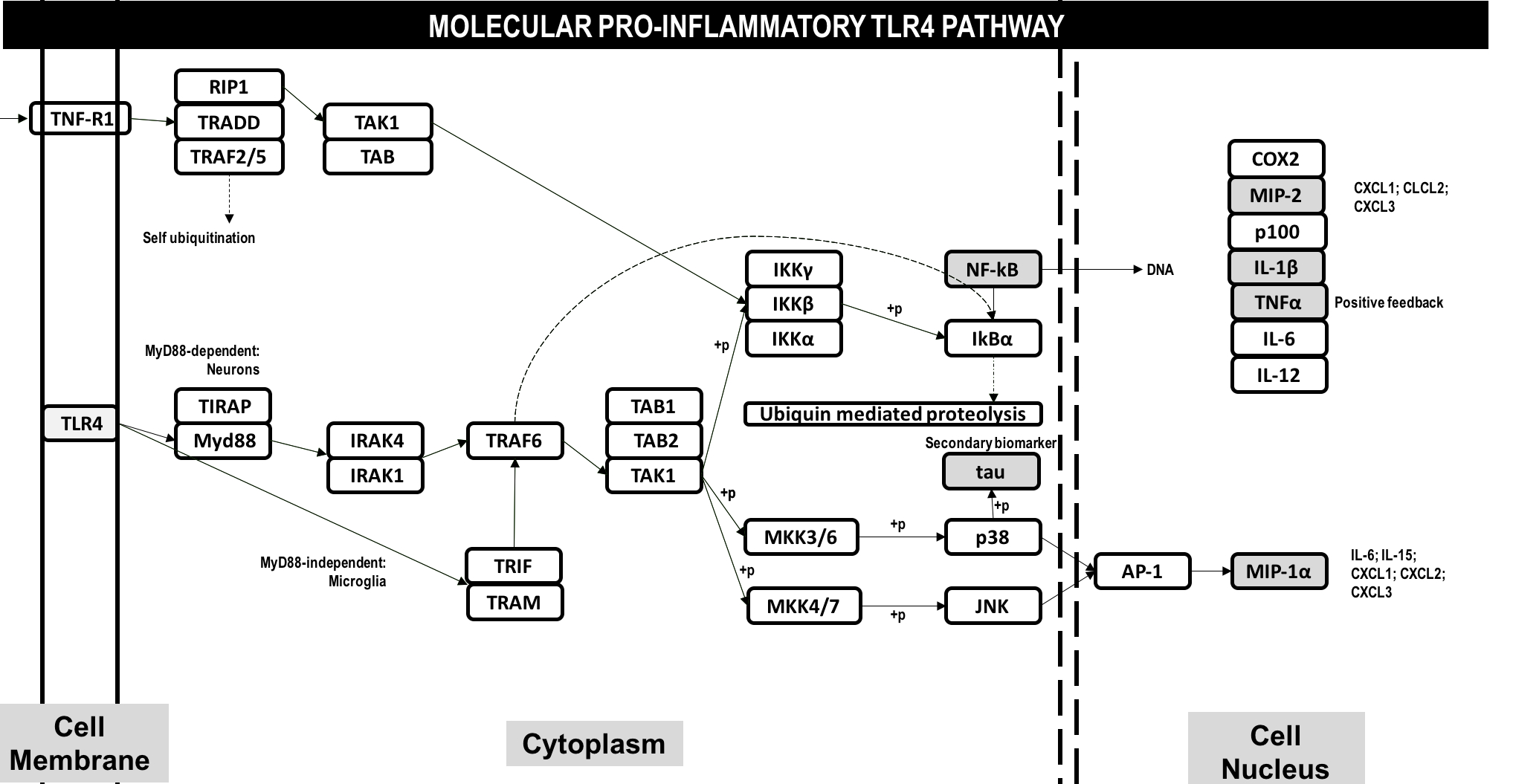
Molecular pro-inflammatory pathway activated in the central nervous system in patients with Mucopolysaccharidosis type III. The activation in glial cells occurs in a MyD88-independent pathway, with translocation of the TRIF-TRAM complex and subsequent activation of TRAF6. Released cytokines and pro-inflammatory products activate, via TLR4 receptors, a pro-inflammatory pathway MyD88-dependent in neurons, with translocation of IRAK4-IRAK1 and subsequent activation of TRAF6. The events of TRAF6 activation resulting in two directions: i) release of NF-kB to the nucleus and expression of interleukines, as well TNF-alpha resulting in a positive feedback for pro-inflammatory activation via TNRR1 receptors; ii) MAPK signaling pathway, resulting in secondary tau-phosphorylation and release AP-1 to the translocation of AP-1 to the nucleus, resulting in expression of MIP-1α inducing pro-inflammatory citokines
Open Exploration maintains a neutral stance on jurisdictional claims in published institutional affiliations and maps. All opinions expressed in this article are the personal views of the author(s) and do not represent the stance of the editorial team or the publisher.
References
Nagpal R, Goyal RB, Priyadarshini K, Kashyap S, Sharma M, Sinha R, et al. Mucopolysaccharidosis: A broad review.Indian J Ophthalmol. 2022;70:2249–61. [DOI] [PubMed] [PMC]
Josahkian JA, Trapp FB, Burin MG, Michelin-Tirelli K, Magalhães APPS, Sebastião FM, et al. Updated birth prevalence and relative frequency of mucopolysaccharidoses across Brazilian regions.Genet Mol Biol. 2021;44:e20200138. [DOI] [PubMed] [PMC]
Montenegro YHA, Kubaski F, Trapp FB, Riegel-Giugliani M, Souza CFM, Ribeiro EM, et al. Disease progression in Sanfilippo type B: Case series of Brazilian patients.Genet Mol Biol. 2024;47:e20230285. [DOI] [PubMed] [PMC]
Montenegro YHA, de Souza CFM, Kubaski F, Trapp FB, Burin MG, Michelin-Tirelli K, et al. Sanfilippo syndrome type B: Analysis of patients diagnosed by the MPS Brazil Network.Am J Med Genet A. 2022;188:760–7. [DOI] [PubMed]
Barone R, Pellico A, Pittalà A, Gasperini S. Neurobehavioral phenotypes of neuronopathic mucopolysaccharidoses.Ital J Pediatr. 2018;44:121. [DOI] [PubMed] [PMC]
Taherzadeh M, Zhang E, Londono I, Leener BD, Wang S, Cooper JD, et al. Severe central nervous system demyelination in Sanfilippo disease.Front Mol Neurosci. 2023;16:1323449. [DOI] [PubMed] [PMC]
Dias C, Ballout N, Morla G, Alileche K, Santiago C, Guerrera IC, et al. Extracellular vesicles from microglial cells activated by abnormal heparan sulfate oligosaccharides from Sanfilippo patients impair neuronal dendritic arborization.Mol Med. 2024;30:197. [DOI] [PubMed] [PMC]
Beard H, Hassiotis S, Gai W, Parkinson-Lawrence E, Hopwood JJ, Hemsley KM. Axonal dystrophy in the brain of mice with Sanfilippo syndrome.Exp Neurol. 2017;295:243–55. [DOI] [PubMed]
Hocquemiller M, Vitry S, Bigou S, Bruyère J, Ausseil J, Heard JM. GAP43 overexpression and enhanced neurite outgrowth in mucopolysaccharidosis type IIIB cortical neuron cultures.J Neurosci Res. 2010;88:202–13. [DOI] [PubMed]
Wilkinson FL, Holley RJ, Langford-Smith KJ, Badrinath S, Liao A, Langford-Smith A, et al. Neuropathology in mouse models of mucopolysaccharidosis type I, IIIA and IIIB.PLoS One. 2012;7:e35787. [DOI] [PubMed] [PMC]
Fu H, Bartz JD, Stephens RL Jr, McCarty DM. Peripheral nervous system neuropathology and progressive sensory impairments in a mouse model of Mucopolysaccharidosis IIIB.PLoS One. 2012;7:e45992. [DOI] [PubMed] [PMC]
Lemonnier T, Blanchard S, Toli D, Roy E, Bigou S, Froissart R, et al. Modeling neuronal defects associated with a lysosomal disorder using patient-derived induced pluripotent stem cells.Hum Mol Genet. 2011;20:3653–66. [DOI] [PubMed]
Pshezhetsky AV. Lysosomal storage of heparan sulfate causes mitochondrial defects, altered autophagy, and neuronal death in the mouse model of mucopolysaccharidosis III type C.Autophagy. 2016;12:1059–60. [DOI] [PubMed] [PMC]
Vitry S, Bruyère J, Hocquemiller M, Bigou S, Ausseil J, Colle M, et al. Storage vesicles in neurons are related to Golgi complex alterations in mucopolysaccharidosis IIIB.Am J Pathol. 2010;177:2984–99. [DOI] [PubMed] [PMC]
Scarcella M, Scerra G, Ciampa M, Caterino M, Costanzo M, Rinaldi L, et al. Metabolic rewiring and autophagy inhibition correct lysosomal storage disease in mucopolysaccharidosis IIIB.iScience. 2024;27:108959. [DOI] [PubMed] [PMC]
Villani GRD, Domenico CD, Musella A, Cecere F, Napoli DD, Natale PD. Mucopolysaccharidosis IIIB: oxidative damage and cytotoxic cell involvement in the neuronal pathogenesis.Brain Res. 2009;1279:99–108. [DOI] [PubMed]
Puy V, Darwiche W, Trudel S, Gomila C, Lony C, Puy L, et al. Predominant role of microglia in brain iron retention in Sanfilippo syndrome, a pediatric neurodegenerative disease.Glia. 2018;66:1709–23. [DOI] [PubMed]
Myers RR, Sekiguchi Y, Kikuchi S, Scott B, Medicherla S, Protter A, et al. Inhibition of p38 MAP kinase activity enhances axonal regeneration.Exp Neurol. 2003;184:606–14. [DOI] [PubMed]
Ohmi K, Kudo LC, Ryazantsev S, Zhao H, Karsten SL, Neufeld EF. Sanfilippo syndrome type B, a lysosomal storage disease, is also a tauopathy.Proc Natl Acad Sci U S A. 2009;106:8332–7. [DOI] [PubMed] [PMC]
Ginsberg SD, Galvin JE, Lee VM, Rorke LB, Dickson DW, Wolfe JH, et al. Accumulation of intracellular amyloid-beta peptide (A beta 1-40) in mucopolysaccharidosis brains.J Neuropathol Exp Neurol. 1999;58:815–24. [DOI] [PubMed]
Barthelson K, Protzman RA, Snel MF, Hemsley K, Lardelli M. Multi-omics analyses of early-onset familial Alzheimer's disease and Sanfilippo syndrome zebrafish models reveal commonalities in disease mechanisms.Biochim Biophys Acta Mol Basis Dis. 2025;1871:167651. [DOI] [PubMed]
Ryazantsev S, Yu W, Zhao H, Neufeld EF, Ohmi K. Lysosomal accumulation of SCMAS (subunit c of mitochondrial ATP synthase) in neurons of the mouse model of mucopolysaccharidosis III B.Mol Genet Metab. 2007;90:393–401. [DOI] [PubMed] [PMC]
Settembre C, Fraldi A, Jahreiss L, Spampanato C, Venturi C, Medina D, et al. A block of autophagy in lysosomal storage disorders.Hum Mol Genet. 2008;17:119–29. [DOI] [PubMed]
Bhat AH, Dar KB, Anees S, Zargar MA, Masood A, Sofi MA, et al. Oxidative stress, mitochondrial dysfunction and neurodegenerative diseases; a mechanistic insight.Biomed Pharmacother. 2015;74:101–10. [DOI] [PubMed]
Islam MT. Oxidative stress and mitochondrial dysfunction-linked neurodegenerative disorders.Neurol Res. 2017;39:73–82. [DOI] [PubMed]
Rey F, Berardo C, Maghraby E, Mauri A, Messa L, Esposito L, et al. Redox Imbalance in Neurological Disorders in Adults and Children.Antioxidants (Basel). 2023;12:965. [DOI] [PubMed] [PMC]
Saffari A, Kölker S, Hoffmann GF, Ebrahimi-Fakhari D. Linking mitochondrial dysfunction to neurodegeneration in lysosomal storage diseases.J Inherit Metab Dis. 2017;40:631–40. [DOI] [PubMed]
Stepien KM, Cufflin N, Donald A, Jones S, Church H, Hargreaves IP. Secondary Mitochondrial Dysfunction as a Cause of Neurodegenerative Dysfunction in Lysosomal Storage Diseases and an Overview of Potential Therapies.Int J Mol Sci. 2022;23:10573. [DOI] [PubMed] [PMC]
Leal AF, Benincore-Flórez E, Rintz E, Herreño-Pachón AM, Celik B, Ago Y, et al. Mucopolysaccharidoses: Cellular Consequences of Glycosaminoglycans Accumulation and Potential Targets.Int J Mol Sci. 2022;24:477. [DOI] [PubMed] [PMC]
Ain QU, Batool M, Choi S. TLR4-Targeting Therapeutics: Structural Basis and Computer-Aided Drug Discovery Approaches.Molecules. 2020;25:627. [DOI] [PubMed] [PMC]
Calvo-Rodriguez M, García-Rodríguez C, Villalobos C, Núñez L. Role of Toll Like Receptor 4 in Alzheimer’s Disease.Front Immunol. 2020;11:1588. [DOI] [PubMed] [PMC]
Wang Y, Zhang S, Li H, Wang H, Zhang T, Hutchinson MR, et al. Small-Molecule Modulators of Toll-like Receptors.Acc Chem Res. 2020;53:1046–55. [DOI] [PubMed]
Lin C, Wang H, Zhang M, Mustafa S, Wang Y, Li H, et al. TLR4 biased small molecule modulators.Pharmacol Ther. 2021;228:107918. [DOI] [PubMed]
Zaffaroni L, Peri F. Recent advances on Toll-like receptor 4 modulation: new therapeutic perspectives.Future Med Chem. 2018;10:461–76. [DOI] [PubMed]
Kuzmich NN, Sivak KV, Chubarev VN, Porozov YB, Savateeva-Lyubimova TN, Peri F. TLR4 Signaling Pathway Modulators as Potential Therapeutics in Inflammation and Sepsis.Vaccines (Basel). 2017;5:34. [DOI] [PubMed] [PMC]