Editorial


Affiliation:
Children’s Orthopaedic Centre, Mumbai 400016, Maharashtra, India
Email: drashokjohari@hotmail.com
ORCID: https://orcid.org/0000-0001-6227-5841


Explor Musculoskeletal Dis. 2026;4:1007120 DOI: https://doi.org/10.37349/emd.2026.1007120
Received: November 02, 2025 Accepted: February 09, 2026 Published: March 29, 2026
Academic Editor: Fernando Pérez-Ruiz, Cruces University Hospital, Spain
The article belongs to the special issue Innovation in Orthopedics
What does innovation mean to me? What does the term ‘innovation’ signify? Are we all on the same page when talking about innovation?
The next questions relate to what is being innovated? Is it a product, a technique, a process, or the way of doing things?
How do we differentiate the terms—creative idea, invention, and innovation?
I recently came across an event called Innovation in Hip Arthroplasty: The Ultimate Solution and another named Robotic Knee Technology with Meaningful Innovation for Your Practice. Here, are we referring to a new product, technique, or process of arthroplasty that impacts the patient population and hence the community?
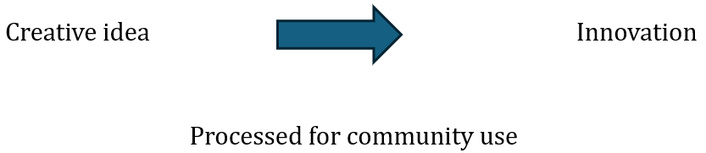
Creativity in any aspect of human endeavour generates an idea. We call it a creative idea. Such ideas come and go—surface, and further action may or may not be taken on them. Such ideas when subjected to a course that popularizes them, change shape into a product or a process. This product or process if repeatedly used creates a change in the practices of a community. This is called innovation (Figure 1).
An apple falling on Isaac Newton created an idea, that of the force of gravity. Gravity can be used in processes, e.g., a waterfall, to generate energy using hydroelectric dams. Using gravity to harness energy is definitely an innovation.
In this special issue on innovation, we take a look at innovations that have revolutionized the area of musculoskeletal disorders in general, with a review of what is happening in the arena of paediatric orthopaedics in particular. In this field, there have been many innovations—some are conceptual, some are biological or technological, and yet others are a result of collaborations at the meeting point of many disciplines.
The widespread adoption of the Ponseti technique [1] typifies the fate of many innovations that are revolutionary and subjected to ridicule to start with. This is because of the fear and lack of acceptance of what is perceived as a radical change. With perseverance and demonstration of better results, less morbidity, and cost effectiveness, the tide turns in its favour towards gradual and then rapid adoption. Ponseti, as an ideal example of an innovator, was curious, wanting to change the status quo, was perseverant and persistent with his method, obsessed to a point in proving its usefulness, leading to an epic change in the status quo.
Safe surgical dislocation of the hip [2] and the use of the extended retinacular flap are probably examples of incremental biological innovations brought about by curiosity and continual experimentation in improving the results of complex surgery for the hip.
Another example of a biological innovation is botulinum toxin. Its application in the field of medicine is an example of serendipity. The extended application of knowledge helped its use for spasticity [3].
Instrumented gait analysis [4] demonstrates the importance of communication and collaboration for innovation. It is an example of collaboration between disciplines to be able to devise objective evaluation, treatment recommendations, and prognostication in gait and other disorders.
There are many examples that follow in this paper [5]. They are all examples of technological innovations that are being used to solve day-to-day problems in paediatric orthopaedics. Examples are the six-axis external fixator, motorized internal limb lengthening, magnetic rods used for elongation of the growing spine, etc.
Are future innovations going to be conceptual, will they exploit biology, or will they be technology-based? Progress is multidirectional! Because of the thrust on technology and industry involvement, it seems that technological progress happens faster, but this is difficult to predict. It will be prudent to say that innovations are a search for the ‘better’, a striving for excellence in a human endeavour, and innovations will continue to happen as long as humans exist.
ANJ: Writing—original draft, Writing—review & editing. The author read and approved the submitted version.
Ashok N. Johari, who is the Associate Editor and Guest Editor of Exploration of Musculoskeletal Diseases, had no involvement in the decision-making or the review process of this manuscript.
Not applicable.
Not applicable.
Not applicable.
Not applicable.
Not applicable.
© The Author(s) 2026.
Open Exploration maintains a neutral stance on jurisdictional claims in published institutional affiliations and maps. All opinions expressed in this article are the personal views of the author(s) and do not represent the stance of the editorial team or the publisher.
Copyright: © The Author(s) 2026. This is an Open Access article licensed under a Creative Commons Attribution 4.0 International License (https://creativecommons.org/licenses/by/4.0/), which permits unrestricted use, sharing, adaptation, distribution and reproduction in any medium or format, for any purpose, even commercially, as long as you give appropriate credit to the original author(s) and the source, provide a link to the Creative Commons license, and indicate if changes were made.



View: 951
Download: 19
Times Cited: 0
Ali Yüce ... Abdülhamit Misir
Tanja Neussl ... Johannes Dominikus Pallua
Ashok N. Johari, Ritesh A. Pandey
Sebastien D’ulisse ... Sagi Martinov