Original Article


Affiliation:
1Faculty of Pharmacy, Applied Science Private University, Amman 11937, Jordan
ORCID: https://orcid.org/0009-0006-4877-9318

 ,
Affiliation:
2Faculty of Pharmacy, The University of Jordan, Amman 11942, Jordan
ORCID: https://orcid.org/0000-0002-7861-1958
,
Affiliation:
3Faculty of Pharmacy, University of Science and Technology, Sana’a P.O. Box 15201, Yemen
4College of Pharmacy, Al-Ayen Iraqi University, Thi-Qar 64001, Iraq
Email: fahmialashwal89@gmail.com; f.al-ashwal@ust.edu.ye
ORCID: https://orcid.org/0000-0003-2076-0771
 ,
Affiliation:
1Faculty of Pharmacy, Applied Science Private University, Amman 11937, Jordan
ORCID: https://orcid.org/0000-0001-8298-4071
Explor Med. 2026;7:1001439 DOI: https://doi.org/10.37349/emed.2026.1001439
Received: July 19, 2026 Accepted: September 09, 2026 Published: November 16, 2026
Academic Editor: Lindsay A. Farrer, Boston University School of Medicine, USA
Aim: To assess the appropriate empirical antibiotic prescribing and characterize antibiotic de-escalation for suspected bacterial meningitis in children with negative cerebrospinal fluid (CSF) culture at a tertiary teaching hospital in Jordan.
Methods: A retrospective study was performed at Jordan University Hospital on children 18 years or younger who were treated with empirical antibiotics for suspected bacterial meningitis and had negative CSF cultures during the study period, from January 2020 to July 2025. Appropriateness of empirical antibiotic therapy was assessed in accordance with the Infectious Diseases Society of America (IDSA) guidelines. Antibiotic de-escalation was evaluated based on modification or discontinuation of the antibiotic regimen within 48–72 hours after the negative culture results.
Results: The study included 208 patients. Vancomycin (91.3%) and ceftriaxone (88.0%) were the most frequently prescribed empirical antibiotics. Overall, 107 patients (51.4%) received an appropriate empirical antibiotic therapy, while 101 (48.6%) did not; of the latter, most received inappropriate therapy due to improper dosing. Successful antibiotic de-escalation was achieved in 122 patients (58.7%), while 56 patients (26.9%) had a missed opportunity for antibiotic de-escalation. Viral meningitis was independently associated with missed antibiotic de-escalation [adjusted odds ratio (AOR) = 2.941, 95% confidence interval (CI): 1.453–5.951; p = 0.003], while children aged 1 month to 18 years had significantly lower odds than neonates (AOR = 0.069, 95% CI: 0.008–0.616; p = 0.017). Missed antibiotic de-escalation was independently associated with longer duration of hospital stay (adjusted B = 0.118, 95% CI: 0.054–0.183; p < 0.001).
Conclusions: More than 50% of patients received a fully guideline-concordant empiric regimen, primarily due to dosage inaccuracies. Over 25% of patients were missed for de-escalation and correlated with extended hospitalization length. Standardization of weight-based dosing and protocolized 48–72 hours antibiotic review can improve antibiotic stewardship.
Despite advances in vaccination, antimicrobial therapy, and supportive care, acute bacterial meningitis remains a major cause of morbidity and mortality among children worldwide [1]. In 2021, childhood meningitis accounted for 1.33 million incident cases and caused over 112,000 pediatric deaths [2], and many survivors suffered from lasting neurological sequelae such as hearing loss (10%) [3], cognitive delays (8.2–41.1%) [4], and seizure disorders (7%) [4]. The predisposing factors for bacterial meningitis in children are young age (those under 5 years and neonates) [2, 5], incomplete immunization [6], poor living conditions/overcrowding [7], and immunocompromised status [7]. Maternal Carriage of group B streptococci can be a significant risk factor in neonates [8]. Young age and Streptococcus pneumoniae infection are also associated with increased risk of severe disease, death, and neurological sequelae [9].
Cerebrospinal fluid (CSF) culture has long served as a definitive tool to diagnose bacterial meningitis. Culture results from approximately 85% of patients with bacterial meningitis were positive on CSF cultures in a prior study [10]. Another study reported no growth in CSF cultures from 62% of patients in whom a CSF multiplex meningitis/encephalitis (ME) panel identified the infecting bacterial organisms [11]. This demonstrates that a negative CSF culture cannot rule out bacterial meningitis in patients, especially in those who received antibiotic therapy prior to lumbar puncture.
Since disease progression can quickly lead to sepsis, cerebral edema, and irreversible neurological damage, guidelines recommend initiating empirical antibiotic therapy immediately at the time of suspicion for bacterial meningitis, even prior to lumbar puncture when necessary [12, 13]. Empirical antibiotic regimens are guided by age and recommended by Infectious Diseases Society of America (IDSA) as a third-generation cephalosporin combined with vancomycin in older infants and children and ampicillin and cefotaxime in neonates [13]. Following the availability of results from CSF or blood culture, the antibiotic therapy should be adjusted and modified appropriately. In cases where definitive microbiological diagnosis is lacking, clinicians often continue broad-spectrum empirical antibiotics for fear of failing to treat a life-threatening bacterial infection [14]. While a clinically sound approach, extended antibiotic use leads to numerous complications, including gut microbiota dysbiosis, Clostridium difficile infection and development of antimicrobial resistance [15, 16].
To minimize these adverse events, antimicrobial stewardship guidelines endorse the de-escalation of therapy after 48–72 hours if culture results are negative and the clinical condition permits narrower or no therapy [12, 13]. Despite the presence of clear recommendations, adherence is inconsistent due to uncertainty. A recent prospective study on children in the pediatric intensive care unit (ICU) found that clinicians continued antibiotics in children with negative cultures despite negative cultures and no clinical improvement [17].
Evidence regarding empirical antibiotic use and subsequent de-escalation in children suspected of bacterial meningitis is sparse, particularly in the Middle East. Therefore, this study aims to characterize empirical antibiotic prescribing and de-escalation strategies in children with suspected bacterial meningitis who have negative CSF culture at a tertiary teaching hospital in Jordan. This includes assessing the appropriate use of empirical antibiotics based on IDSA guidelines and describing patterns of de-escalation in response to negative culture results or evidence of clinical improvement.
A retrospective review of the medical charts of pediatric patients admitted to Jordan University Hospital, Amman, Jordan, between 01/01/2020 and 07/31/2025, suspected of having bacterial meningitis, was performed. Jordan University Hospital is a 600-bed tertiary care university teaching hospital which also serves as a center for advanced pediatric care.
Children aged 18 years and less who were started empirically on antibiotics for the management of suspected bacterial meningitis and in whom the CSF was found to have negative cultures for bacteria were included in the study. International classification of diseases codes G00 and G01 were used to query the electronic medical record system to retrieve eligible cases. Patients with missing medical charts, those who left against medical advice prior to completing treatment, and those who were transferred out to another health facility before the antibiotic therapy course had ended were not included in the study.
Data were extracted using a standardized data collection form from the hospital’s electronic medical records. Demographic variables included age, sex, weight, and health insurance status. Clinical variables included presenting symptoms and signs (fever, headache, vomiting, seizures, neck stiffness, altered consciousness, bulging fontanelle, irritability, and photophobia). All clinical observations made by the clinicians were logged, and no specific or standardized clinical assessment methods were applied post hoc. Also, laboratory data included white blood cell count, CSF glucose and protein levels, and CSF and blood culture results were also extracted.
Information on empirical antibiotic therapy included the antimicrobial agent(s), dosage, route of administration, duration of therapy, and modifications following culture results. Clinical outcomes included length of hospital stay, ICU admission, and in-hospital mortality.
The appropriateness of empirical antibiotic therapy was assessed according to the IDSA guidelines for the management of bacterial meningitis, considering the antimicrobial agent, dosage, route of administration, treatment duration, and patient characteristics, including age and weight.
Viral meningitis was defined based on a positive viral polymerase chain reaction result documented in the medical record, indicating molecular detection of a viral pathogen.
Antibiotic de-escalation was defined as reducing the spectrum or number of antibiotics or discontinuing antibiotic therapy when bacterial infection was considered unlikely following negative culture results. Successful de-escalation was defined as appropriate modification or discontinuation of therapy within 48–72 hours after negative culture results in patients demonstrating clinical improvement. Clinical improvement was ascertained by chart review and was defined as resolution or amelioration of signs and symptoms contributing to initial presentation, specifically fever resolution and improved overall well-being, without any other described clinical worsening or evidence of ongoing bacterial infection. Missed de-escalation was defined as continuation of broad-spectrum empirical therapy despite negative cultures and the absence of a documented clinical indication for ongoing treatment. For patients in whom antibiotics were modified or continued, the appropriateness of the antibiotic regimen after de-escalation was not assessed as a separate outcome.
Data were analyzed using IBM SPSS Statistics version 22 (IBM Corp., Armonk, NY, USA). Continuous variables were assessed for normality using the Kolmogorov-Smirnov test and are presented as medians with interquartile ranges (IQRs), while categorical variables are summarized as frequencies and percentages.
Simple logistic regression was initially performed to identify variables associated with missed opportunities for antibiotic de-escalation and the appropriateness of empirical antibiotic therapy. Variables with a p-value < 0.05 in univariate analyses were entered into multiple logistic regression models. Multicollinearity was assessed using Pearson correlation coefficients, with a correlation coefficient > 0.90 indicating significant collinearity.
Simple and multiple linear regression analyses were performed to identify factors associated with length of hospital stay. Length of hospital stay was log-transformed to reduce skewness and the influence of extreme values and to better satisfy the assumptions of linear regression, particularly the normality and homoscedasticity of the residuals. Variables with p < 0.05 in univariate analyses were included in the multivariable model. Statistical significance was defined as a two-sided p-value < 0.05.
A total of 279 patients met the eligibility criteria; however, 71 patients were excluded due to incomplete medical records, resulting in 208 patients included in the final analysis. No patients were excluded because they left against medical advice before completing treatment or were transferred to another health facility before completion of antibiotic therapy. The demographic characteristics of the study population are presented in Table 1. Most patients were aged ≥ 1 month (202, 97.1%), while six patients (2.9%) were younger than 1 month. Males accounted for 62.0% of the cohort (n = 129), and the majority of patients had health insurance coverage (n = 202, 97.1%).
Demographic characteristics of study participants (n = 208).
| Parameter | n (%) |
|---|---|
| Age categories | |
| 6 (2.9) |
| 202 (97.1) |
| Gender | |
| 129 (62.0) |
| 79 (38.0) |
| Medically insured | |
| 202 (97.1) |
| 6 (2.9) |
Clinical characteristics are presented in Table 2. Fever (86.5%), headache (51.4%), and vomiting (51.0%) were the most common presenting symptoms. The median hospital stay was 5 days (IQR: 3). Viral meningitis was diagnosed in 48 patients (23.1%). Among patients diagnosed with viral meningitis, enterovirus was the most commonly identified viral etiology, while one case was attributed to parechovirus. No ICU admissions or in-hospital deaths occurred.
Summary of the signs and symptoms presented by the study participants (n = 208).
| Parameter | n (%) |
|---|---|
| Symptom present | |
| 208 (100) |
| 0 (0.0) |
| Signs and symptoms of meningitis | |
| 107 (51.4) |
| 180 (86.5) |
| 14 (6.7) |
| 106 (51.0) |
| 40 (19.2) |
| 1 (0.5) |
| 2 (1.0) |
| 11 (5.3) |
| 44 (21.2) |
| Viral meningitis | |
| 48 (23.1) |
| 160 (76.9) |
| In-hospital all cause mortality | |
| 0 (0) |
| 208 (100) |
| ICU admission | |
| 0 (0) |
| 208 (100) |
Length of hospital stay (days), median (interquartile range): 5.0 (3.0). ICU: intensive care unit.
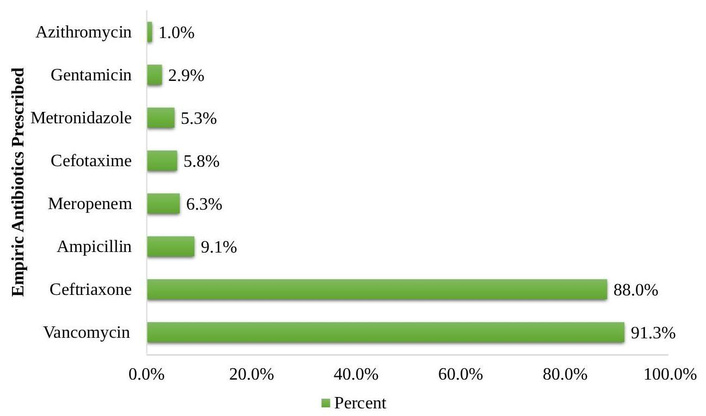
Vancomycin (91.3%) and ceftriaxone (88.0%) were the most frequently prescribed empiric antibiotics, followed by ampicillin (9.1%), meropenem (6.3%), and cefotaxime (5.8%) (Figure 1).
According to IDSA guideline criteria, 107 patients (51.4%) received appropriate empiric therapy, while 101 (48.6%) received inappropriate therapy (Table 3). The most common prescribing issues were excessive dosing (23.6%) and insufficient dosing (16.3%) (Table 3). Examples of inappropriate empirical antibiotic therapy are shown in Table 4.
Appropriateness of empiric antibiotic use in the study participants (n = 208).
| Parameter | n (%) |
|---|---|
| Overall appropriate use | |
| 107 (51.4) |
| 101 (48.6) |
| Type of inappropriateness | |
| 49 (23.6) |
| 34 (16.3) |
| 15 (7.2) |
| 3 (1.4) |
$: Suboptimal therapy was defined as antibiotic treatment that did not fully conform to the guideline recommendations. This included patients who received the correct antibiotic dose but an incomplete antibiotic regimen, such as receiving monotherapy when combination therapy was recommended based on the IDSA guidelines.
Examples of inappropriate empiric therapy for suspected meningitis in pediatric patients.
| # | Age/Weight | Symptoms | Antibiotics given | Type of inappropriateness |
|---|---|---|---|---|
| 1 | 6 years/30 kg | Fever, headache, vomiting | Ceftriaxone 1 g q12h, vancomycin 500 mg q6h | Ceftriaxone dose is too low for age/weight |
| 2 | 9 years/21 kg | Fever | Ceftriaxone 250 mg q6h (4 days), vancomycin 200 mg (4 days), azithromycin | Azithromycin not recommended for suspected meningitis |
| 3 | 11 years/78 kg | Fever, headache | Ceftriaxone 2 g q12h (7 days) | Missing vancomycin in empiric therapy |
| 4 | 1 month/4 kg | Fever | Ampicillin 300 mg q6h, cefotaxime 300 mg q12h | Ampicillin and cefotaxime doses are too high. Correct doses: ampicillin 200 mg q6h, cefotaxime 200 mg q6h or 266 mg q8h |
q12h: every 12 hours.
Antibiotic de-escalation outcomes are presented in Figure 2. Among the 208 patients, successful de-escalation was achieved in 122 patients (58.7%). This included complete discontinuation of antibiotics in 120 patients (57.7%) and appropriate reduction in antibiotic therapy without complete discontinuation in two patients (1.0%). All patients classified as having successful de-escalation underwent de-escalation within the predefined 48–72-hour period following negative CSF culture results.
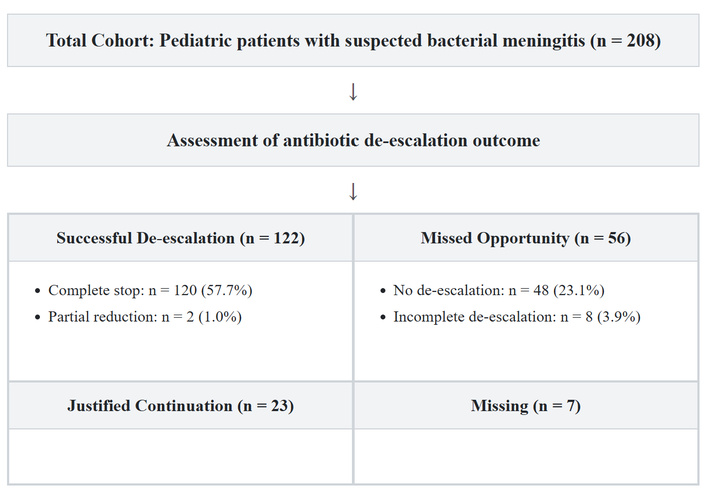
Study flow diagram illustrating antibiotic management outcomes. n = 7 cases were excluded from sub-analysis due to incomplete medical records.
Missed opportunities for de-escalation were identified in 56 patients (26.9%). Of these, 48 patients (23.1%) continued antibiotic therapy despite clinical improvement or a final diagnosis of viral meningitis, while eight patients (3.9%) had incomplete de-escalation despite clinical improvement. These eight patients had antibiotic modification within the 48–72-hour assessment period but were classified as missed opportunities because the de-escalation was incomplete. Antibiotic continuation was considered justified in 23 patients (11.1%) due to insufficient clinical improvement. Seven patients (3.4%) had insufficient information to determine the appropriateness of de-escalation.
The mean duration of antibiotic therapy was significantly shorter among patients with successful de-escalation compared with those with missed de-escalation (4.81 ± 1.83 days vs. 6.04 ± 2.57 days, respectively; p < 0.001).
Factors associated with missed opportunities for antibiotic de-escalation are presented in Table 5. In multivariable logistic regression analysis, age and viral meningitis diagnosis were significantly associated with missed de-escalation. Children aged 1 month to 18 years had lower odds of missed de-escalation compared with infants younger than 1 month [adjusted odds ratio (AOR) = 0.069; 95% confidence interval (CI): 0.008–0.616; p = 0.017], whereas viral meningitis was associated with higher odds of missed de-escalation (AOR = 2.941; 95% CI: 1.453–5.951; p = 0.003). Gender and clinical improvement were not significant predictors. The model showed modest explanatory ability (Cox and Snell R2 = 0.087; Nagelkerke R2 = 0.122; –2 log likelihood = 205.55).
Factors associated with missed opportunities for de-escalation in pediatric meningitis management: a logistic regression analysis.
| Parameter | Dependent variable: missed opportunities for de-escalation[0: no (successful de-escalation), 1: yes (missed de-escalation)] | |||||
|---|---|---|---|---|---|---|
| CORa | 95% CI of CORa | p-valuea | AORb | 95% CI of AORb | p-valueb | |
| Age categories | ||||||
| Reference | |||||
| 0.084 | 0.010–0.740 | 0.026^ | 0.069 | 0.008–0.616 | 0.017* |
| Gender | ||||||
| Reference | |||||
| 1.117 | 0.588–2.122 | 0.734 | --- | --- | --- |
| Viral meningitis diagnosis | ||||||
| Reference | |||||
| 2.704 | 1.356–5.394 | 0.005^ | 2.941 | 1.453–5.951 | 0.003* |
| Clinical improvement | ||||||
| Reference | |||||
| 0.450 | 0.062–3.279 | 0.431 | --- | --- | --- |
| CSF WBC (cells/µL) | 1.001 | 1.000–1.001 | 0.126 | --- | --- | --- |
| CSF glucose (mg/dL) | 0.985 | 0.965–1.007 | 0.182 | --- | --- | --- |
| CSF protein (mg/dL) | 1.005 | 0.999–1.011 | 0.115 | --- | --- | --- |
AOR: adjusted odds ratio; CI: confidence interval; COR: crude odds ratio; CSF: cerebrospinal fluid; WBC: white blood cells. a: Using simple logistic regression; b: using multiple logistic regression; ^: eligible for entry in multiple logistic regression; *: significant at 0.05 significance level.
Factors associated with length of hospital stay are presented in Table 6. In multivariable linear regression analysis, older age and viral meningitis were associated with shorter hospitalization, while missed opportunities for de-escalation were associated with longer hospital stay. Children aged 1 month to 18 years had shorter stays compared with infants younger than 1 month (adjusted B = –0.202; 95% CI: –0.364 to –0.040; p = 0.015), and viral meningitis was associated with reduced length of stay (adjusted B = –0.071; 95% CI: –0.137 to –0.004; p = 0.038). Missed de-escalation was associated with prolonged hospitalization (adjusted B = 0.118; 95% CI: 0.054–0.183; p < 0.001). The model explained 15.5% of the variability in length of stay (R2 = 0.155).
Factors associated with length of hospital stay in pediatric meningitis patients: a linear regression analysis.
| Parameter | Dependent variableLog-transformed length of stay | |||||
|---|---|---|---|---|---|---|
| B | 95% CI of Ba | p-valuea | B | 95% CI of adjusted Bb | p-valueb | |
| Age categories | ||||||
| Reference | |||||
| –0.215 | –0.420– –0.081 | 0.004^ | –0.202 | –0.364– –0.040 | 0.015* |
| Gender | ||||||
| Reference | |||||
| –0.013 | –0.073–0.047 | 0.668 | --- | --- | --- |
| Viral meningitis diagnosis | ||||||
| Reference | |||||
| –0.069 | –0.137– –0.001 | 0.046^ | –0.071 | –0.137– –0.004 | 0.038* |
| Clinical improvement | ||||||
| Reference | |||||
| –0.166 | –0.249– –0.083 | < 0.001^ | –0.182 | –0.375–0.010 | 0.063 |
| Appropriateness of empiric therapy | ||||||
| Reference | |||||
| 0.059 | 0.002–0.117 | 0.042^ | 0.021 | –0.036–0.079 | 0.470 |
| De-escalation outcomes | ||||||
| Reference | |||||
| 0.124 | 0.061–0.187 | < 0.001^ | 0.118 | 0.054–0.183 | < 0.001* |
| CSF WBC (cells/µL) | 7.635 × 10⁻⁶ | 0.000–1.9 × 10⁻⁴ | 0.179 | --- | --- | --- |
| CSF glucose (mg/dL) | 0.001 | –0.001–0.003 | 0.447 | --- | --- | --- |
| CSF protein (mg/dL) | 1.94 × 10⁻⁴ | 0.000–0.001 | 0.366 | --- | --- | --- |
CI: confidence interval; CSF: cerebrospinal fluid; WBC: white blood cells. a: Using simple linear regression; b: using multiple linear regression; ^: eligible for entry in multiple linear regression; *: significant at 0.05 significance level.
Acute bacterial meningitis remains a medical emergency requiring prompt initiation of empiric antibiotics because delays in treatment are associated with increased morbidity and mortality [1, 18]. However, once microbiological results become available, particularly in culture-negative cases, clinicians must balance the risks of untreated infection against the harms of unnecessary antibiotic exposure. This study evaluated empiric antibiotic prescribing practices and de-escalation patterns among pediatric patients with suspected meningitis and negative CSF cultures in a tertiary teaching hospital in Jordan.
Vancomycin and ceftriaxone were the most commonly prescribed antibiotics when empiric antibiotic treatment was initiated, which suggested reasonable conformity with the standard of care for suspected bacterial meningitis; however, close to half of patients (48.6%) received inappropriate empiric therapy in reference to IDSA guidelines. Most prescribing errors were associated with drug dosage issues (ie, too much and too little). Although general agent selection was not a significant issue, the prescribing challenges indicate a failure to incorporate guideline-based recommendations on dosing and individual patient factors when dosing antibiotics for pediatric patients.
Previous studies have reported similar concerns regarding adherence to meningitis treatment guidelines. A retrospective study from Sudan found very low adherence to IDSA recommendations, with inappropriate antibiotic selection, dosing, and duration being frequent causes of non-compliance [19]. Likewise, poor adherence to bacterial meningitis management guidelines has been reported in other Middle Eastern settings, including the United Arab Emirates and Lebanon [20]. Together with our findings, these results suggest that inappropriate empiric antibiotic use in suspected meningitis is not limited to a single healthcare setting but represents a broader challenge requiring targeted antimicrobial stewardship interventions. Our study adds data from Jordan and provides further insight into specific factors associated with missed de-escalation, particularly the association with viral meningitis, as well as the independent association between missed de-escalation and longer hospital stay.
Although the choice of empiric antibiotics is critical, appropriate dosing is equally important, particularly in children where pharmacokinetic differences may affect drug concentrations in the CSF. Underdosing may result in inadequate antimicrobial exposure and treatment failure, whereas excessive dosing may increase the risk of toxicity, including nephrotoxicity and neurotoxicity [15, 21–23]. In our cohort, dosing errors represented the most frequent cause of inappropriate therapy, emphasizing the need for improved pediatric dosing practices, and regular review of weight-based calculations. Implementation of clinical pharmacy services could be an additional approach that supports the appropriate dosing and antimicrobial management, but could not be tested as clinical pharmacists were not in place in the pediatric ward at the time of data collection for this study.
An important finding of this study was the identification of missed opportunities for antibiotic de-escalation. Although de-escalation occurred in most patients, 26.9% experienced missed opportunities, mainly because antibiotics were continued despite clinical improvement or a final diagnosis of viral meningitis. Culture-negative meningitis presents a particular challenge because clinicians may remain concerned about false-negative results and the consequences of prematurely stopping therapy. However, prolonged unnecessary antibiotic exposure increases the risk of antimicrobial resistance, microbiome disruption, and adverse drug events [24].
Patients diagnosed with viral meningitis had significantly higher odds of missed de-escalation compared with those without viral meningitis (AOR = 2.941; p = 0.003). This finding suggests that diagnostic uncertainty may persist even when a non-bacterial cause is suspected or established. Viral meningitis is generally a self-limiting disease that does not require prolonged antibacterial therapy [25]. Similar barriers to antibiotic discontinuation have been reported in pediatric practice, where clinicians often continue empiric therapy because of concern about deterioration despite negative cultures and clinical improvement [24]. In our research, missed de-escalation denotes continuation of antibiotics when the criteria for de-escalation is met, and therefore results in prolonged antibiotic exposure. Continued hospitalization in viral meningitis has been attributed to the physician’s inability to cease antibiotic use due to suspicion of a coexisting or initially misdiagnosed bacterial etiology. Developing clear institutional de-escalation criteria may help address this uncertainty and support safer discontinuation decisions.
Infants younger than one month also had higher odds of missed de-escalation. This finding is clinically understandable because neonates represent a high-risk population in whom bacterial infections may present with subtle signs, and negative cultures do not completely exclude infection. Consequently, clinicians may adopt a more conservative approach and continue antibiotics longer in this age group [26]. However, antimicrobial stewardship evidence suggests that carefully designed protocols can reduce unnecessary antibiotic exposure without compromising safety, even among vulnerable pediatric populations [27].
The present study also demonstrated that missed opportunities for de-escalation were independently associated with longer hospital stays. Patients with missed de-escalation had significantly prolonged hospitalization compared with those successfully de-escalated. This prolonged hospitalization may be related to the continued antibiotic therapy in patients for whom de-escalation was indicated, potentially contributing to unnecessary prolongation of hospital stay. This finding supports the potential clinical and resource implications of delayed antibiotic optimization. Earlier reassessment of therapy, combined with improved diagnostic support, may reduce unnecessary hospitalization and improve healthcare efficiency.
This study has important implications for antimicrobial stewardship in pediatric meningitis. Interventions aimed at improving pediatric antibiotic prescribing should focus on optimizing antibiotic dosing and appropriate de-escalation. The implementation of standardized, age- and weight-based antibiotic dosing protocols, with regular verification of dose calculations, may help reduce the dosing errors observed in our population. In addition, formal implementation of a structured antibiotic review at 48–72 hours would provide an opportunity to reassess culture results and clinical response and facilitate discontinuation or narrowing of therapy when bacterial infection is considered unlikely or no longer suspected [24, 27]. Involvement of clinical pharmacists in antibiotic review may further improve dosing accuracy and adherence to guideline recommendations. Rapid molecular diagnostic techniques, such as polymerase chain reaction, may also enable earlier pathogen identification than conventional culture methods, allowing more targeted antimicrobial therapy and supporting earlier discontinuation of unnecessary antibiotics, particularly in culture-negative cases.
There are several limitations to this study. Being retrospective, it relied on the accuracy and completeness of medical records, which may have introduced missing data or misclassification bias. Although information on the duration of antibiotic therapy was collected, total antibiotic days of therapy were not analyzed as a separate antimicrobial stewardship outcome. In addition, adverse drug events and other clinical outcomes beyond those available in the medical records, including post-discharge outcomes, were not systematically assessed. Moreover, subjective symptoms, such as headache and photophobia, were collected from medical records. So, in neonates or infants who cannot reliably self-report, some of these symptoms are not as readily observable and could have been missed or underdiagnosed. Information regarding prior antibiotic exposure before hospital presentation was not consistently available in the medical records and therefore could not be analyzed; such exposure may have influenced CSF culture results. Also, we did not follow up patients after discharge, so we can neither estimate delayed deterioration nor recurrence of infection after hospital discharge. In addition, de-escalation was evaluated within the defined window of 48 to 72 hours following a negative CSF culture report and thus, delays in de-escalation beyond this window were not assessed. Furthermore, the study was conducted at a single tertiary care institution, limiting the generalizability of the findings to other healthcare settings. Nevertheless, this study provides valuable real-world evidence regarding empiric antibiotic prescribing and de-escalation practices among pediatric patients with suspected culture-negative meningitis in the Middle East. Future studies that may include qualitative methods (i.e., in-depth interviews of clinicians, standardized questionnaires) might better discern the nature of the factors that support and/or hinder clinicians from adhering to guideline antibiotic prescribing and de-escalation recommendations.
In conclusion, while most empiric antibiotics were generally guideline-concordant, prescribing errors—particularly incorrect dosing—were common. We also identified substantial missed opportunities for antibiotic de-escalation, which were associated with prolonged hospitalization. These findings emphasize the importance of optimizing antimicrobial stewardship through improved adherence to guideline-recommended dosing and implementation of structured de-escalation protocols.
AOR: adjusted odds ratio
CI: confidence interval
CSF: cerebrospinal fluid
ICU: intensive care unit
IDSA: Infectious Diseases Society of America
IQRs: interquartile ranges
During the preparation of this work, the authors used ChatGPT (OpenAI) for language editing, mainly for grammar correction. After using the tool, the authors reviewed and edited the content as needed and take full responsibility for the content of the publication.
TH: Conceptualization, Data curation, Data collection, Validation, Formal analysis, Methodology, Visualization, Writing—original draft, Writing—review & editing. KAH: Conceptualization, Data collection, Validation, Methodology, Writing—original draft, Writing—review & editing. FAA: Conceptualization, Validation, Methodology, Writing—original draft, Writing—review & editing. RAF: Conceptualization, Data curation, Formal analysis, Validation, Methodology, Supervision, Visualization, Investigation, Writing—original draft, Writing—review & editing. All authors read and approved the final manuscript.
The authors declare that they have no conflicts of interest.
The study was approved by the Institutional Review Board of Jordan University Hospital (Approval No. 10/2025/16116) and conducted in accordance with the Declaration of Helsinki.
According to the approved protocol, no informed consent was needed since it is a retrospective study using a previously recorded data of medical reports.
Patient confidentiality was maintained by anonymizing all collected data.
The datasets used and/or analysed during the current study are available from the corresponding author on reasonable request.
Not applicable.
© The Author(s) 2026.
Open Exploration maintains a neutral stance on jurisdictional claims in published institutional affiliations and maps. All opinions expressed in this article are the personal views of the author(s) and do not represent the stance of the editorial team or the publisher.
Copyright: © The Author(s) 2026. This is an Open Access article licensed under a Creative Commons Attribution 4.0 International License (https://creativecommons.org/licenses/by/4.0/), which permits unrestricted use, sharing, adaptation, distribution and reproduction in any medium or format, for any purpose, even commercially, as long as you give appropriate credit to the original author(s) and the source, provide a link to the Creative Commons license, and indicate if changes were made.



View: 69
Download: 6
Times Cited: 0