Original Article


Affiliation:
Department of Psychology, Faculty of Health Sciences, Universidad Rey Juan Carlos, 28922 Madrid, Spain
Email: cecilia.penacoba@urjc.es
ORCID: https://orcid.org/0000-0001-6307-5921


 ,
,
Affiliation:
Department of Psychology, Faculty of Health Sciences, Universidad Rey Juan Carlos, 28922 Madrid, Spain
ORCID: https://orcid.org/0000-0003-4989-9099
Explor Digit Health Technol. 2026;4:101191 DOI: https://doi.org/10.37349/edht.2026.101191
Received: November 26, 2025 Accepted: March 18, 2026 Published: April 15, 2026
Academic Editor: Pasquale Caponnetto, University of Catania, Italy
The article belongs to the special issue Digital Health Innovations in the Battle Against Psychological Problems: Progress, Hurdles, and Prospects
Aim: To explore preliminary signals of change associated with a digitalized educational innovation—The Vital House (La Casa Vital)—on psychological flexibility and introspection among prospective secondary-school teachers in Spain, with the broader goal of promoting mental health competencies relevant to adolescent well-being.
Methods: A total of 82 students enrolled in a Master’s program in teacher training at a Spanish public university participated in a 10-session intervention over 2.5 months (approximately 20 hours total). The Vital House model, a metaphorical representation of personal identity through “rooms” symbolizing life roles, was adapted into a digital format. Each room included interactive resources designed to address key psychosocial variables, including self‑efficacy, emotional regulation, and cognitive defusion. Participants reflected on their learning histories and the influence of significant figures, including teachers, on adult identity. Pre- and post-intervention measures assessed components of the ACT Hexaflex model (ad-hoc questionnaire) and introspective capacity (Self-Reflection and Insight Scale-Short Form).
Results: Paired-sample analyses indicated pre–post differences on five of six ACT processes: values (p = 0.048), mindfulness (p = 0.014), self-as-context (p < 0.001), cognitive defusion (p = 0.034), acceptance (p = 0.019), and on introspective capacity (p = 0.008). Effect sizes were in the small‑to‑moderate range, with Cohen’s d values ranging from 0.22 (small) to 0.42 (moderate). These findings should be interpreted cautiously given the design.
Conclusions: In this pilot‑level, single‑group study, Vital House showed preliminary indications of promise for enhancing psychological flexibility and introspection in teacher training. However, the absence of a control/comparison group, the potential influence of concurrent course content, maturation, historical events, and repeated‑testing effects, as well as the lack of post‑intervention follow‑up, limit causal inference and claims about durability. Future controlled studies with follow‑up are warranted to evaluate efficacy, mechanisms, and maintenance, and to assess scalability across educational contexts.
Adolescent mental health has become a major global public health concern, with rising rates of anxiety, depression, and emotional dysregulation among young people [1, 2]. Recent reviews highlight a sustained increase in mental ill‑health over the past decades, driven by social, educational, technological, and environmental pressures, and further intensified by the COVID‑19 pandemic [3, 4]. Evidence from cross‑national studies indicates that, although countries differ in their socioeconomic contexts and specific risk factors, adolescent mental health problems show a broadly similar pattern worldwide. Internalising symptoms, general psychological distress, and bullying emerge as consistently prevalent issues across regions, suggesting that adolescent mental ill‑health is a widespread global concern rather than a phenomenon confined to particular contexts [5]. Overall, findings converge on the importance of equipping educators and institutions with evidence‑based strategies for early detection and timely intervention to support adolescent wellbeing [1–5].
Multiple individual, relational, and social determinants converge to heighten adolescents’ vulnerability to psychological distress. Risk factors include exposure to adverse childhood experiences, such as abuse, neglect, and household dysfunction, as well as chronic academic stress, social isolation, and cyberbullying [6]. An umbrella review found that low self-esteem, poor family functioning, and lack of social support are consistently associated with increased risk of self-harm and suicidality in adolescents [7]. Generational shifts in digital media use and reduced face-to-face interactions have been associated with higher levels of social anxiety and depressive symptoms among youth [8]. Cultural and socioeconomic disparities further increase these risks, with marginalized adolescents often facing systemic barriers to accessing mental health care [5]. These findings highlight the need for early, context-sensitive interventions that address both individual vulnerabilities and broader environmental stressors.
School-based interventions are widely implemented as a primary approach to promoting adolescent mental health, offering accessible and preventive support within educational settings [8]. In Spain, programs such as “Awakened Schools” (Escuelas Despiertas), a mindfulness and compassion-based initiative, have shown promising results in reducing psychological distress and improving emotional regulation among secondary school students [9]. These interventions often face challenges related to implementation fidelity, teacher training, and institutional support, which can limit their scalability and long-term impact [8].
Digital mental health interventions have emerged as a complementary and increasingly popular approach, providing formats that are scalable, adaptable, and engaging for adolescents. A recent systematic review found that digital tools—such as apps and online platforms grounded in cognitive-behavioral therapy (CBT) can effectively reduce symptoms of anxiety and depression in youth, particularly when integrated into school curricula. However, barriers such as digital literacy gaps, privacy concerns, and limited personalization remain significant challenges [8].
Recent research emphasizes that digital innovation—such as cloud-based platforms, AI tools, and data-driven learning environments—can support transformative learning when integrated into coherent pedagogical models and institutional strategies. These technologies also introduce new demands for educators’ digital health and well-being. Advances in cloud infrastructures, virtual labs, and HyFlex models have been identified as enablers of scalable, personalized, and collaborative learning [10]. At a systems level, international reports highlight that the integration of digital technologies in education remains uneven, and that meaningful transformation depends on designing supportive ecosystems that address infrastructure, governance, and teacher professional conditions [11]. In parallel, recent European guidelines on wellbeing and mental health in education emphasise whole‑school approaches that combine digital competence, safe use, and staff support within a comprehensive framework involving the entire school community [12]. Evidence from recent reviews also shows that digital interventions can improve mental health outcomes when they are well‑designed, context‑adapted, and supported by educators and institutions [8]. Taken together, these findings frame our study within global efforts to align educational technologies with teachers’ professional functioning and overall well-being.
Promoting core psychological strengths—such as resilience, emotional regulation, and self‑esteem—is essential for supporting adolescent mental health. Evidence shows that adaptive emotion regulation strategies, particularly cognitive reappraisal and acceptance, strengthen resilience and protect against anxiety, depression, and emotional distress [13, 14]. Likewise, self‑esteem consistently emerges as a protective factor associated with healthier coping, reduced risk behaviours, and better psychological adjustment during adolescence [15]. Building these capacities via digital platforms enables scalable, preventive mental health strategies for youth.
Despite the growing number of school-based mental health initiatives aimed at adolescents, few interventions have focused on the formative stage of those who will become primary providers of emotional support in educational settings: future teachers. The proposed intervention stands out by embedding mental health promotion within the academic training of pre-service educators, specifically through the course “Learning and personality development” (Aprendizaje y desarrollo de la personalidad) in a master’s program. Unlike most existing programs (which tend to prioritize external strategies for student management or offer general mental health literacy), this initiative adopts an introspective, experiential approach. It emphasizes the development of personal psychological resources such as emotional regulation, self-awareness, and psychological flexibility, based on the principles of acceptance and commitment therapy (ACT) [16, 17]. This theoretical foundation is particularly relevant, as ACT has demonstrated efficacy in enhancing well-being and reducing stress among educators [18], yet its integration into teacher education remains scarce. The intervention uses digital tools to support self-reflection and emotional skill development, addressing a gap in the literature where digital mental health programs for teachers-in-training remain underexplored [19]. By emphasizing the inner development of future teachers as a foundation for promoting adolescent mental health, this approach provides a scalable, evidence-based contribution to educational practice.
Secondary school teaching is increasingly characterized by high levels of occupational stress, emotional exhaustion, and burnout, driven by workload, curricular change, limited institutional support, and sustained emotional demands [20]. Evidence indicates prevalent symptoms of anxiety, depression, and depersonalization among secondary teachers, with documented consequences for well‑being and performance [21, 22]. Post‑pandemic surveys further suggest that up to 78% of teachers have considered leaving the profession due to stress and burnout [23]. Within this context, the intervention (centered on introspection and ACT) was designed to strengthen future educators’ competencies for supporting adolescent well-being while promoting proactive strategies for managing their own mental health, thereby addressing a documented gap in teacher training [20–23].
The mental health of educators is a determinant of classroom climate and student outcomes. Teacher distress is associated with greater mental health difficulties among adolescents, particularly under conditions of perceived low safety and support at school [24]. Burnout and emotional exhaustion are linked to challenges in classroom management and a less supportive socio‑emotional environment, with effects on student engagement and development [25, 26]. Interventions that promote introspection and psychological flexibility in teachers, therefore, have dual value: they improve educators’ psychological functioning and contribute to healthier learning environments and student mental health.
Schools function not only as educational settings but also as key contexts for psychological support, where teachers influence students’ emotional and cognitive development. Preparing future educators to identify and respond to mental health needs is therefore essential. Providing tools that strengthen introspection and psychological resilience can enhance their ability to create supportive learning environments. In this regard, digital health interventions grounded in evidence-based approaches offer scalable strategies for early detection and prevention. Integrating these technologies into teacher education programs may represent an important step toward promoting adolescent mental health.
Initial teacher education often provides limited preparation for pre-service teachers in introspective and self-regulatory competencies essential for creating psychologically safe and responsive classrooms. While many candidates possess theoretical knowledge of mental health, they frequently lack experiential skills to model adaptive coping, regulate emotions, and manage emotionally demanding situations. Scalable approaches that extend beyond mental health literacy to cultivate psychological flexibility and self-awareness are needed. These competencies enable teachers to de-escalate conflict, tolerate discomfort, act in accordance with professional values, and maintain supportive learning environments. However, few initial teacher education programs explicitly address psychological flexibility through structured, experiential practices grounded in established therapeutic frameworks. Detailed descriptions of program logic and content remain scarce, and empirical evidence involving pre-service teachers (particularly within European and Spanish contexts) is limited. Existing digital initiatives for teacher training have primarily focused on instructional or managerial skills rather than sustained experiential self-reflection [27].
To address these gaps, this study develops and evaluates La Casa Vital (The Vital House), a digital, introspection‑based program for future secondary teachers. Using a symbolic house metaphor aligned with the ACT Hexaflex [16, 17], the study (1) presents the program’s theoretical framework, structure, and components to facilitate implementation and replication, and (2) examines short‑term pre–post changes in psychological flexibility processes (acceptance, cognitive defusion, mindfulness, self‑as‑context, values, committed action) and in introspective capacity among a cohort of Master’s students.
By prioritizing the intrapersonal development of future teachers and delivering content through a modular digital format, this study explores a theoretically grounded and potentially scalable approach for integrating mental health promotion into initial teacher education. The combination of ACT-based processes with professional identity formation may offer conceptual and practical relevance, providing preliminary insights that could inform future research and implementation within Spain and comparable educational contexts. The manuscript is organized as follows. First, the introspection‑based program developed for pre‑service teachers is described, as it constitutes the core contribution of this study. Second, the study design, participants, and measurement instruments are detailed. Third, the intervention results and their implications are presented. Finally, limitations, practical applications, and directions for future research are discussed.
The introspection-based program lasted two and a half months and was part of the Learning and Personality Development course (weekly sessions), comprising a total of 10 sessions. The sessions were delivered digitally and included applied exercises that the participant had to complete individually. These exercises were hosted on the website https://mdmadre.com/blogs. Each two-hour class included 20 minutes dedicated to presenting the relevant activities, which focused on the personal application of emotional regulation techniques, understanding and relating to thoughts and their content, reflecting on life history and learning, identifying values and actions aligned with them, time management and its meaning, resilience, personal growth, and psychological well-being. Each of the 10 sessions addressed specific content, with individual assignments submitted via the digital platform. The following session involved reflecting on the learning acquired and, for another 20 minutes, discussing the challenges of the next digital session. The rest of the class time (1 hour and 20 minutes) was dedicated to presenting and working on other content from the subject Learning and Personality.
The digital program is based on the metaphor of the “Vital House” [28], which was substantially adapted and scientifically expanded by the teaching and research team from the initial conceptual idea presented in The Nine Rooms of Happiness by Danziger and Birndorf. Whereas the original metaphor had a predominantly pop-psychology and self‑help orientation, our adaptation departs considerably from that framework. Over the past years, our team has developed a clinically grounded and theoretically structured version of the metaphor, integrating principles of learning processes, introspection, emotional regulation, and ACT/Hexaflex. This work is presented in detail in the book “La arquitectura del aprendizaje” (the architecture of learning) [28], which includes a foreword by the original authors, acknowledging the scientific evolution of the metaphor.
In our adaptation, only the basic architectural structure of the house was preserved—rooms representing symbolic domains of life. All other elements were reconceptualised within an ACT-consistent framework, incorporating processes such as values clarification, self-as-context, acceptance, and cognitive defusion. The resulting “Vital House” comprises ten symbolic spaces: the kitchen (emotional nourishment and habits), living room (daily relationships), lounge (social connections), couple’s bedroom (intimacy and rest), bathroom (self-care and internal dialogue), children’s room (caregiving roles), office (work and studies), attic (expectations and emotional residues), basement (learning history), and Room 10, explicitly designed as a space for self-as-context. Each room serves as an anchor for structured introspection, helping participants explore how learning histories, beliefs, habits, and emotional patterns shape their current functioning.
This scientifically informed redesign makes the metaphor particularly suitable for pre‑service teachers, as it provides an accessible and developmentally meaningful framework for exploring personal history, values, identity, and psychological resources. These processes directly affect how teachers interact with students, regulate emotions in the classroom, and understand their role as agents of student well‑being.
As previously noted, based on this metaphor of the “Vital House”, the ten sessions are structured. For each session, the participant has access to digitized materials for individual work and reflection on the website https://mdmadre.com/blogs. Each element is designed to foster personal insight and practical application, helping participants explore the different rooms of their Vital House and strengthen psychological flexibility in meaningful ways.
The present study uses the same intervention dataset previously reported [29], but focuses specifically on psychological flexibility processes derived from the ACT framework.
Table 1 provides an overview of the ten sessions that make up the intervention, including the title assigned to each session and the motivating, metaphorical phrase used to guide participants’ reflection. These phrases were designed to evoke the symbolic meaning of each “room” within the Vital House model, encouraging introspection about personal experiences, values, and roles. By combining descriptive titles with metaphorical prompts, the program aimed to create an engaging and meaningful learning environment that facilitated psychological flexibility and self-awareness throughout the intervention.
Sessions of “Vital House” program.
| Session | Metaphorical phrase of denomination |
|---|---|
| Session 1: Rooms of the vital house | To inhabit myself is to recognize every corner of who I am. |
| Session 2: The bathroom | The bathroom is the only place where we close the door to the world… Why not open it to self‑care? |
| Session 3: The kitchen | What nourishes your body sustains your life; what nourishes your mind sustains your being. |
| Session 4: The office | Your workroom is not just where tasks are done—it is where purpose takes shape. |
| Session 5: The living room & the lounge | Connection grows when we speak with honesty and listen with heart. |
| Session 6: The basement | In the basement lies the story of how we became who we are. |
| Session 7: The attic | The attic stores the voices of expectation; yet you decide who rides your bus. |
| Session 8: Room 10—introspection | To step outside myself is to see with clarity who I truly am. |
| Session 9: Plasterboard walls | What is hidden in one room may echo loudly in another. |
| Session 10: My house under construction | I am the architect of my own vital house. |
Detailed session content and resources are provided in the supplementary materials (Tables S1–S10). These tables provide a detailed overview of the ten sessions that structure the intervention, specifying the objectives addressed in each and the digital resources. Each session corresponds to a symbolic “room” within the Vital House model (such as the living room, study, or bedroom) (see Table 1), representing different life roles and domains of personal identity. The objectives and digital content were designed to align with the metaphorical meaning of each room, guiding participants through reflective exercises that foster psychological flexibility and introspection in relation to these roles.
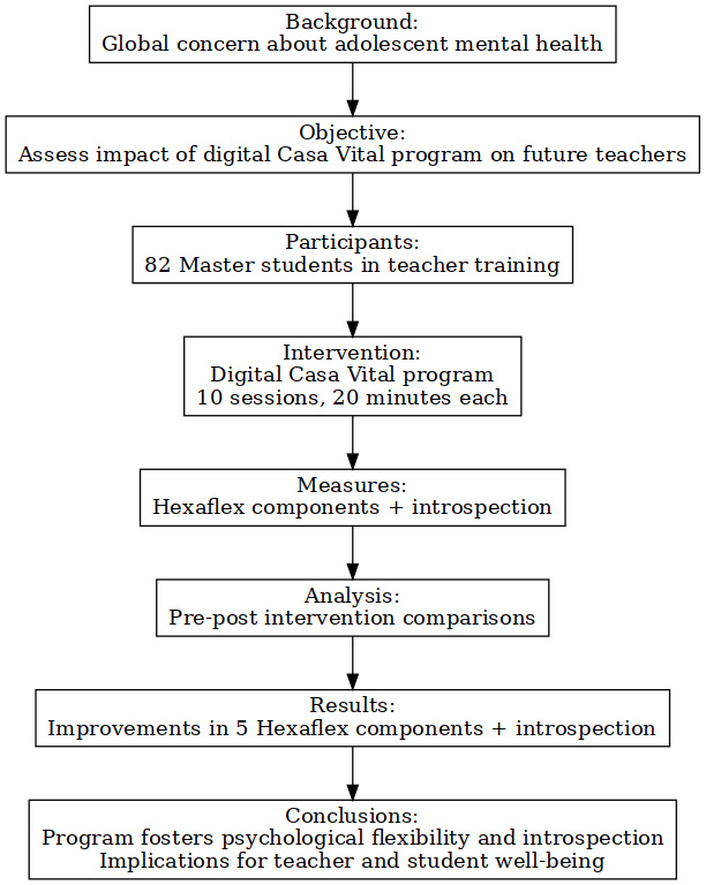
A quasi-experimental pre–post intervention design was carried out (without a control group). This study was reported in accordance with the TREND statement (see Supplementary material). Figure 1 illustrates the overall study design and procedure, including participant recruitment, intervention phases, and data analysis.
A total of 82 students from the Master’s Program in Teacher Training participated, with an average age of 31.80 (SD = 8.34). The age range is between 22 and 57 years old. The median is 28, and the mode is 26. Regarding gender, 49 (59.8%) are women, 31 (37.8%) are men, and 2 (2.4%) prefer not to answer.
Pre- and post-intervention assessments were conducted on variables related to introspection and the six core processes of the ACT Hexaflex model (acceptance, cognitive defusion, present-moment awareness, self-as-context, values, and committed action) [16, 17]. The intervention was carried out within the context of the Learning and Personality Development course during the 2024/25 academic year.
The Self-Reflection and Insight Scale-Short Form (SRIS-SF) [30, 31] is a 12-item instrument designed to assess individual differences in private self-consciousness. It allows the assessment of two scales: self-reflection and insight. The self-reflection subscale includes six items that measure the tendency to engage in introspective thought (e.g., “I frequently examine my feelings”), while the insight subscale consists of six items that assess clarity and understanding of one’s internal states (e.g., “I usually know why I feel the way I do”). Participants respond using a 5-point Likert scale ranging from 1 (“strongly disagree”) to 5 (“strongly agree”). The SRIS-SF has demonstrated strong psychometric properties and is suitable for use in both clinical and non-clinical populations. In the present study, a Cronbach’s alpha of 0.93 was obtained for the self-reflection dimension and 0.83 for the introspection dimension.
In addition to standardized measures, a context‑specific questionnaire aligned with the Hexaflex model [16, 17] was developed to assess ACT‑related processes within the teaching role. This decision was motivated by the absence of validated instruments that comprehensively capture ACT processes in teacher functioning. While global measures such as the AAQ-II [32], MPFI [33], or CompACT [34] are widely used, they primarily assess psychological flexibility in general terms and may not fully reflect role-contingent demands relevant to classroom contexts. Our approach follows a growing trend toward domain-specific measures, such as the Work-related Acceptance and Action Questionnaire (WAAQ) [35], Teacher Acceptance and Action Questionnaire (TAAQ) [36], and Parenting Psychological Flexibility Questionnaire (PPFQ) [37], which situate items within role-specific contexts to improve ecological validity and responsiveness to change.
The questionnaire was designed to assess six core psychological processes adapted to the academic learning environment: cognitive defusion (e.g., “I can observe my thoughts about my learning abilities without getting caught up in them”), acceptance (e.g., “I allow myself to experience unpleasant thoughts and emotions related to my learning without trying to change them”), mindfulness (e.g., “I use mindfulness techniques to focus on the present moment when I study”), values (e.g., “I am clear about which personal values guide my learning and development process”), committed action (e.g., “I take concrete and committed actions that reflect my values in the context of my learning”) and self-as-context (e.g., “When I struggle with learning, I remind myself that I am more than my thoughts and emotions”). Each dimension was represented by three items, resulting in a total of 18 items. Responses are rated on a 7-point Likert scale ranging from 1 (‘never true’) to 7 (‘always true’). Items were formulated to reflect how pre-service teachers engage with their thoughts, emotions, and behaviors in relation to learning tasks, academic challenges, and personal goals. The instrument aims to capture the degree of psychological flexibility students demonstrate in educational contexts, a construct increasingly recognized as critical for self-regulated learning, resilience, and adaptive functioning. Preliminary analyses indicated acceptable internal consistency and conceptual alignment with ACT principles. The following Cronbach’s alpha values were obtained for each of the dimensions: acceptance (0.72), cognitive defusion (0.82), mindfulness (0.80), self-as-context (0.76), values (0.78), committed action (0.69). Because the committed action subscale exhibited borderline internal consistency (α = 0.69), findings involving this dimension should be viewed as provisional. This scale was developed specifically for this study; therefore, its use is exploratory, and a full psychometric evaluation, including analyses of factor structure, test–retest reliability, and convergent validity, is planned for future research.
Statistical analyses were conducted to evaluate the effects of the intervention. Normality was assessed with the Shapiro–Wilk test; none of the outcomes were normally distributed (all p < 0.05). Given the sample size (n = 82) and the well‑documented robustness of paired t‑tests to moderate non‑normality, parametric analyses were retained, with emphasis placed on effect sizes and confidence intervals [38, 39]. Descriptive statistics were first calculated to summarize baseline and post‑intervention measures. Subsequently, paired‑sample t‑tests were performed to compare pre‑ and post‑intervention scores for the study’s target variables within the intervention group. For each outcome, the mean change (Δ) with 95% confidence intervals (CIs), the test statistic, and the effect size (Cohen’s d for dependent means) with 95% CIs were reported. There were no missing data: the online form required completion of each page before proceeding, and all participants provided complete pre–post responses for the analysed outcomes. All analyses were carried out using IBM SPSS Statistics, version 29.0. Statistical significance was set at p < 0.05.
Participants provided informed consent online prior to enrollment. The consent and privacy notice detailed the study purpose, types of data collected and processing procedures, legal basis (consent), contact information for the data controller and Data Protection Officer, participants’ rights under GDPR (including access, rectification, erasure, restriction, portability, and objection), data retention policies, and withdrawal procedures. The digital platform (mdmadre.com) employed HTTPS/TLS encryption, role-based access controls, pseudonymization of reflections, and data minimization aligned with study objectives, with all data stored within the European Economic Area (EEA). No cross-border transfers outside the EEA occurred. Participants could withdraw consent at any time, affecting subsequent processing without adverse consequences. Ethics approval was obtained from Universidad Rey Juan Carlos (Ref: 2911202227122), and the study adhered to the TREND reporting guideline for non-randomized evaluations.
The pre–post comparison of scores on the two dimensions of the SRIS showed distinct patterns of change. Participants exhibited a statistically significant increase in introspective capacity from pre to post‑intervention (pre: M = 25.19, SD = 7.83; post: M = 27.14, SD = 7.10; t = –2.715, p = 0.008), suggesting an association between program participation and a greater ability to examine internal experiences. By contrast, self‑reflection scores remained stable across the program (pre: M = 33.25, SD = 7.80; post: M = 33.64, SD = 7.03; t = –0.505, p = 0.615) [29].
Table 2 shows the pre–post differences in the six components of the Hexaflex model: acceptance, cognitive defusion, mindfulness, self-as-context, values, and committed action. Significant improvements were observed in five components: acceptance (p = 0.019), mindfulness (p = 0.014), self‑as‑context (p < 0.001), values (p = 0.048), and cognitive defusion (p = 0.034). Committed action aligned with values was the only Hexaflex component in which no statistically significant differences were found (p = 0.40). These results suggest that the intervention was associated with measurable changes in most psychological flexibility processes.
Pre-post differences in Hexaflex model components.
| Hexaflex model components | Pre | Post | t | p |
|---|---|---|---|---|
| Mean (SD) | Mean (SD) | |||
| Acceptance | 3.85 (1.62) | 4.37 (1.57) | –2.400 | 0.019 |
| Mindfulness | 3.56 (1.92) | 4.05 (1.75) | –2.512 | 0.014 |
| Self as context | 4.57 (1.21) | 5.11 (1.11) | –3.828 | < 0.001 |
| Values | 5.53 (1.20) | 5.79 (1.17) | –2.009 | 0.048 |
| Value-committed action | 5.38 (1.17) | 5.51 (1.29) | –0.845 | 0.401 |
| Cognitive defusion | 4.14 (1.23) | 4.46 (1.26) | –2.159 | 0.034 |
Figure 2 displays the absolute pre–post differences (Δ = post − pre) on the x‑axis, with annotations for Δ, p, and the within‑subject effect size (dz), thereby highlighting the most robust improvements. As shown in Figure 2, effect sizes for pre–post changes fall within the small‑to‑moderate range, with Cohen’s dz values from 0.22 (small) to 0.42 (moderate), indicating modest but consistent gains following the intervention. The largest effect size is observed for self‑as‑context (dz = 0.42), followed by introspection (dz = 0.30).
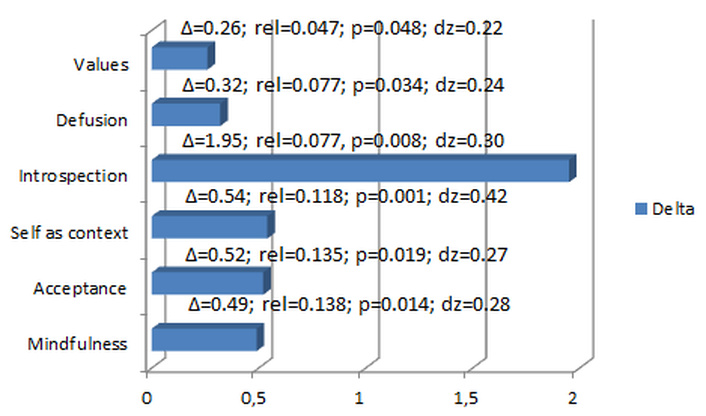
Significant pre–post changes in introspection and dimensions of psychological flexibility. Only statistically significant results are shown. The x-axis represents the pre–post change (in mean scores). Δ = (mean pre–post difference), The proportional change (rel) was calculated as (post−pre)/pre, using mean scores for each variable. Effect size reported as Cohen’s dz [t/sqrt(n)], n = 82.
This study presents the implementation of an introspection‑based teaching methodology delivered through a digital platform (“Vital House”), in which each room symbolizes a different life domain. The program was offered to students enrolled in a Master’s in Teacher Training and examined using a single‑group pre–post design, which limits causal inferences. In this exploratory context, pre–post analyses suggested preliminary indications of change in introspection and in several components of the ACT Hexaflex model [16, 17], except for committed action aligned with values. Moreover, in a previous investigation on the same Vital Home program [29], in addition to the aforementioned changes in introspection, significant increases were observed in intrinsic goal orientation, control of learning beliefs, and self‑efficacy for learning and performance. These findings should be interpreted cautiously, as potential confounding influences, such as concurrent course content, maturation, or repeated‑testing effects, cannot be ruled out. The broader aim of the Vital House program is to support teachers’ psychological well‑being and to strengthen their capacity to foster mental health among adolescents, though future controlled studies are needed to more rigorously evaluate its efficacy.
Targeting teachers is relevant given the high prevalence of psychological distress in this group. Evidence shows that many teachers experience clinically significant symptoms such as anxiety and depression [20, 21], with mental health concerns increasing since the COVID-19 pandemic [23]. Similar trends have been observed among adolescents [1–5]. These data highlight the need for routine screening, early intervention, and stigma reduction within educational settings.
The psychological well-being of future teachers is an essential component of the educational system. Teachers’ mental health can influence the quality of instruction and the emotional climate experienced by adolescents [24–26]. Evidence indicates that distress during teacher training is associated with less favorable school environments, which may affect students’ academic performance and mental health [24]. Emotional overload—such as exhaustion from disruptive behaviors or lack of institutional support—has also been identified as a factor contributing to teacher burnout, limiting their ability to respond empathetically to students’ needs [40].
These findings highlight the magnitude of the mental health challenges faced by teachers and underscore the need for interventions that offer structured support, such as the Digital Vital House program. Educational settings offer a suitable context for these initiatives. In both teacher and adolescent training, there is growing recognition of the importance of fostering cognitive-emotional skills beyond curricular content, including resilience, emotional self-regulation, and emotional intelligence [13–15]. These competencies help teachers manage stress, reduce burnout risk, and create emotionally supportive learning environments. Current conceptual models emphasize skills that enable teachers to regulate their own emotions, recognize students’ emotions, and promote a positive classroom climate, which in turn supports students’ socio-emotional development [41–43].
Research indicates that teacher-focused interventions can reduce stress, anxiety, and burnout among educators [44] and improve classroom dynamics by strengthening teacher–student relationships and decreasing disruptive behaviors [41]. For students, these programs have been associated with increased prosocial behavior and reductions in externalizing symptoms and ADHD-related difficulties, suggesting their relevance for managing challenging situations [8]. Improvements in teachers’ well-being may also contribute to more supportive learning environments [24, 25]. The results obtained with the proposed intervention align with this evidence, particularly regarding the mental health of future teachers.
Improvements in several components of the ACT Hexaflex model after the “Vital House” intervention suggest increased psychological flexibility, a core construct in ACT. Strengthened processes included mindfulness, acceptance, values, cognitive defusion, and self-as-context, consistent with ACT principles. Psychological flexibility is associated with greater well-being and lower emotional rigidity, while inflexibility relates to anxiety and depression [33]. Interventions targeting these processes have shown benefits for emotional regulation and value-driven actions, including among teachers [18]. In educational contexts, strategies such as the symbolic rooms of Vital House may help future teachers accept internal experiences, maintain present-moment awareness, clarify values, and respond to self-critical thoughts with perspective. Overall, within the limitations previously noted, these findings indicate that digital introspective interventions may support psychological flexibility and provide teachers with skills to foster healthy classroom environments.
Unlike internal processes such as acceptance, cognitive defusion, or mindfulness—which can be meaningfully fostered through introspective practices and symbolic or experiential exercises such as those proposed in the “rooms of the Vital House”—committed action entails a qualitatively different level of intervention. Specifically, it requires bridging the gap between values clarification and overt behavior by translating personally meaningful values into concrete, observable, and sustained actions in daily life. The literature conceptualizes committed action as the most explicitly behavioral component of the psychological flexibility model, as it involves identifying valued directions, setting realistic and values-consistent goals, formulating action plans, and persistently engaging in these behaviors over time. This process necessarily involves the capacity to confront internal barriers such as discomfort, fear, and self‑doubt, as well as external obstacles including contextual constraints and lack of support, while maintaining behavioral coherence with one’s values [45, 46]. Therefore, while metaphorical and reflective exercises may effectively support awareness, clarification, and motivation, fostering committed action requires additional behavioral supports. This includes structured goal-setting, monitoring progress, and reinforcing persistence, ensuring that values are not only symbolically understood but also enacted through lived, sustainable patterns of behavior. Accordingly, while introspective and experiential interventions may lay the groundwork for value clarification, observable value-driven action is more likely to emerge over time, as it generally requires prolonged training, deliberate behavioral practice, and structured support mechanisms. Future research could extend the present approach by incorporating components specifically aimed at behavioral activation, such as structured goal-setting and action planning, in order to further strengthen the committed action dimension.
A notable finding is that the program enhanced introspection but did not significantly affect self-reflection, highlighting the distinct nature of these processes [47]. Introspection involves present-focused awareness of thoughts and emotions, whereas self-reflection requires retrospective analysis and advanced metacognitive skills. The intervention’s emphasis on mindful engagement rather than evaluative judgment aligns with this outcome. Importantly, the absence of increased self-reflection should not be viewed as a limitation, as excessive self-reflection can lead to rumination, self-criticism, and anxiety [48, 49]. In contrast, introspection supports emotional regulation and resilience without triggering dysfunctional thought patterns [50], offering a functional approach to teacher development.
This study has several limitations. First, the short-term pre–post design without follow-up prevents conclusions about the durability of improvements or their transfer to classroom behaviors and student outcomes. Maintaining contact after graduation was challenging; future studies should consider strategies for long-term follow-up when feasible. Second, reliance on web-based self-report measures introduces risks related to response validity and social desirability, despite safeguards such as anonymity, confidentiality, neutral wording, and clear instructions. Evidence from web surveys with teachers indicates that response quality is influenced by survey length, perceived relevance, and trust in data use [51]. Mixed-method designs, behavioral or observational indicators, and procedures to detect socially desirable responding could strengthen validity in this context. A further limitation concerns the measurement instruments. One of the instruments used in this study (the teacher‑specific Hexaflex questionnaire) was developed specifically for the educational context and underwent only preliminary analyses of internal consistency, with one subscale (committed action) showing borderline reliability. This tool was selected to assess the six ACT processes [16, 17] within the teaching role, addressing a gap not covered by existing validated measures, which are either global or focus on a single process in teachers [36]. However, because the scale has not yet undergone full psychometric validation, all findings derived from it should be considered exploratory and interpreted with caution. Future cohorts will include established ACT instruments such as the MPFI [33] and the CompACT [34] alongside the teacher‑specific measure to strengthen convergent and discriminant validity and enhance comparability. In addition, a dedicated psychometric study is planned to examine factor structure, test–retest reliability, and convergent validity in independent samples, which will be essential to determine the robustness of this measurement approach.
Sampling and design also constrain inference. The convenience sample from a single university limits generalizability to other institutions, training modalities, or practicing teachers. Additionally, the sociodemographic information collected was intentionally limited to age and gender in order to comply with the institutional data‑protection policies governing research conducted within the educational setting of the Master’s programme. Since all participants belonged to the same cohort and university, collecting more detailed personal data was not necessary for the pedagogical implementation. Broader recruitment across universities and diverse teacher training programs would improve external validity. The absence of a control group or comparisons with alternative interventions restricts causal inference; observed changes may plausibly reflect maturation, concurrent elements of the Master’s curriculum, or expectancy/attention effects rather than the intervention itself. This constraint was tied to ethical and organizational requirements, as all students were required to participate. Finally, although effect sizes were small to moderate, these magnitudes should be interpreted as preliminary indicators rather than evidence of substantial practical impact, particularly given the exclusive reliance on self‑report measures and the potential influence of social‑desirability bias. Future research should incorporate comparison groups (potentially via collaboration with instructors who do not implement the program) and examine impacts on students to strengthen internal validity and practical implications.
Despite these limitations, the findings may have tentative implications for teacher training and well‑being. The modest improvements observed in several Hexaflex processes among pre‑service teachers could potentially relate to aspects such as better emotional regulation, reduced distress, or more adaptive coping with school demands [16–18], although these possibilities should be interpreted with caution given the exploratory nature of the study and the absence of comparative data. Given consistent links between teacher well-being, classroom emotional climate, and the quality of pedagogical interactions—with downstream associations to students’ socio-emotional outcomes—early interventions targeting these processes may have indirect effects on educational environments [24, 25]. In addition, symbolic and digital formats such as Vital House offer an accessible and scalable modality within initial teacher education, enabling guided self-exploration and introspective practice beyond face-to-face sessions. Such resources can facilitate continuity and personalization and may broaden access to evidence-informed practices that support teachers’ mental health and, indirectly, students’ socio-emotional development.
Beyond the specific outcomes of Vital House, the broader literature indicates growing interest in digital programs for teacher training and well-being [52–54]. These initiatives offer flexible and scalable formats that can be adapted to diverse educational contexts, allowing self-paced learning and ongoing practice. Digital platforms also facilitate personalization, enabling progress tracking, repeated engagement with exercises, and integration of introspective practices into daily routines. Evidence suggests that such programs can reduce access barriers and extend the reach of evidence-informed interventions to teachers with limited institutional support [52]. Embedding psychological skills training within digital environments may contribute to improvements in teacher resilience, emotional regulation, and classroom climate, with potential indirect benefits for educational communities.
Taken together, the findings from the “Vital House” intervention suggest that introspective practices may support several processes within the ACT Hexaflex model among participants in this specific teacher‑education context. In this sample of Master’s students, improvements in components such as acceptance, cognitive defusion, mindfulness, and values clarification indicate a more adaptive engagement with internal experiences [16–18], without increasing self-reflection—a process often associated with rumination and distress [47, 48]. These patterns are consistent with theoretical expectations about the role of experiential openness and value‑guided awareness in the development of psychological flexibility [16–18].
The absence of changes in committed action is consistent with its behavioral nature, which typically requires extended interventions and opportunities for contextual application [45, 46]. This underscores the need to complement introspective strategies with behavioral activation elements in future iterations of the program.
Finally, although the results provide promising indications regarding the potential relevance of psychological‑flexibility‑oriented resources in initial teacher education, the implications must be interpreted cautiously. The study relied on a convenience sample from a single Master’s program and collected limited demographic information, which constrains the generalisability of the findings. It is also acknowledged that the observed changes may partly reflect expectancy effects, as participants were aware of the introspective focus of the program, as well as potential social‑desirability bias due to the exclusive reliance on self‑report measures. Furthermore, no external benchmarks or normative criteria were available in this educational setting, which limits the interpretation of the practical significance of the findings. Thus, these outcomes should be viewed as preliminary and applicable primarily to similar educational settings. Even so, the feasibility of integrating digital resources such as “Vital House” into pre‑service teacher training appears encouraging, offering a structured and theoretically grounded approach to support psychological flexibility and emotional resilience in emerging educators [41, 55].
This study provides preliminary, pilot‑level indications that a digital introspection program such as La Casa Vital may be associated with changes in psychological flexibility and introspection among future teachers. By integrating ACT principles into an interactive and reflective format, the program addresses a relevant area in teacher education related to mental well‑being. However, these findings should be interpreted with caution due to the single-group pre–post design, the characteristics of the sample, and the absence of follow-up data, all of which limit causal inference and the assessment of long‑term effects.
Looking ahead, a controlled trial is planned, with randomization at the section or class‑group level when feasible, incorporating (a) a wait‑list or active comparison condition, (b) blinded outcome assessment where possible, and (c) pre‑registered primary outcomes and analysis plans to strengthen causal inferences and improve internal validity. Within this framework, longer‑term follow‑up will also be included to evaluate maintenance of effects, along with complementary strategies designed to reinforce behavioral components.
Nonetheless, the signals observed here suggest that scalable digital interventions could represent a feasible and potentially useful approach within educational settings, warranting rigorous evaluation through the planned trial.
ACT: acceptance and commitment therapy
SRIS: Self-Reflection and Insight Scale
SRIS-SF: Self-Reflection and Insight Scale-Short Form
The supplementary tables for this article are available at: https://www.explorationpub.com/uploads/Article/file/101191_sup_1.pdf. The supplementary material for this article is available at: https://www.explorationpub.com/uploads/Article/file/101191_sup_2.pdf.
Detailed course content corresponding to Tables S1–S10 is provided in the supplementary materials to ensure clarity and conciseness in the main text. These tables include the full description of session objectives, activities, and resources used during the intervention.
CP: Conceptualization, Investigation, Writing—original draft, Writing—review & editing, Supervision. PC: Conceptualization, Investigation, Writing—original draft, Writing—review & editing. Both authors read and approved the submitted version.
The authors declare that they have no conflicts of interest.
The study complied with the Declaration of Helsinki (2013 version). The project received approval from the ethics committee of the Rey Juan Carlos University (reference number: 2911202227122).
All participants were of legal age and were informed of the intervention program. Informed consent to participate in the study was obtained from all participants.
Not applicable.
The datasets used and analyzed during the current study are available from the corresponding author on reasonable request.
This research was funded by Universidad Rey Juan Carlos, Call for Educational Innovation Projects 2024/2025, project code PIE24_025 (Educational Innovation Tools Applied to the Methodology of Introspection Aimed at the Acquisition of Attitudinal and Motivational Competencies in Future Teachers; Herramientas de innovación educativa aplicadas a la metodología de introspección dirigidas a la adquisición de competencias actitudinales y motivacionales en futuros docentes). The funders had no role in study design, data collection and analysis, decision to publish, or preparation of the manuscript.
© The Author(s) 2026.
Open Exploration maintains a neutral stance on jurisdictional claims in published institutional affiliations and maps. All opinions expressed in this article are the personal views of the author(s) and do not represent the stance of the editorial team or the publisher.
Copyright: © The Author(s) 2026. This is an Open Access article licensed under a Creative Commons Attribution 4.0 International License (https://creativecommons.org/licenses/by/4.0/), which permits unrestricted use, sharing, adaptation, distribution and reproduction in any medium or format, for any purpose, even commercially, as long as you give appropriate credit to the original author(s) and the source, provide a link to the Creative Commons license, and indicate if changes were made.



View: 1961
Download: 49
Times Cited: 0
Saidy Eliana Arias-Murcia ... Christiane Stock
Shiyuan Chen ... Michelle Demaray
Michael Baber, Barbara Baker
Michael Kavanagh
Sara Garcia-Navarra ... Marta Mendez
Elnaz Moghimi ... Hayden P. Smith
Phoebe Howlett, Dominic Murphy
Lucía Bellver-Peñalver ... Gemma García-Soriano
Iolie Nicolaidou, Despo Nicolaidou
Lilien Tóth ... Adrienn Ujhelyi
Klaus Kellerwessel ... Adrienn Ujhelyi