 Original Article


Affiliation:
1Department of Social Psychology, Institute of Psychology, Eötvös Loránd University (ELTE), 1075 Budapest, Hungary
2Institute for Theoretical Studies, Moholy-Nagy University of Art and Design (MOME), 1121 Budapest, Hungary
Email: kellerwesselklaus@gmail.com
ORCID: https://orcid.org/0009-0005-6420-5691


 ,
,
Affiliation:
1Department of Social Psychology, Institute of Psychology, Eötvös Loránd University (ELTE), 1075 Budapest, Hungary
ORCID: https://orcid.org/0000-0002-1455-6902
,
Affiliation:
1Department of Social Psychology, Institute of Psychology, Eötvös Loránd University (ELTE), 1075 Budapest, Hungary
ORCID: https://orcid.org/0000-0003-1360-1350
Explor Digit Health Technol. 2026;4:101180 DOI: https://doi.org/10.37349/edht.2026.101180
Received: July 01, 2025 Accepted: October 30, 2025 Published: January 12, 2026
Academic Editor: Pasquale Caponnetto, University of Catania, Italy
The article belongs to the special issue Digital Health Innovations in the Battle Against Psychological Problems: Progress, Hurdles, and Prospects
Aim: Diagnosing and treating major depressive disorder (MDD) remains a pressing global health challenge. Generative-AI tools, by lowering technical barriers and offering rapid visual feedback, may open new avenues for art-based assessment and intervention.
Methods: In this exploratory qualitative pilot, we conducted reflexive thematic analysis of semi-structured interviews with N = 10 young adults at elevated risk for depression who generated self-representative images in Midjourney during a 45-minute session. Participants were selected from a larger cohort described elsewhere; no quantitative analyses were conducted in the present paper.
Results: Qualitative findings suggested therapeutic-like mechanisms that mirror—and in some cases amplify—those reported for traditional art therapy, including the experience of flow and spontaneity, a heightened sense of creative agency, and the safe externalization of difficult or extreme emotions. Some participants described abrupt “sentiment switches,” where joyful imagery was immediately followed by scenes of sudden, intrusive self-criticism. Importantly, the generative process also surfaced idiosyncratic “resource images” (e.g., nature motifs, hobbies, values, loved ones) that participants experienced as calming or empowering, hinting at personalised anchors for future interventions.
Conclusions: In line with prior quantitative work showing that more negative prompt sentiment statistically relates to higher BDI scores, the present qualitative narratives offer an interpretive account of how such negativity may emerge during AI-assisted self-representation. However, the current study does not integrate datasets or perform mixed-methods triangulation and uses those prior findings solely for contextualization. We conclude that, with appropriate ethical safeguards, generative-AI image making may serve as a flexible, low-cost adjunct to existing diagnostic and art-therapeutic practices, offering clients and clinicians a shared visual language for exploring the multi-layered experience of depression.
Depression remains one of the most prevalent and disabling psychological disorders globally [1]. Despite significant advancements in both pharmacological and psychotherapeutic treatments, many individuals continue to experience residual symptoms, incomplete recovery, or recurrent episodes [2].
Its most pronounced form, major depressive disorder (MDD), is marked by pervasive disturbances in cognition, emotion, and self-perception. Cognitive models of depression have long posited a “negative cognitive triad”—negative views of the self, the world, and the future—that is maintained by maladaptive biases in information processing [3, 4]. Another characteristic feature of MDD is a pronounced reduction in energy, motivation, even persistent fatigue and psychomotor retardation, contributing to a pervasive sense of stagnation or being “stuck” [5]. These low-energy symptoms often interact with the cognitive distortions mentioned above: for instance, fatigue and insomnia may intensify self-critical interpretations of low productivity [6], and may gradually erode the individual’s sense of agency over time, making it difficult to envision, let alone initiate, positive change. This multidimensional constellation of symptoms—distorted self-image, impaired cognitive-emotional control, and depleted drive—underscores the need for tools that can help individuals re-engage with their internal world in more adaptive, creative, and emotionally meaningful ways.
Art therapy has long been recognized as a powerful method for facilitating emotional self-expression and self-reflection—capabilities that classical psychotherapy alone sometimes cannot fully achieve [7]. Both verbal and visual expressive modalities have demonstrated robust efficacy in supporting emotional regulation and psychological healing in individuals with depression. In Pennebaker’s [8] expressive writing paradigm, participants write freely without censorship for a predetermined period (typically 15–30 minutes), either focusing on a specific topic or engaging in free association. This practice not only facilitates a controlled confrontation with emotions [9] but also aids in processing past traumas [10] and addressing future anxieties [11]. Notably, these benefits have been found to be independent of the medium used—whether it be on paper or via computer [12]. Expressive writing exercises are also effective adjunct therapies in treating major depression [13].
Similarly, visual art therapy has demonstrated comparable effectiveness in helping individuals regain control over their emotions and thoughts [14]. Beyond the stress-reducing effects often associated with flow experiences during art creation [15] and the boost in self-esteem that comes from successful art-making [16], art therapy methods encourage the development of new self-expression strategies [7] and assist in identifying and overcoming internal inhibitions [17]. As Franklin [16] noted, engaging in the work of artmaking is essentially a form of self-work, with each creation helping to create a more complete self-image. Consequently, art therapy can play a crucial complementary role in the treatment of depression alongside medication and psychotherapy [18]. Ciasca et al. [19] found that 41.9% of older adults with major depression who received 20 sessions of adjunctive art therapy (in addition to standard pharmacotherapy) achieved a ≥ 50% reduction in depression scores on the Beck Depression Inventory (BDI), compared to only 4% in a control group receiving usual care. In interviews, adults recovering from depression have described art-making as empowering, or even transformative [20]. Making art externalizes inner experiences: patients concretize emotions and conflicts into visual form, which “become more active than rational thoughts” and thereby promote insight into one’s feelings [20]. The tangible art product itself can serve as a meaningful artifact of progress, helping individuals derive personal meaning and pride from their creations [21].
Among the range of therapeutic practices, self-portrait creation holds particular potency. Acting as a “projective mirror,” it enables individuals to confront internal conflicts and discrepancies in self-perception that might be difficult to articulate verbally [22, 23]. This form of creative self-representation facilitates emotional processing and supports the development of effective coping strategies [22]. According to Muri [21], reviewing one’s artworks can yield revelatory experiences for the creator across a range of mental disorders. For individuals with addiction, it can increase acknowledgment of their condition—thus facilitating acceptance of therapeutic help—and for those suffering from depression, it may reveal the richness of their inner world beyond the depressive state, allowing them to acknowledge their sadness without being defined by it [21].
The term visual art therapy is not confined to traditional media such as drawing and painting—any medium can be used creatively [24]. Different media interact with an individual’s emotional world in unique ways. For example, in sculpting, participants encounter the tactile resistance of the material, which they have to cope with, like external constraints [25], while creating collages from found objects involves a deliberate selection of materials that can facilitate recognizing possibilities in one’s environment [26].
Digital tools are increasingly being integrated into therapeutic practices, particularly among digital natives. These tools lower the entry barriers for individuals with limited traditional artistic skills, enable rapid exploration of visual possibilities, and stimulate creative experimentation through immediate visual feedback [27, 28], and might help to avoid the hindering effect of perfectionism, which might appear in other art therapy methods [18]. Generative AI systems, such as Midjourney and DALL·E, transform textual descriptions into visual artworks, and although the status of these creations as “true art” might remain debatable and the legal as well as ethical implications of the technology continue to be contentious [29], AI art is finding practical applications across diverse fields [30, 31].
Within psychological research, generative art has predominantly been examined in the context of studies exploring stereotypes toward machine-generated artworks. Participants consistently preferred artworks they believed were human-made over those attributed to AI, regardless of the true creator [32]. However, according to aesthetic philosopher Feng Tao [33], this might be temporary, predicting that as our aesthetic attitudes evolve, the “AI-created” label will recede in favour of appreciating the inherent aesthetic value of works, ushering in a “new harmony” between art and technology (page 1). Chamberlain et al. [34] found that the human-machine distinction already diminishes when participants observe the generative process instead of just the output, fostering deeper engagement with the created images.
Du et al. [35] investigated generative tools’ therapeutic potential using DeepThInk, an AI-based software they developed, that enriched participants’ drawings with real-time, realistic textures. Participants described the creation using the machine as an exciting and engaging experience, seeing themselves as active co-creators with the software and notably feeling strong ownership over the results. Similarly, Boris Eldagsen [36]—who won a prestigious photography award in 2023 with an AI-generated (Midjourney) piece—referred to his creative process as fundamentally collaborative, which is nothing new in terms of art creation: “It was always a collaboration. I’ve been working in teams with artist friends for 25 years.” (page 1).
Kellerwessel and Ujhelyi [37] explored the image creation patterns in AI-assisted self-image creation. In their study, eleven participants created self-portraits using Midjourney, followed by semi-structured interviews. Several were surprised by their creative potential and found the experience positive. Many felt their images were strikingly representative (“This is how I see myself, and it’s beautiful. I feel like I didn’t give much guidance, but it captured something I imagined really well. That’s so cool.” [page 25]), suggesting that—based on this creative freedom and the strong feeling of ownership—generative softwares might become valid media in art therapy.
In a subsequent quantitative study with 227 participants [38] found that participants with higher BDI scores used significantly more negative language in describing themselves upon creating self-images on Midjourney; furthermore, those at elevated risk for depression could be effectively identified based on this linguistic pattern.
While earlier quantitative analysis revealed statistical associations between prompt sentiment and depression risk, it could not fully explain why or how individuals at higher risk generated particular images.
In contrast, qualitative methods—through in-depth analysis of interviews and images—offer a richer, more nuanced exploration of the individuals’ lived experiences and creative strategies [39, 40]. By integrating these subjective narratives with earlier numeric indicators (such as varying sentiment frequencies), we aim to bridge the gap between “hard data” and therapeutic dialogue, thus uniting the perspectives of quantitative and qualitative psychological research. This data-driven yet human-centered approach offers a concrete example of how algorithmic insight and human interpretation can work hand-in-hand.
The present study aims to explore how individuals at high risk for depression experience and interpret the process of creating self-images using generative AI. The focus is specifically on the emotional and self-reflective dimensions that emerge during this AI-assisted self-representation. This article reports a qualitative, exploratory study using reflexive thematic analysis of interviews for ten individuals with the highest BDI scores. Our aim was descriptive and generative rather than confirmatory; no a priori hypotheses were tested, no control condition was used, and no quantitative analyses are presented here. References to prior quantitative results serve only to situate the present themes.
The findings may not only have implications for art therapy and clinical diagnostics but could also contribute to a broader understanding of generative AI as an expressive medium.
The ten participants selected for the thematic analysis were chosen from a total of 227 individuals who completed the study by April 2024 (141 women, 85 men, 1 gender-fluid; mean age = 21.54 years, SD = 2.12). Inclusion criteria were: (i) age 18–28 years; (ii) residence in Hungary and native Hungarian language; (iii) willingness to complete the online questionnaire battery and to generate self-representative images within a 45-minute session; and (iv) basic computer literacy and willingness to enter prompts in English. Exclusion criteria were: (i) current psychiatric care at the time of recruitment; (ii) inability to complete the questionnaires; and (iii) acute distress during the session, in which case the session was discontinued.
To support the exploratory aims of the study and enable an in-depth understanding of self-representation among individuals at elevated risk for depression, we employed a purposeful sampling strategy [41, 42]. Specifically, we selected the ten participants with the highest BDI scores, based on the assumption—supported by Beck and Haigh [3]—that they would be more likely to exhibit salient cognitive-affective patterns characteristic of MDD. Such individuals were considered particularly suitable for exploring the therapeutic and diagnostic potential of a novel, image-based intervention. We chose N = 10 a priori to balance analytic depth (line-by-line coding, cross-case comparison, and consensus meetings) with breadth across cases typical of reflexive thematic analysis. Previous studies in expressive therapies and mixed-methods clinical psychology have shown that cases with more severe symptoms often provide the clearest insights into both psychological suffering and self-regulatory processes [43, 44], allowing researchers to surface subtle mechanisms that may remain undetectable in low-symptom populations.
The ten selected participants represented a variety of educational backgrounds, gender identities, and experiences with generative art software (see Supplementary material 1). They ranged in age from 20 to 25 years (M = 21.5, SD = 1.8), with most either currently pursuing or having completed higher education. The group included six women, three men, and one gender-fluid individual.
All image-generation sessions and interviews were conducted in person, individually (one participant and one experimenter), in a quiet lab setting. No group administrations were used, and no sessions were conducted online or remotely. The questionnaire battery, administered one day prior to the session, was completed remotely by participants without experimenter presence (approximately 20 minutes; see Supplementary material 2), whereas the entire image-generation and interview procedure took place on site. At the beginning of the session, participants received a brief introduction to the generative AI software (Midjourney [45]) and provided their informed consent. They were then given 45 minutes to create self-representative images using standardized instructions (see Supplementary material 3). The task was to create self-representative images with Midjourney using text prompts that reflected how they saw or felt about themselves. Participants were explicitly told that (a) any representational mode was acceptable—literal, symbolic, or abstract—and (b) there were no constraints on prompt form: they could enter single words, comma-separated lists, or full sentences. The instruction emphasized: “The goal is to create as many images as possible that you feel capture something of your personality.”
Midjourney generates visual images based on textual prompts provided by the user. For each prompt, the software produces four unique visual interpretations (see Supplementary material 4). Participants could refine these images by requesting alternative variations or enhanced resolutions (upscaling), or restart the process by modifying or creating new prompts (see Supplementary material 5). They could not modify an already generated image by adding further text to it; when they wished to change content or direction, they did so by starting a new prompt. If an output did not match their intention, participants either generated variations of that output or entered a fresh prompt that better captured their idea. The workflow was demonstrated with the standard and neutral prompt “dogs, flowers”—no other examples were shown. Throughout the session, technical support was available upon request, and participants were allowed to use an online translation service (DeepL [46]) to overcome potential language barriers (as all participants were Hungarian). No additional external aids or visual references (e.g., mirrors, photographs) were allowed.
After the image-generation phase, participants engaged in a semi-structured interview (15–20 minutes) to discuss their experiences, creative strategies, and the resulting images (see Supplementary material 6). The experimenter did not watch the image-generation procedure and could only view the images that the participant chose to share during the interview.
The research fully complied with ethical guidelines and regulatory standards, and all protocols were approved by the Ethics Committee of the Faculty of Education and Psychology at Eötvös Loránd University (approval number: 2022/454). Participants’ identities were protected by pseudonyms chosen by themselves, which were consistently used to link their questionnaires, images, and interviews. To facilitate international readership, these pseudonyms have been translated into English while preserving their intended original meanings.
The participants were volunteers and did not receive any financial compensation. They retained the right to withdraw at any stage without providing reasons and were fully informed about the research process and data management procedures. They could request the deletion of audio recordings within one week and ask for the exclusion of their prompts or images from analysis and publication within one month after participation. All collected data were stored on password-protected Drive folders accessible only to the research team. All materials were anonymized prior to storage so that no participant could be personally identified; even the authors worked exclusively with anonymized datasets. Audio recordings were accessible only to those researchers who transcribed them (mostly the experimenters), and were stored in separate, restricted-access folders. Data will be retained for five years after publication of the final study results, after which all files will be permanently deleted.
Approximately thirty undergraduate students served as experimenters in this research as part of their Research Field Practice in Social Psychology, supervised by Adrienn Ujhelyi. All of them received a brief, standardized training delivered by the research team. The training covered informed consent procedures, standardized task instructions, on-site technical support for Midjourney and DeepL, interview etiquette, audio recording, anonymization, and secure data handling. Each student typically conducted 5–7 sessions during the semester. Because the data lock for the larger cohort occurred mid-semester, not all sessions they conducted fell into the previously reported analytic window; the present qualitative sub-study draws its cases from the finalized N = 227 dataset. A substantial share of sessions—especially in the early weeks—were conducted by the first author and a senior research assistant (Lilla Juhász).
This was a non-interventional study focused on exploring subjective experiences through thematic analysis, not on delivering treatment. At enrolment, participants confirmed they were not in current psychiatric care and provided informed consent acknowledging that no psychotherapy or clinical management would be provided as part of the research. Because the short BDI is a screening instrument, not a diagnosis, elevated scores did not trigger treatment within the study; instead, all participants received a written list of local counselling services and national helplines. No therapeutic techniques were administered by the research team during data collection in order to avoid dual-role conflicts and preserve the observational nature of the study. In case of acute distress during the session, our protocol included immediate on-site risk assessment, provision of mental health support contact information, and referral to appropriate services when necessary. No such incidents occurred during the present study.
For depression risk assessment, we employed the Hungarian adaptation of the 9-item short BDI [47–49]. Each item corresponds to a specific depressive symptom, representing its most severe manifestation (e.g., “I have lost all interest in other people”). Participants rated each item on a four-point Likert scale, from “not at all characteristic of me” to “completely characteristic of me.” The short version shows a strong correlation with the original full-length BDI and has demonstrated reliable diagnostic validity compared to structured clinical interviews, making it a popular tool in Hungarian epidemiological and clinical settings [49]. It should be noted that this abbreviated inventory differentiates only between low and high depression risk, omitting intermediate severity categories.
To capture the experiential realm of image creation, we applied the flexible methodology of thematic analysis [50]. Our approach is grounded in a realist epistemological stance, treating participants as experts on their own experiences and basing our assertions solely on what they have shared, independent of external factors [51]. All participant quotes originally in Hungarian were translated into English by the first author, and subsequently checked for accuracy by the other two authors, also fluent in both languages. Minor wording adjustments were made to preserve the original meaning and tone.
It is important to note that we did not directly ask about the topics appearing in the results section, like “flow”, “resource images”, or “visual metaphors”. The semi-structured interview schedule (Supplementary material 6)—as mentioned before—contains only broad, open questions about the overall experience, images felt most/least self-expressive, and reflections after viewing the series. The headings in the Results section denote inductively derived, data-driven themes that emerged across participants’ accounts during coding; they are not labels for questions in the interview guide.
All prompts from the participants selected for interview analysis are provided in Supplementary material 10. We refer to each prompt by its order in the image creation sequence (e.g., the seventeenth prompt of the participant with the pseudonym “Raspberry Syrup”—which is: “family, apart, distance, sister, brothers”—will be cited as “Raspberry Syrup {17}). In the interview excerpts, the researcher’s questions are indicated in italics, and all emphasis is ours. Supplementary material 9 contains two or four images from the ten participants selected for analysis, which we refer to by a combination of their sequence order and participant pseudonym (e.g., Image 5/3 denotes the third illustrative image of the participant “Leaf”, who has the fifth-lowest depression score, with the prompt “underachieving, expectations” [8]). This image selection was purely illustrative: we prioritized the exact variant (often the upscaled image) that participants explicitly discussed during the interview, or images that clearly exemplify a theme discussed in the text.
Of the ten participants selected for analysis, eight expressed enthusiastic, positive opinions about the task (‘I was amazed’ [Pupu], ‘It really struck me’ [Window]), with several also feeling that it positively impacted their overall mood (‘This task gave me a bit of a boost for the rest of the day’ [Candle], ‘I feel better than before’ [Leaf], ‘I felt relieved’ [Starbucks]).
Two participants had more neutral opinions: ‘I’m not the kind of person who can easily open up in this way, and secondly, I don’t really like these image-based tasks. [But] it wasn’t bad. It was interesting to see what the machine came up with’ [Apple], and ‘A mildly absurd experience, but nothing too serious. […] It was fine as a one-off’ [Pink Towel].
The image creation instructions provided participants with ample space to develop their generation strategies; however, each participant selected for the analysis approached the task using a free association strategy, which might closely resemble expressive writing: ‘There wasn’t really a goal; I was just thinking about words and curious to see what would come of it. […] Whatever came to mind,’ [Raspberry Syrup]. ‘During the process, I realized that as I typed the words, they were more about reflecting my feelings. […] I approached it in a very intuitive way, typing in the words that just came to mind’ [Starbucks]. ‘Just jumped in and started typing.’ [Bob].
Several participants mentioned that their focus was primarily on the visual formation of the images, with the words that emerged during the association only serving as tools for the visual creation. ‘I tried to write down everything I could relate to myself, but I was really more interested in the visual aspect.’ [Blue], ‘I was mostly just looking at how good the images turned out to be and how they could be even better.’ [Raspberry Syrup], ‘My mind was working, thinking […] what thought could I express that might result in an interesting image?’ [Window].
In several participants’ statements, a sense of relinquishing control could be observed, they seemed to find their way by doing: ‘[After hearing the instructions] I didn’t know exactly what I should be doing or what kind of image I had in my mind. But when I started, it became clear.’ [Pupu]. ‘I thought I wouldn’t have any ideas and wouldn’t be able to do anything. But then all sorts of things just kept coming up. If I typed in a few words, more ideas would come to mind for the next image […] It was easier than I thought […] the ideas just kept coming and coming’ [Candle]. ‘It completely took me away. One idea led to another’ [Leaf]. ‘I just let it take me along.’ [Pink Towel].
The act of relinquishing control may also be suggested by the fact that most participants reported that the time allotted for image creation passed quickly: ‘It went by quickly’ [Pupu], ‘It went by quickly’ [Leaf], ‘It really didn’t seem that long’ [Window]. Additionally, several of them found it difficult to estimate how many images they had created. Of the ten participants analysed, Pupu, who created the fewest images, overestimated: ‘I was fumbling around at the beginning. So, I think I made a lot [of images], especially since I started in two different directions. And then I didn’t like one of them, but I still went through with it a bit.’ In contrast, Apple, who created the most images, initially felt disappointed that she had made so few: ‘I felt a bit down that I don’t know myself well enough’.
During the review of the images, several participants found pictures they had completely forgotten about: ‘It’s strange [to look through the images], because as I was scrolling through, I realized I had forgotten many of them.’ [Candle]. ‘It’s strange [to look through the images], but it’s completely different. I got so absorbed [in the image creation process] that I don’t even remember what I was doing at the time.’ [Raspberry Syrup].
During the free association, several participants encountered negative thoughts or feelings, often almost involuntarily, as suggested by their passive phrasing (‘And then it just flipped in me, that I shouldn’t just write happy things, because I’ve had worse times too’ [Candle]; ‘There’s this duality in it, where at first, I dealt with the good stuff, and then I moved on to the bad’ [Blue]).
Raspberry Syrup called these sharp sentiment switches ‘sidetracks’: ‘Sometimes I was thinking of words, and not the happiest words came to mind, so I got a bit sidetracked. But it wasn’t a bad experience at all, just reflective of my life and what I’ve gone through’. In quoting participants, we retain the colloquial term “sidetrack”; analytically, we refer to the same phenomenon as a sentiment switch, defined as an abrupt polarity change across 1–2 consecutive prompts/images. The suddenness of these sidetracks is particularly interesting. Raspberry Syrup’s first prompt was ‘music, girl, happy’ {1}, immediately followed by the first appearance of the loneliness theme: ‘piano, girl, lonely, window, lake, rain’ {2}. Later, the prompt ‘fantasy, unreal, people’ {24}, which resulted in fairy-tale images, was refined to ‘fantasy, unreal, people, horror, scared’ {25}, which then transitioned to a series of images about a girl being shamed by her mother in front of a mirror because of her body, with the prompt ‘mother, criticize, daughter, fat, shame, bully’ {28} ({28–36}, Image 6/2). This series, which constitutes one-fifth of her whole image creation process, is abruptly concluded with a positive switch: ‘castle, meadow, sun, happy, animals, people’ {37}. Similar sharp shifts can be observed in the images of Candle (‘dance, rain, relationship’ {24}, ‘lonely, depression, dark’ {25}, ‘make-up, skin-care’ {26}, Images 7/1–2), Apple (‘cuddling on the sofa’ {29}, ‘alone’ {30}), and Window (‘music that gets your eye teary it’s so good’ {21}, ‘most people are pretty dumb primitive and simple’ {22})—in contrast to, for example, the images of Pupu, where the prompts used consistently show similar sentiment (Supplementary material 7).
The hundreds of images created by the participants reflect a broad thematic representation of negative emotions. Apart from slowed movement and sudden weight changes, examples of each major depressive symptom defined in the DSM-5 appear in their prompts and images (Supplementary material 8). For instance, Blue explored themes of self-destruction (‘[…] extreme, anger, unfair, self-destruction, questioning everything […]’ [{14}, Image 4/1]), while Starbucks brought up suicidal thoughts as a theme in image creation (‘suicide, fantasy, nature’ {15}—Figure 1/1).
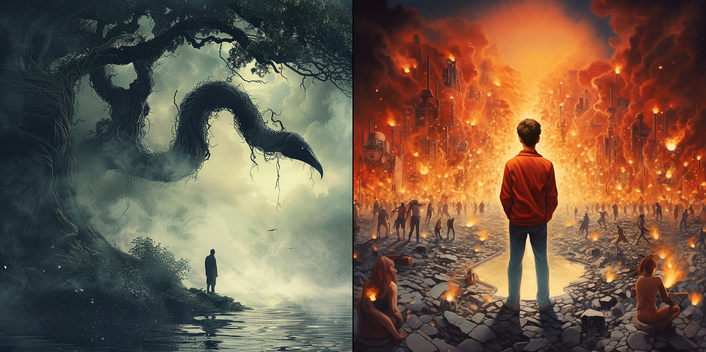
It expresses things—images from participant Starbucks (Beck score 25) and Window (Beck score 27). ‘It expresses things surprisingly well.’ (Window). 1. Starbucks: [Prompt 16]: ‘suicide, fantasy, nature.’ (one upscale); 2. Window: [Prompt 15]: ‘I would like to be more social and if more people liked me.’ (one upscale).
The specific symptoms that appear and how they are depicted in each participant’s images can reveal which symptoms are most concerning to them at this moment or stage of life. (‘Anxiety. And darkness. Yes, that’s definitely the mood right now.’ [Leaf], ‘I feel like I’m constantly just longing for things to be good, and I’m not enjoying the moment’ [Apple], ‘I feel as if I’m experiencing all emotions at once, and [I’m] always moving too fast in life, and what I haven’t taken the time for is chasing me.’ [Blue]). Bob chose the image of ‘a guy being distracted from his job, unable to pay attention to what he should be doing’ [{17}, Image 3/1] as the most expressive of himself, and in the interview, he talked about how much he suffers from concentration difficulties: ‘This procrastination, and not doing my thing […] That’s what’s going on with me. In general. For the past two years.’
Not all emerging negative thoughts were as explicitly linked to the participants’ sense of self as Bob’s were. Candle framed her most negative images as reflections of a past state she had fortunately moved beyond (‘I often felt very alone, like in this picture [Image 7/2] with the darkness and depression; there was a phase in my life when these were very present. […] After that, I switched back […] to happier images. […] I didn’t feel as connected to it anymore.’ [Candle]).
There were also instances where a participant chose not to elaborate further on the story behind certain objects depicted in the images—Pink Towel, for example, identified images related to the consumption of human body parts as the most representative of herself (Figure 2). Regarding the image created from the ‘edible hands’ prompt (Figure 2/1), she commented: ‘Maybe others wouldn’t associate this ‘edible hands’ [image] with me as much, but it feels pretty close to me […] Lately, I’ve developed a serious phobia of my own hands. [pause] And I’ve been thinking about it a lot from that angle [pause].’
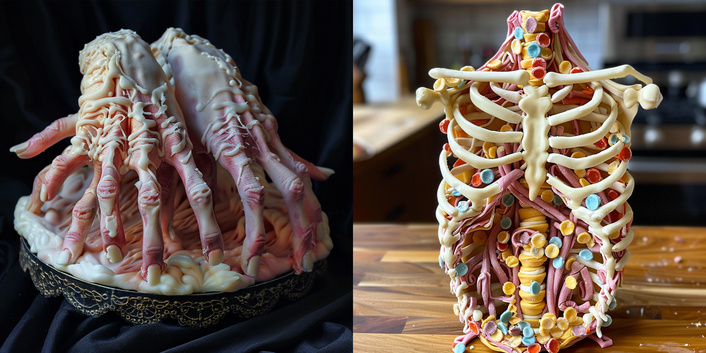
A serious phobia of my own hands—images from participant Pink Towel (Beck score 26). ‘Maybe others wouldn’t associate this ‘edible hands’ [image] with me as much, but it feels pretty close to me […] Lately, I’ve developed a serious phobia of my own hands.’ (Pink Towel). 1. [Prompt 35]—Most expressive: ‘edible hands’ (one upscale); 2. [Prompt 10]—Most expressive: ‘messy ribcage made out of cake’ (one variation, one upscale).
The most frequently recurring theme was loneliness, which emerged in all selected participants (except for Pupu), and for several of them, it accompanied the entire image creation process (Window, Raspberry Syrup, Starbucks, Apple). This loneliness often manifested in a social context, such as feeling lost in a faceless crowd (‘There are many people around me, but none of them look at me, none of them have a face.’ [Leaf]), or as an unwanted prominence (‘This image also represents me quite well. [Image 2/3] […] All my life, I’ve wanted nothing more than to be part of the crowd, it represents me to want to be the part of it, but it also represents me that I am not part it, […] sadly, I’m not.’ [Apple]).
The process of self-representation through generative art allowed for the spontaneous articulation of a wide range of negative thoughts (helplessness, anxiety, loneliness), often through sudden sentiment shifts.
In addition to the emergence of negative emotions and thoughts, the process of working with images also revealed one or more environments that provided a sense of security for the participants. For many, this environment involved a natural scene or phenomenon (‘Nature is a recurring [element]. I don’t like big cities’ [Bob, Image 3/3], ‘It’s like the calm before the storm […] I really, really love that feeling when the storm is coming […] It’s still calm, but right before the tension.’ [Pupu, Image 10/2]).
Beyond natural scenery, many participants also identified various forms of engaging with or creating art as part of these protective environments. For Window, after an initial series of long, negative, and demotivated self-descriptions highlighting a lack of joy (‘I feel like there are huge problems with me’ {2}, ‘I have no motivation, and I am too tired to do anything. My head hurts all the time’ {6}, ‘I don’t know what I like anymore or what I want to do with myself’ {8}), a sudden mention of a love for music appeared among the prompts (‘When a certain music moves you, that is one of the greatest feelings in the world’ {16}), followed later by prompts expressing enthusiasm for ‘quality’ in various aspects of life (‘I like girls who are incredibly beautiful’ {34}, ‘I mostly like abstract movies that have a huge emphasis on hidden meaning and art.’ {38}, ‘I’m really passionate about high-quality food’ {47}). This chain of association culminates in a personal and global declaration (‘I would like to do everything at the highest possible quality’ [{45}, Image 9/4], ‘A person’s life should be full of satisfaction’ {49}), celebrating the values during the creative process.
As a counterpoint to loneliness and social isolation, some important, close individuals appeared in the images of several selected participants. For example, Candle, when discussing the image, she chose as the most representative, shared that she considers her relationship to be the central aspect of her current life: ‘With this image, I really felt that this is my life right now. The relationship and everything. I’m really living this phase now.’ [Image 7/1, Candle].
For Leaf, the moon symbol, which appears in several of her images, has been an important resource since a shared experience with her father (Image 5/1): ‘My dad told me this, who doesn’t live with us. [pause] He moved away a long, long time ago, and we didn’t keep in touch, but recently we’ve started to reconnect. And when I moved away too, very far—for university […]—and I felt lonely, […] he said, “If you look out the window now, what do you see?” I said, “The moon,” because we were on a mountain, and it was shining over the city. And he said, “Well, from now on, think about how if I look out the window, I’m seeing the same moon.”’
During the image creation process, Raspberry Syrup realized how important her dog is to her and how much security she feels when they are together (Image 6/1): ‘[I made this image] based on a real event—I love playing the piano, and we recently got a dog, and every time I play the piano, she curls up under me and sleeps. And this happened just as it was raining, so I tried to recreate that. […] This is kind of the manifestation of my happy place.’ However, this realization also brought up some concerns: ‘[Seeing this image now] brings up a feeling in me—and I hadn’t really thought about this before—but I’m afraid that one day, when we go for a walk, my dog might run off, and we won’t find her. She’ll be left alone in a place like this, and [pause] Obviously, when she’s with me, I only think of the good things, how enjoyable life is with her, how much joy she brings, and [pause] Then the bad thoughts come, like okay, when will this end?’
However, several participants described creating and revisiting the images of happy places as a very pleasant experience (‘I really liked this image. [Image 2/4] […] I love it when there’s this warmth, and I’m with my partner and the animals, and it’s all so cozy, so calm. This is what I long for, to have this. […] This image [Image 2/1] was also really nice. I love these rainy, more mystical pictures. […] Looking at an image like this, it feels like I’m there, and it would be nice. […] The beach too, it means peace to me, I associate it with that […] It makes me think of vacation, that I’d love to go, how great it would be to finally get away.’ [Apple]).
Several participants depicted pleasant situations, important people, and central values in their images, giving insight into some of their inner resources (such as a love of nature/art or social relationships).
Engaging with the visual characteristics of the images helped many participants define and present their self-image. As Apple noted, “This is what characterizes me the most […]. The mood, the colours, and the aesthetics.” Pink Towel also observed, “The colour composition and stuff like that, I think that’s a big part of who I am […] very aggressively colourful and glittery [Image 8/1].” The visual feedback also aided in working through complex and multifaceted emotions and bringing inner dynamics to the surface. As Blue explained, “I have a hard time understanding my emotions […] I feel them all at once, and I don’t know […] I feel like I don’t know myself, [but] colours always calm me down, and then somehow, in an image, I understand something better than if someone were to explain it to me. […] I understand things better through images.”
Beyond capturing the complexity of identity and emotions, focusing on visual elements also helped participants confront negative feelings. Here, the contrast between light and dark often emerged as a common visual language. Leaf described one of her images: “Light and dark, and the girl there almost in the middle [Image 5/2]. And she’s facing the darkness. [That’s] my look on life… from the outside everything seems fine, everything is beautiful, the sun is shining, the clouds are lovely, and so on, but she’s staring into the darkness. From the outside, everything is okay, there’s no real problem, but she can only focus on what’s in front of her, and it’s total darkness. […] I also feel like everything is okay. And yet, when I think about what will happen […] let’s say in 5 years, I can’t see past this sharp black line. […] Darkness is a recurring theme in my images.”
For Starbucks, this contrast between light and dark was a key dimension in comparing images during the interview. Discussing the image he later chose as the most expressive [Image 1/1], he said, “If I had to describe myself, I might say that the dark colour dominates my feelings more, but in this image, I don’t see the dominance of darkness; rather, I see the absence of light.” He contrasted this with an image he found less expressive [Image 1/2]: “This represents a phase of my life or personality that […] hopefully, I won’t experience again because it’s too dark. This isn’t about the absence of light; it’s about everything being completely dark, totally isolated from everyone, and feeling utterly meaningless.” Light also appeared in an image he believed his friends would find the most expressive of him, though not in a positive role: “I think this light could be the eye of the outside world. That’s why it feels so oppressive.”
The participants found it intriguing to see objects, people, or even body parts with personal significance—whether positive or negative—visually represented in their images. However, each participant also encountered at least one instance where a machine-generated image quartet revealed an unexpected additional meaning, offering a particularly fitting situation or visual symbol that resonated with the thoughts behind their prompts.
For example, Leaf found an unexpectedly resonant visual metaphor in her ‘underachieving, expectations’ [8] image [Image 5/3]. She explained, “I didn’t give [the machine] the idea to have a door, but as soon as I saw it [in the image], I realized how fitting it was to have it there. […] It evoked a feeling in me that it really captured well, […] this works, this is me. There’s a door. I should go through it because it’s an opportunity, it’s an opportunity, whatever, let’s take it in any way. But I’m afraid to go through because there’s that cloud above it, which is connected to me, and it’s also connected to the little figure. It’s like, I don’t know. I feel like I could do something, but I’m too scared to move in that direction, I’m too scared to go through the open door because there’s that cloud above it, which is also in my head, and I’m sure I’ll mess something up.”
These found meanings help to surface and articulate thoughts already present within the participant. As Window observed, “It’s probably also a bit about how in my head, I associate it with a meaning that somehow [adds more to it for me].” Discussing the image he highlighted, “I would like to do everything at the highest possible quality” {45, 46}, he said: “There were four images like this [Image 9/3]. And, for example, I liked this one because, in all the images, the program interpreted [the highest quality] as a kind of mountain metaphor, and […] in the other images, there’s this luxury at the top, or lots of people, so it’s like […] a huge civilization, which is incredibly advanced, and so on, but in the one I chose, there’s just this small thing at the top, which I found to be a pleasing idea [Image 9/4]. So, […] it’s hard to get up there, but it’s still beautiful. Simple and beautiful. So, that’s what I liked about it in a somewhat abstract way.” Although simplicity had appeared in Window’s earlier images as a characteristic of the Others present in the image (“most people are pretty dumb, primitive, and simple” {23}), during the interview, he emphasized that the visual idea that associated simplicity with beauty and quality resonated with him the most.
Given the central role of visuality and the inherent randomness in the creation process, several images emerged that allowed creators to discover unexpected meanings, helping them access their own unarticulated thoughts.
Most participants felt that the images they created were effective in representing various aspects of their inner experiential world. This, combined with the process of revisiting and discussing the images, helped many participants become more aware of their subjective experiences (‘As I generated the images, I felt quite strange, for being able to see those things that people usually only feel. It was quite an interesting and intense experience. […] It was really a positive surprise for me; I didn’t expect that at all.’ [Starbucks]). Many participants highlighted the role of seeing many differing, competing facets of their selves mirrored back at them (‘I think this was a really good experience. Especially because […I might have gained a bit of self-knowledge from this, because I saw these many emotions and all the things that are true about me in so many variations. […] It feels good to dig a little into ourselves.’ [Blue].
Integrating the positive and negative elements of the self-image seemed to be of particular importance. As we have seen earlier, revisiting images that depicted positive experiences and safe relationships was generally a pleasant experience, but even confronting negative self-image elements was not a traumatic experience, rather something interesting or ‘even good, a little bit’, as participant Leaf put it: ‘It definitely managed to capture [my feelings]. Whether I like what I see, [the answer is] no, because I feel the same stuff inside, and these are no good feelings. But to see them - it’s even good, a little bit. That was all a very intense therapeutic experience for me - to see almost exactly what I imagined. [pause] It’s a very intense feeling. [pause] Surprising, yes, very surprising. I didn’t expect that.’ [Leaf]. During the generation procedure, corrective experiences emerged: ‘When I look at each image, I see that it represents me in some way, even if just a little part of me. No matter how much I don’t want to see it, it’s there. […] It was hard, I haven’t really done anything like this before. And I never like to think too much on anything in general because something bad always comes out of it. [pause] But this time, it was a positive experience, it was okay—there were one or two [images] that were scary, but it’s interesting to look back and see them.’ [Raspberry Syrup]).
The image creation process alone was not enough for everyone to have this experience. As we have seen before, immediately after finishing the image creation, a significant portion of the participants had not yet fully grasped the process in its entirety; they forgot about several images and misjudged the proportions of the images they had created. Bob, for instance, was quite distressed right after the image creation:
‘—How do you feel now, after finishing?
—I’m shocked.
—You’re shocked. Why are you shocked?
—I thought this wouldn’t get close to my emotions, but it did. It affected me. […] Writing about myself was shitty, and realizing, oh, this is what I’m like, was tough. […] I mostly wrote down negative things. […] But it was in there. I knew it would be like this.’
During the interview, however, participants had the opportunity to revisit and interpret their images, which could lead to the rediscovery of forgotten aspects of their selves, the emergence of unexpected meanings, and the uncovering of previously hidden resources (such as social relationships). By the end of the fifteen-minute interview, Bob’s mood had significantly improved:
‘—How does it feel to look through the images now?
—Well, it’s good. I thought I had made more bad ones, but it turns out it’s about fifty-fifty, so it’s not that bad. It just felt like there was more crap in the middle of it. [scrolls through the images]
—So now you see more good in them?
—Yes! […] Looking back on it now.
—Is there anything else you’d like to share about the experience or the images?
—[laughs] They’re really good.
—Do you like that one? The old man?
—The old men sitting in the truck and driving [Image 3/4] […]. My dad drives the car [laughs, and continues scrolling] This is a good one, a really good one. This should be with us!
—Which one? [leans in to see]
—This should be with us with the buddies! [laughs]
—[reads the prompt] Tall man [laughs] bulky man drinking.
—This is what I want in 30 years. That we’re still getting together!’
The importance of this shared reflection is underscored by the fact that Starbucks specifically thanked the interviewer at the end of the study: “Considering everything, I’m feeling really good. I’m not usually the type who likes interviews, but this felt good. I feel very relieved after all of this.”
The present study set out to explore how young adults at high risk of depression experience and interpret the process of creating self-representations with a generative AI tool. Our qualitative results mirror established art therapy mechanisms—projection, externalization, and a sense of creative control [7]—and demonstrate that these can be effectively transferred into a digital environment. Most of the participants were surprised by their own creative potential and felt that the images authentically reflected aspects of their inner world. This lowered threshold for producing striking, “artistic” images enhanced the sense of agency and artistic competence, giving participants a sense of accomplishment, even when lacking traditional artistic ability. This echoes findings by Du et al. [35] and Kellerwessel and Ujhelyi [37], who found that the creative process with generative tools can be experienced as genuinely collaborative and can even foster a strong sense of ownership. Such positive reactions may counteract perfectionism and creative inhibition that often accompany depression [18]. This sense of self-efficacy and ownership is well known to predict increases in hope and readiness for change in cognitive therapy [3].
A recurrent motif in participants’ accounts was losing track of time, letting go of conscious control, and having ideas arise spontaneously, which are all part of Csikszentmihalyi’s concept of flow [52], one of the most frequently cited mechanisms through which art therapy alleviates emotional distress [15]. The pleasure of creation, even for those without prior artistic experience, appeared to have a refreshing and energizing effect, providing a temporary respite from depressive rumination. This aligns with findings that art therapy can boost self-esteem and promote psychological well-being through the experience of creative mastery and flow [7, 15]. For participants in our study, this art-making joy provided temporary relief from the sense of “stuckness” that typifies depressive states [5].
Interestingly, this spontaneous prompt-writing technique bears a striking resemblance to the mechanisms underlying expressive writing as well, where unfiltered language helps facilitate emotional processing and access to latent thoughts [9]. In both cases, individuals spontaneously externalize internal states through open-ended, intuitive engagement with a creative medium. Research on expressive writing suggests several mechanisms that plausibly carry over to AI-assisted image-making: (a) inhibition reduction/exposure—repeated, controlled articulation of distressing material promotes habituation and emotion regulation [53, 54]; (b) cognitive reappraisal and meaning-making, indexed by increases in “insight” and “causal” language that predict better outcomes [8, 9]; (c) affect labelling and self-distancing, which dampen limbic responses and support reflective processing [55, 56]; and (d) narrative self-organization, whereby fragmented experiences are integrated into more coherent stories [11]. The prompt→image feedback loop may engage these pathways via dual coding: rapid linguistic labelling followed by immediate visual externalization can scaffold regulation and insight [57]. Iterative prompting, variations, and upscales operate as micro-cycles of reappraisal, while participant-identified “resource images” (images that participants experienced as personally meaningful sources of comfort, strength, or positive emotion) align with the imagery literature showing that positive, vividly constructed scenes can shift mood and motivation [58].
Further research is needed to explore whether the benefits observed in writing-based interventions—such as reduced symptom severity or increased self-insight—can be extended to image-based generative environments, especially when paired with reflective discussion.
Participants described how negative thoughts and feelings often surfaced spontaneously during the creative process, but the act of visualizing these emotions offered a safe space for confrontation rather than avoidance. This supports prior research on expressive therapies, which suggests that the articulation and externalization of negativity can foster emotional regulation and insight [7, 9]. Participants often reported that seeing their negative feelings materialized allowed them to process distressing content with greater distance and self-compassion, suggesting that AI-assisted image-making can provide a unique field for controlled emotional exploration. Participants’ images often brought into focus one or more “core symptoms,” such as procrastination, existential anxiety, or self-criticism. These highly individualized visual narratives could function as potential diagnostic markers, complementing traditional assessment tools like the BDI [3], and may be valuable in clinical settings for personalized treatment planning [19]. The present qualitative themes add to the statistical patterns reported in the earlier sentiment-prediction study [38]. It showed that the mean negative sentiment of prompts was the strongest linear predictor of BDI scores (r ≈ 0.39), while here we see how that negativity might surface—through sudden ‘sidetracks’, body-shame sequences, or loneliness metaphors. Thus, the two data streams converge: quantitative correlations point to a negativity bias, and qualitative narratives illuminate its lived phenomenology.
Conversely, the prior sentiment-only models plateaued (AUC ≈ 0.70), leaving some high-risk cases systematically undetected, as they had mostly neutral/positive prompt sentiment and were misclassified. Several participants with BDI ≥ 19 produced lexically neutral or positive prompts yet disclosed acute distress in their images or narratives—e.g., “Pink Towel’s” cannibal-hand motif. Although integrating more nuanced visual or textual metrics—colour entropy, compositional complexity, recurrence patterns—could raise model sensitivity, without qualitative context, the quantitative pipeline is likely to overlook some valuable metaphor-rich distress signals.
The process of creating images in a generative art environment led many participants to depict “safe spaces”—scenes or environments representing security, comfort, or meaningful connections. For some, these included nature, music, or the presence of loved ones. Such imagery not only provided psychological relief for the participant but also offered the therapist valuable insight into the individual’s values and emotional resources [16]. This function of image-making as a window into a client’s inner safe havens can inform and enrich therapeutic dialogue, enabling more precise support tailored to personal strengths and needs. This might also be useful from the resource-focused perspective of positive psychology [59], particularly the importance of positive emotions, engagement, and relationships (PERMA model). Such images may later serve as visual anchors in self-regulation or relaxation exercises [15, 16].
The algorithmic unpredictability of generative AI sometimes led to the emergence of striking, personally resonant metaphors, which participants could not have planned. This “projective mirror” effect [22, 23, 60] provided moments of sudden insight—paralleling the “aha” moments sought in classical art therapy and projective testing [25]. This dynamic, user-driven interplay between randomness and interpretation appears to foster cognitive and affective integration. These found meanings can provide a powerful, personal language for participants to communicate their complex, difficult-to-articulate emotional states. This aligns with the established role of metaphor in art therapy as a bridge between client and therapist [22, 23]. Through shared attention to the imagery, therapist and client can co-construct meaning and language, deepening mutual understanding and providing a richer ground for therapeutic intervention.
One of the key advantages of the AI-supported method was its capacity to create hundreds of images in only one setting—making it possible to reflect a broad spectrum of self-aspects, including both positive and negative elements. Participants frequently reported that reviewing their series of images helped them see themselves more holistically, integrating conflicting emotions and experiences. This integration is a central goal of many therapeutic modalities, and our findings suggest that the generative art process can directly and effectively support it [7]. The visual juxtaposition of divergent self-states—often facilitated by discussion in the subsequent interview—allowed participants to construct a more nuanced and accepting narrative identity, incorporating, rather than suppressing, the complexities of their inner life [60].
AI-assisted self-image creation may become a low-cost, flexible adjunct to individual or group art therapy. We recommend a two-step protocol: (1) a 45-minute free-form image generation session in a safe digital environment, followed by (2) a therapist-led review and discussion. The resulting “resource images” can then be used in later relaxation or guided imagery exercises [7, 16]. Additionally, the language of prompts and recurring visual themes could serve as preliminary indicators for screening and diagnosis [38].
This pilot, exploratory study has several limitations that should be considered when interpreting the findings. First, although a sample size of N = 10 is appropriate for in-depth qualitative thematic analysis, the demographic homogeneity (non-psychiatric Hungarian young adults, 20–25 years) constrains transferability to other age groups, cultural contexts, and clinical populations. Broader and more diverse sampling—across ages, cultures, and clinical severities—will be needed to evaluate the stability of these themes. Second, the study included no control or comparison condition (e.g., hand drawing, tablet painting, text-only expressive writing). Consequently, we cannot determine whether the perceived benefits (flow, externalization, resource discovery) are specific to the AI medium or reflect more general features of time-limited, visually supported expression. Third, with respect to procedural transparency and analytic rigor, the present report now includes an outline of the standardized task instructions and the semi-structured interview schedule in the main text (full protocol in the Supplementary material). While two trained coders conducted the thematic analysis and maintained an audit trail, future studies should further strengthen credibility with pre-registered codebooks, systematic double-coding with agreement reporting (or an explicit reflexive-TA rationale for not doing so), and expanded peer debriefing/triangulation procedures. Forth, English was not the native language of our participants, and this linguistic mediation may alter spontaneity, nuance, or emotional tone of free association. Future work should compare native-language prompting versus translation, and evaluate whether prompt language systematically shifts themes or image characteristics.
Although the Ethical implications section details consent and withdrawal rights, the present design was not optimized to test risk-management frameworks. Negative or distressing imagery can emerge abruptly; future implementations should formalize and report a crisis protocol (e.g., on-site safety check, stepped referral pathways, documentation, and follow-up) and evaluate participant safety outcomes prospectively.
It is important to note that this is a short-term, cross-sectional assessment. We did not conduct longitudinal follow-up, so the durability of perceived gains (e.g., flow experiences, use of resource images) and any symptom change over time remain unknown. Randomized and longitudinal designs are needed to test persistence and clinical impact. This paper prioritizes participants’ narratives; in this paper, we did not perform objective, multimodal image analysis (e.g., colour distributions, entropy, compositional complexity, recurrence patterns). Integrating validated visual features (and temporal “switch” dynamics) with textual metrics may yield stronger multimodal links to depressive phenomena. Additional considerations: all image-generation sessions and interviews were conducted in-person, individually (one participant, one experimenter); findings may therefore not generalize to group formats or remote/online delivery.
Further research should recruit larger, more diverse samples and compare AI-assisted self-image creation with traditional drawing or other digital modalities. Longitudinal studies are needed to assess whether the benefits persist and whether AI-based art interventions can reduce relapse rates in depression. Automated analysis of images (e.g., colour use, composition) and prompt texts using natural language processing may support the development of predictive diagnostic tools [38]. Conversely, model outputs can guide qualitative focus: prompts with the largest negative score can be flagged for deeper narrative exploration, for example. This symbiosis exemplifies mixed-methods ‘algorithm-in-the-loop’ workflow, where quantitative salience directs human interpretive labour. Here, data-derived flags—like highest mean negative sentiment, sharpest within-session sentiment switches, or atypical colour/compositional metrics—help interpreters prioritise “where to look first”, while human judgement remains decisive.
Future applications of AI-assisted image generation in therapeutic or diagnostic contexts should be guided by strong ethical safeguards. Beyond protecting participant anonymity and clarifying boundaries for content disclosure, particular care is needed to prevent generated self-representative images—often containing sensitive information—from being incorporated into future model training without explicit consent. Broader concerns include the widespread scraping of online artworks without permission and the unintentional embedding of harmful visual stereotypes into outputs. To address these risks, future researchers should prioritise ethically sourced or locally hosted models, maintain transparent data governance, and ensure participants have full agency over the storage, sharing, and potential reuse of their creations.
Our findings indicate that generative AI-supported self-representation integrates the well-established benefits of traditional art therapy into a rapid, accessible, and highly engaging digital format. The process enables creative flow, ownership, and deep emotional exploration, but also demands careful facilitation to ensure that sudden negative content can be safely integrated into the individual’s narrative identity. With appropriate safeguards, AI-based image generation holds promise as a valuable adjunct to the psychotherapeutic repertoire for depression. Ultimately, weaving together lexical sentiment, switch dynamics, image chromatics, and interview-coded themes could yield a multimodal depression signature. The quantitative pilot mapped one facet (statistical signal in language); the present thematic analysis supplied texture (how negativity and positivity are experienced). The logical next step is a fused, multimodal framework that links textual, visual, and narrative markers in a single model and evaluates whether this fusion improves their predictive and therapeutic value.
AI: artificial intelligence
BDI: Beck Depression Inventory
MDD: major depressive disorder
Due to file size limitations, supplementary materials—including the AI-generated images discussed in the interviews—are hosted externally and can be accessed via OSF: https://osf.io/97b2h.
The authors would like to thank Lilla Juhász for her contribution as a senior research assistant, including support in data collection and assistance with the supervision of experimental sessions. We also thank the undergraduate students who participated as experimenters in the Research Field Practice in Social Psychology for their careful and committed work.
AI-Assisted Work Statement: Participants used Midjourney V4–6 to create self-representative images as part of the data collection process. To create this manuscript, we, the authors, used OpenAI’s ChatGPT models (versions 4o, o3, and 4.5) to assist with the formulation and refinement of the text in English. After using these tools, we carefully reviewed and edited the content as needed and took full responsibility for the final version of the publication.
KK: Conceptualization, Methodology, Investigation, Data curation, Formal analysis, Writing—original draft, Project administration, Software, Funding acquisition. AK: Methodology, Supervision, Writing—review & editing. AU: Project administration, Supervision, Writing—review & editing. All authors read and approved the submitted version.
The authors declare no conflicts of interest.
This study was conducted in accordance with the Declaration of Helsinki. Ethical approval was obtained from the Ethics Committee of the Faculty of Education and Psychology at Eötvös Loránd University, Budapest, Hungary (approval number: 2022/454).
All participants provided written informed consent prior to participation.
All images were generated by study participants using Midjourney V5–V6 prompts in accordance with the study protocol. The copyright of the images is fully retained by the participants. The images do not infringe upon any third-party rights (e.g., trademarks, brands, or recognizable characters) and adhere to the Midjourney community guidelines. Publication of the images has been authorized through explicit participant consent for scholarly purposes.
The dataset, including participants’ images, prompts, the associated prompt sentiments, and the results of the questionnaires (such as the Beck Depression Inventory), analysed during the current study, is available in the following OSF repository: https://osf.io/vpz6x/. Due to minor inconsistencies in Midjourney’s export process, a small number of images (1–2 per participant) may not appear in the downloaded set. These can be provided upon request.
The complete dataset, including the images generated during the study, is available for the first 150 participants at the time of this study in the following Hugging Face repository: https://huggingface.co/datasets/Hipnotalamusz/AI_Assisted_Self_Images_With_Prompts_And_Personality_Tests.
This research was funded by the Hungarian Ministry of Culture and Innovation under the New National Excellence Programme, code number [ÚNKP-23-2], with the support of the Hungarian National Research Development and Innovation Fund. The funders had no role in study design, data collection and analysis, decision to publish, or preparation of the manuscript.
© The Author(s) 2026.
Open Exploration maintains a neutral stance on jurisdictional claims in published institutional affiliations and maps. All opinions expressed in this article are the personal views of the author(s) and do not represent the stance of the editorial team or the publisher.
Copyright: © The Author(s) 2026. This is an Open Access article licensed under a Creative Commons Attribution 4.0 International License (https://creativecommons.org/licenses/by/4.0/), which permits unrestricted use, sharing, adaptation, distribution and reproduction in any medium or format, for any purpose, even commercially, as long as you give appropriate credit to the original author(s) and the source, provide a link to the Creative Commons license, and indicate if changes were made.


View: 4143
Download: 146
Times Cited: 0
Saidy Eliana Arias-Murcia ... Christiane Stock
Shiyuan Chen ... Michelle Demaray
Michael Baber, Barbara Baker
Michael Kavanagh
Sara Garcia-Navarra ... Marta Mendez
Elnaz Moghimi ... Hayden P. Smith
Phoebe Howlett, Dominic Murphy
Lucía Bellver-Peñalver ... Gemma García-Soriano
Iolie Nicolaidou, Despo Nicolaidou
Lilien Tóth ... Adrienn Ujhelyi
Cecilia Peñacoba, Patricia Catalá


