Original Article


Affiliation:
1Atrium Health Wake Forest Baptist Medical Center, Winston Salem, NC 27103, USA
2Global Remote Research Scholars Program, Princeton Junction, NJ 085550, USA
Email: areendhoon@gmail.com
ORCID: https://orcid.org/0009-0005-3412-9368


 ,
,
Affiliation:
3Jordanian Royal Medical Services, Irbid 28610, Jordan
ORCID: https://orcid.org/0009-0001-8777-0387
,
Affiliation:
2Global Remote Research Scholars Program, Princeton Junction, NJ 085550, USA
Affiliation:
4Ludwig Boltzmann Institute Digital Health and Patient Safety, Medical University of Vienna, 1090 Vienna, Austria
5Department of Biochemistry, Saveetha Medical College and Hospital, Saveetha Institute of Medical and Technical Sciences, Chennai 602 105, Tamil Nadu, India
6Institute of Genetics and Animal Biotechnology of the Polish Academy of Sciences, Magdalenka 05-552, Poland
7Patient Safety & Digital Health (PaDiH) Group, Danube Private University, Fakultät Medizin/Zahnmedizin, Krems-Stein 3500, Austria
ORCID: https://orcid.org/0000-0003-2545-0967
,
Affiliation:
4Ludwig Boltzmann Institute Digital Health and Patient Safety, Medical University of Vienna, 1090 Vienna, Austria
8Department of Management, Marketing and Quality Assurance in Pharmacy, National University of Pharmacy of the Ministry of Health of Ukraine, Kharkiv 61002, Ukraine
ORCID: https://orcid.org/0000-0003-1578-7398
,
Affiliation:
4Ludwig Boltzmann Institute Digital Health and Patient Safety, Medical University of Vienna, 1090 Vienna, Austria
ORCID: https://orcid.org/0000-0003-0813-5682
,
Affiliation:
9LNCT Medical College and SevaKunj Hospital, Indore 452001, Madhya Pradesh, India
,
Affiliation:
2Global Remote Research Scholars Program, Princeton Junction, NJ 085550, USA
Affiliation:
2Global Remote Research Scholars Program, Princeton Junction, NJ 085550, USA
11Department of Research, WellSpan Health, York, PA 17403, USA
ORCID: https://orcid.org/0000-0002-4383-3411
,
Affiliation:
2Global Remote Research Scholars Program, Princeton Junction, NJ 085550, USA
12Al Amal Psychiatric Hospital, Emirates Health Services, Dubai 2299, United Arab Emirates
ORCID: https://orcid.org/0000-0002-0701-7628
Explor Digit Health Technol. 2026;4:101192 DOI: https://doi.org/10.37349/edht.2026.101192
Received: September 02, 2025 Accepted: March 23, 2026 Published: April 27, 2026
Academic Editor: Feng Chen, Zhejiang University of Technology, China
Aim: This study aims to explore the role of the hashtag #EndoTwitter on the social media platform X by examining its geographical distribution, user demographics, engagement patterns, and post sentiments. With the increasing prevalence of endocrine and metabolic diseases, rapid knowledge exchange is essential. #EndoTwitter provides a unique communication medium for healthcare professionals, researchers, advocacy groups, journalists, and patients; however, its impact has not yet been systematically studied.
Methods: The Fedica research analytics tool was used to analyze X posts containing #EndoTwitter from July 1, 2019, to July 1, 2023. Parameters assessed included post volume, impressions, sentiment, co-occurring hashtags, and geolocation.
Results: A total of 58,392 posts with #EndoTwitter were retrieved from around 21,000 users, generating 46.9 million impressions. These posts originated mainly from the United States (N = 29,546, 50.6%), followed by India (N = 6,567, 11.2%) and Mexico (N = 3,310, 5.7%). The top co-occurring hashtags included #MedTwitter, #Diabetes, and #NAFLD. Sentiment analysis revealed 16% positive sentiment, 8% negative, and 76% neutral among all posts.
Conclusions: #EndoTwitter has the potential to foster evidence-based information sharing and inclusive communities, making it a valuable tool for endocrinology advocacy and patient care. Future research should explore specific post content to deepen insights into its impact.
The ‘hashtag’ feature of X, formerly recognized as Twitter, provides a mechanism for users to gather and classify posts about specific topics, grouping them under an ‘umbrella’ denoted by a designated name. For instance, the psychiatry-focused hashtag #PsychTwitter has generated over 125,000 posts from more than 40,000 users, accumulating nearly 500 million impressions and demonstrating the substantial reach achievable within medical subspecialty communities [1]. Among 450 articles from nine journals, only four journals had active Twitter accounts, yet most articles showed some Twitter activity; those with Twitter mentions had significantly higher citation rates than those without [2]. Also, a recent systematic review of 18 studies found that Twitter-based health campaigns, most of which focused on preventive topics such as cancer prevention, tobacco reduction, and breastfeeding, consistently increased user engagement and public conversations, highlighting the platform’s effectiveness in raising health awareness [3].
In the field of endocrinology, the hashtag #EndoTwitter serves as a platform for diverse discussions encompassing major endocrine conditions, including patients sharing their experiences or seeking information, healthcare providers raising awareness or disseminating new research, research centers discussing opportunities, conferences, and findings, as well as institutions engaging in marketing endeavors for novel technologies or seeking collaborations, collectively contribute to the discourse within this hashtag. However, to date, there have been no systematic studies evaluating the impact of #EndoTwitter on the X user community, nor its potential for improving scientific communication and increasing engagement in medical discussions.
In this study, we aim to assess the outreach achieved (defined as the act of engaging the X community, measured by engagement metrics like the number of impressions and posts, which were used as the key performance indicators) of endocrine-related posts using the hashtag #EndoTwitter.
This cross-sectional hashtag analysis observes the growth of #EndoTwitter over a four-year period, ranging from July 1st 2019, to July 1st 2023. The analysis focused on understanding the main engaged audience using #EndoTwitter on X. Other variables included geographical trends, social media engagement metrics, sentiment, scientific discourse posts, reposts, and comments using #EndoTwitter.
The social media analytics tool, Fedica was used to analyze posts containing the #EndoTwitter hashtag. The analyses retrieved multiple variables, including the total number of posts, reposts, the widest audience reached, the number of likes, responses, quoted posts, and impressions, which refer to the number of times a post appears on a user’s screen, regardless of whether it was clicked [4].
We examined all posts that included the #EndoTwitter hashtag, without imposing any restrictions based on language, user countries, age, or gender. The data collected was then transferred to Microsoft Excel for our final analysis. Our primary objective was to analyze trends observed on the X hashtag, which means how effectively the content reached the broader community interested in X (in this case, endocrinology). We measured this aspect by looking at the number of posts, reposts, likes, and overall impressions.
Additionally, our analysis encompassed other factors, such as identifying prominent influencers, post languages, sentiment analysis, and geolocation trends. Data about the top influencer accounts was collected by manually analyzing the top 10 influencer accounts. An influencer is defined as an individual or entity with a significant online presence and large social media following, capable of shaping audience attitudes, actions, and consumer choices due to their perceived expertise, credibility, or prominence in a specific field. This analysis involved examining their account biographies and posts to determine the type of account (personal or organizational) and to ascertain the associated genders and professions.
Further, Fedica was used to discern temporal trends regarding the fluctuation in the volume of posts featuring the hashtag #EndoTwitter across various years.
This research is not subject to ethical review as it solely utilizes publicly accessible data that already exists and does not involve gathering new information from individuals. All data shared in this study are anonymized, safeguarding identities, and no specific details about individual X users are disclosed within the research findings.
Over a span of four years dedicated to this hashtag analysis, the #EndoTwitter movement witnessed the dissemination of 58,392 posts, including 206,621 likes, and 1,826 mentions. These contributions were shared by a diverse user base of approximately 21,000 individuals, resulting in a cumulative viewership of 46.9 million impressions.
The #EndoTwitter movement engaged participants from 148 countries and 1,785 cities. Leading the discourse, the United States took the forefront with 29,546 posts, constituting 50.6% of the total. India followed with 6,567 posts (11.2%), and Mexico contributed significantly with 3,310 posts (5.7%). Noteworthy city-level contributions were observed in New York (USA), Jacksonville, and Houston. The United Kingdom and Spain made notable contributions, each comprising 3.8% (2,241 posts) and 3.7% (2,139 posts), respectively. Table 1 illustrates the top 10 countries with the highest number of posts containing #EndoTwitter.
Top 10 countries with the highest number of posts containing #EndoTwitter.
| Sr.No | Country | Number of posts | Percentage (%) |
|---|---|---|---|
| 1 | United States | 29,546 | 50.6% |
| 2 | India | 6,567 | 11.2% |
| 3 | Mexico | 3,310 | 5.7% |
| 4 | United Kingdom | 2,241 | 3.8% |
| 5 | Spain | 2,139 | 3.7% |
| 6 | Saudi Arabia | 1,262 | 2.2% |
| 7 | Canada | 1,097 | 1.9% |
| 8 | Australia | 914 | 1.6% |
| 9 | Colombia | 793 | 1.4% |
| 10 | Ecuador | 735 | 1.3% |
The distribution of posts featuring the #EndoTwitter hashtag in the MENA region reveals the following statistics: Saudi Arabia led the discourse with 1,262 posts, constituting 2.2% of the total posts. Following Saudi Arabia, Egypt contributed 242 posts, representing 0.4% of the overall posts, while the United Arab Emirates ranked third with 194 posts, accounting for 0.3% of the total posts. In contrast, South Sudan registered the least engagement, with just 3 posts, making up 0.005% of the entire dataset. Syria and Somalia followed with 7 and 9 posts, respectively, constituting 0.01% and 0.015% of all posts. Consequently, South Sudan exhibited the lowest level of engagement with the #EndoTwitter hashtag among Arab countries.
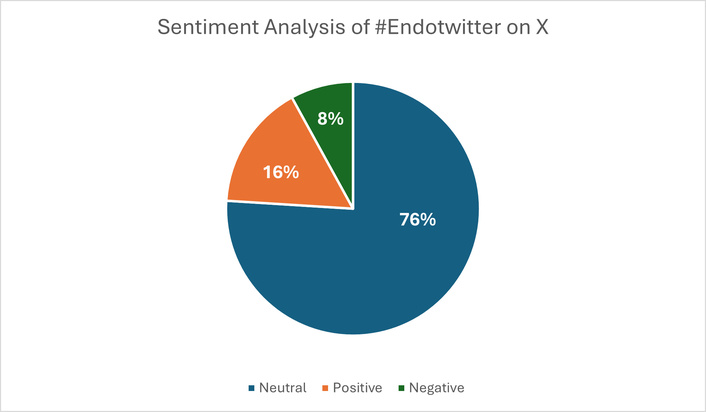
Sentiment analysis was conducted on the pertinent posts disseminated during the study period using the Fedica framework, revealing an average positivity score of 16%, an average negativity score of 8%, and approximately 76% of the posts were classified as neutral in sentiment. The top co-occurring hashtags alongside #EndoTwitter encompass #MedTwitter, #Diabetes, and #NAFLD. Figure 1 illustrates the sentiment analysis of #EndoTwitter on X.
Following an extensive examination of the profiles of the foremost influencers within the #EndoTwitter community, it was determined that among the top ten influencers, six belonged to personal accounts, with an equitable representation of 50% males and 50% females. Notably, all male influencers were identified as medical doctors, while one female influencer identified as a journalist, and the professions of two female influencers were not discernible from their profiles. Additionally, one influencer account was associated with a healthcare organization, and another was identified as a Twitter bot designed to facilitate thread readability for readers. Furthermore, two influencer accounts were affiliated with medical journals located within the United States.
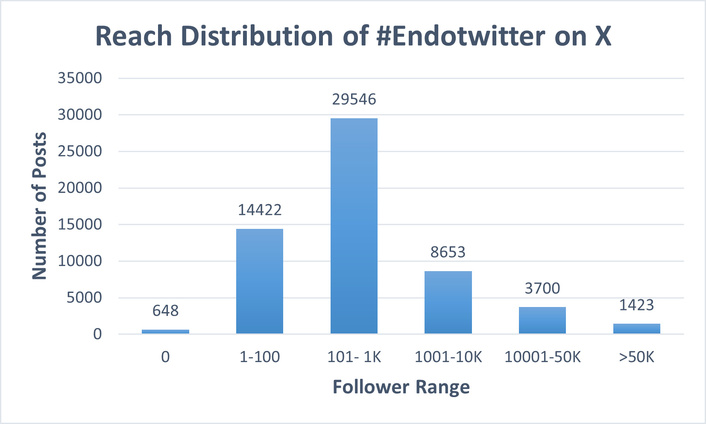
Individuals using #EndoTwitter with zero followers generated 648 posts. Those with fewer than 100 followers collectively generated 14,422 posts, while users with follower counts ranging from 100 to 1,000 contributed a cumulative total of 29,546 posts. Users possessing followers within the range of 1,000 to 10,000 collectively posted 8,653 times. For participants with follower counts spanning from 10,000 to 50,000, the collective count amounted to 3,700 posts. Remarkably, individuals boasting follower counts surpassing 50,000 collectively published approximately 1,423 posts. Figure 2 illustrates the reach distribution of #EndoTwitter on X.
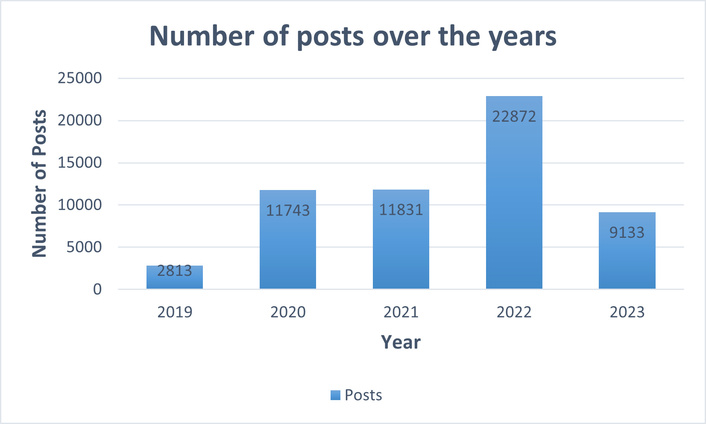
Notably, the analysis revealed an increase in the frequency of the posts containing #EndoTwitter hashtag over the years with a peak in frequency during the year 2022, where the recorded number of posts amounted to 22,872. In the years 2020 and 2021, contributions were closely comparable, yielding post counts of 11,743 and 11,831, respectively. A total of 9,133 posts were documented in 2023, while the least substantial contribution was identified in the inaugural year of 2019, amounting to 2,813 posts. Figure 3 illustrates the activity timeline of #EndoTwitter on X.
The hashtag #EndoTwitter is a widely used communication method on X utilized by users such as patients to communicate regarding their health problems, inquiries, or any advice; by doctors to raise awareness, pursue connections, and involvement in research; by companies for marketing, and by conference managers to connect all conference attendees. In this study, we analyze #EndoTwitter over a 4-year period. The overall use of #EndoTwitter showed 58,392 posts generating more than 46 million impressions globally. Overall, the USA had the greatest number of posts generated, while from the MENA region, Saudi Arabia took the lead. In terms of the sentiments of the posts, most had neutral sentiments. This analysis stands as the first in the literature on #EndoTwitter usage on X.
Our study shows the highest number of posts containing #EndoTwitter originated from the United States followed by India and Mexico, respectively. This was similar to a study that was done to investigate the usage of #GItwitter, which showed that most of the hashtag users were Gastroenterology physicians practicing in the USA, followed by the United Kingdom and Spain [5]. Likewise, another study examining the impact of the #PCOSWeightLoss hashtag on the X platform found that the majority of posts originated from the USA, followed by India [6]. This emphasizes the diversity of endocrine experiences in different countries and the global engagement in health discussions. Access to the Internet could be a reason for the differences in participation and engagement. The 2023 Statista reports showed that USA and India are among the top three countries with the largest number of digital access while Mexico was among the top ten [7], the wide use of X platform among these countries also contribute to the large number of posts obtained as in 2022 X was one of the top social media applications in the USA with 33 million downloads while India and Mexico showed a high number of active users as well same year [8].
The posts containing this hashtag were seen to be distributed by users with different numbers of followers, which indicates the diversity and equity in expressing opinions through X. The highest number of posts was from users with followers between 100–1,000 followers, and this is maybe due to the fact that the average number of followers for general X users is 707 [9]. Similar observations were made for the users of #physiotherapy on X, where a majority of contributors had 100–1,000 followers, indicating broad participation rather than just by high-profile influencers [10]. When it comes to hashtag usage, we saw users with less than 100 followers participating in the hashtag discussion suggesting that irrespective of follower count, the participation in conversations around the hashtag was seen, instead of it being mostly used by influencers. Users with followers between 1,000–10,000 and between 10,000–50,000 contributed 21.2% to the hashtag which highlights the importance of the discussion with #EndoTwitter hashtag as influencers usually lead to a high reach of the discussed topics, a study published in 2024 revealed that the average engagement rate for Nano-Influencers (0–10K) and Micro-Influencers (10K–50K) 16.65% and 8.57% respectively [11]. Furthermore, recent studies showed that marketing by influencers has exceeded the performance of revenue- boosting tools on social media like embedded advertisements, and this aligns with our finding of the influencer’s role of the hashtag presence [12].
The main contributors to the #EndoTwitter hashtag usage were healthcare workers, followed by people who are working in art and culture, education, science and technology, and students. According to Nakagawa et al. [13], 6,399,146 posts on Twitter originated from 39,084 US physician accounts over a 5-year period from 2016 to 2020. During the same period, also, the number of US physicians who are using X has increased by 112.2%, and there has been a 19.7% increase in the number of new accounts created by physicians, which indicates a rising engagement of the medical community in digital communication and further explains the high number of posts containing #EndoTwitter [13]. Physicians from different specialties participated in the hashtag. Furthermore, the Sociocrinology review revealed that X, along with Instagram, is mainly used by reproductive endocrinology and infertility specialists, highlighting the significant role of these platforms in scientific communication within the endocrinology community [14].
In a recent study published in 2024 analyzing the discourse on #GlobalHealth on the X platform during the COVID-19 pandemic, doctors ranked at the top of the stakeholders’ list, comprising 4.2% of the overall classified contributors over a four-year period [15]. This finding aligns with the results of our paper, as physicians—who are licensed as MDs and DOs—play a key role in raising awareness about various health issues. This is particularly relevant since the X platform has become a valuable tool for health communication.
The activity timeline identified in our study demonstrated considerable variation in users’ engagement on X, with the lowest posting activity observed in 2019. Users primarily employed the #EndoTwitter hashtag to disseminate medical knowledge and personal experiences, discuss unique clinical cases, and promote medical conferences. During the COVID-19 pandemic, our analysis showed a modest increase in #EndoTwitter activity in 2020 and 2021; however, this rise was less pronounced than might have been anticipated.
Several contextual factors may explain this pattern. First, although overall social media use increased during the early phases of the pandemic as individuals, particularly young adults, spent more time online due to disrupted routines [16]. This increase did not necessarily translate into higher posting activity within specialized or niche hashtags such as #EndoTwitter. During this period, social media discourse largely shifted toward urgent public health messaging, pandemic-related updates, and broader lifestyle topics rather than specialty-specific medical discussions [17]. As a result, engagement within the endocrine-focused online community may have remained relatively limited as attention was redirected toward pandemic-related content.
Second, the unique demands imposed by the pandemic including lockdowns, increased strain on healthcare systems, cancellation of in-person conferences, and redeployment of clinicians may have reduced the capacity of key contributors to #EndoTwitter, such as healthcare professionals, researchers, and advocates, to maintain their usual level of activity. Thus, despite increased overall social media use, engagement within specialized medical communities may have been temporarily constrained or deprioritized.
The subsequent increase in #EndoTwitter activity, particularly from mid-2022 through April 2023, likely reflects a gradual return to professional normalcy, including the resumption of conferences, in-person networking, and renewed focus on specialty-related discourse. Similar temporal patterns have been observed in other long-term hashtag analyses, in which online engagement declines during periods of global crisis and rebounds as attention shifts back to specialized topics—for example, a six-year analysis of #Longevity demonstrated comparable cycles in engagement [18].
Finally, it is important to note that increased time spent on social media does not inherently result in higher levels of active participation within niche communities. Evidence suggests that while overall social media use rose during pandemic-related lockdowns, the nature of engagement evolved; increased usage was often associated with psychological distress rather than enhanced participation in focused or professional discussions [19]. By late 2023, user interests appeared to shift toward other topics, leading to a decline in #EndoTwitter activity, although posting levels remained higher than those observed in 2019.
The hashtags most commonly associated with #EndoTwitter include #MedTwitter, #Diabetes, and #NAFLD, reflecting the interconnected nature of these topics within the medical and endocrine communities. The #MedTwitter hashtag represents an active network of researchers, healthcare professionals, and students dedicated to advancing medical education and fostering professional connections across various specialties [20]. Its frequent pairing with #EndoTwitter is expected, as both hashtags create spaces for active discussions, with #EndoTwitter focusing specifically on endocrine health. These hashtags are especially valuable for students’ seeking mentorship and professionals aiming to collaborate and exchange knowledge. The connection between #NAFLD and #EndoTwitter lies in the hormonal implications of non-alcoholic fatty liver disease. A 2015 study identified NAFLD as a multisystem disease linked to an increased risk of type 2 diabetes mellitus and other endocrinopathies, such as polycystic ovary syndrome, highlighting its relevance in endocrine discussions [21].
Current clinical guidelines confirm these findings, emphasizing the leading role of endocrinologists and primary care physicians in the early detection of patients with NAFLD, fibrosis risk stratification, and comprehensive therapy, including lifestyle modification, modern pharmacological approaches to weight control, and management of cardiometabolic risk factors [22].
Similarly, #Diabetes frequently appears alongside #EndoTwitter due to the prevalence of diabetes as one of the most common endocrine disorders. According to the American Diabetes Association, 38.4 million Americans, or 11.6% of the population, were diagnosed with diabetes in 2021, underscoring the importance of its discussion within the #EndoTwitter community [23]. Together, these hashtags illustrate the multidisciplinary and collaborative spirit of the #EndoTwitter platform, bringing professionals and learners together to explore interconnected aspects of medical and endocrine health.
The analysis showed that 76% of the posts under the #EndoTwitter hashtag were neutral, indicating their primarily informative nature. Positive sentiment appeared in 16% of the posts, mostly reflecting patient experiences, marketing efforts, and conference-related updates. In contrast, 8% of the posts exhibited negative sentiment, often driven by adverse experiences or disease-related news.
Conversely, the #PsychTwitter study found that 53.9% of the posts carried a positive sentiment, while 46.1% were negative. This aligns with the hashtag’s focus on emotional and mental health topics, which inherently elicit diverse sentiments [1]. Similarly, an analysis of the #MedTwitterAI hashtag identified 230 positive and 172 negative single-word sentiments, with an overall positive engagement toward the use of artificial intelligence in healthcare [1].
#EndoTwitter demonstrates the capacity of digital platforms to extend medical discourse beyond traditional academic venues such as conferences and peer-reviewed journals. Furthermore, research on the use of tweets in broader media contexts illustrates how social media content can be repurposed and amplified beyond the original platform: for example, the embedded tweets in online news coverage were found to be strategically selected based on their relevance, popularity cues, and contextual fit within journalistic narratives, highlighting the potential for specialized content like #EndoTwitter to influence discourse in traditional media environments as well as within the platform itself [24].
The platform enables real-time engagement among clinicians, researchers, and patients, facilitating experience sharing, research highlight dissemination, and rapid communication of clinical updates. Insights from digital health research further highlight the potential of such platforms to enhance patient engagement and knowledge sharing; for instance, a 2023 study demonstrated how eHealth solutions can improve patient experience and participation within healthcare systems, illustrating how technology-driven communication can support both professional and patient-centered outcomes [25]. Such digital communities may accelerate the translation of clinical guidelines into practice, foster international professional collaborations, and enhance patient awareness of chronic endocrine conditions.
The main strength of this study is its four-year duration, providing ample time spectrum to gain valuable insights into the use of the #EndoTwitter hashtag and its evolving patterns. Analyzing this hashtag during significant global events, such as the COVID-19 pandemic and the announcement of new LGBTQ laws in the USA, possibly enhanced its visibility and hence our dataset. Furthermore, studying the hashtag’s global reach highlighted the influence of geographic location on social media discussions and awareness of endocrine issues. Our inclusion of posts in multiple languages, beyond English, expanded the scope of the study. However, several important limitations must be acknowledged. First, our analysis was restricted to posts explicitly containing the #EndoTwitter hashtag, potentially excluding relevant endocrinology discussions that occurred without this specific tag. Second, engagement metrics and sentiment classifications derived from proprietary algorithms may introduce measurement bias of unknown magnitude and direction. Third, the absence of automated filtering for bot or spam accounts may have inflated activity metrics, though manual review of high-impact accounts suggests minimal contamination among influential contributors. Fourth, geographic and professional identification data rely on self-reported information, which may contain inaccuracies or be systematically biased. Finally, as a descriptive study, our findings cannot support causal inferences regarding knowledge dissemination effectiveness, clinical practice impacts, or patient outcomes.
While this analysis provides valuable insights, it does not incorporate data from the post-pandemic period. Future research should include longitudinal analyses to better understand emerging trends and behavioral shifts following the pandemic and the change in Twitter ownership.
Future investigations should extend beyond descriptive characterization to examine the qualitative dimensions of #EndoTwitter content, analyze network structures to identify communities of practice, and evaluate whether hashtag activity correlates with measurable academic or clinical outcomes. Linking social media engagement metrics with traditional impact measures such as citation counts, conference presentation frequencies, or patient education effectiveness would provide stronger evidence of digital platform influence on medical knowledge translation. Emerging techniques from the fields of big data analytics and social media mining provide promising avenues for such work. For example, deep convolutional neural network models and big data–driven topic mining approaches have been effectively used to extract semantic and structural patterns from high-volume social media data, demonstrating the value of advanced machine learning frameworks for sentiment and trend analysis on social platforms [26]. Studies on real-time social media data processing underscore the potential for sophisticated analytical pipelines that incorporate temporal dynamics and predictive modeling, which could be adapted to assess temporal changes in hashtag discourse more robustly [27]. Similarly, frameworks leveraging machine learning for social media feature extraction and pattern recognition suggest methods to automate the classification of post content and improve the interpretation of clinical and patient-centered dialogue within #EndoTwitter [28, 29]. Moreover, interdisciplinary work on social media analytics frameworks, such as those linking hashtag research with social network analysis, provides structured strategies for integrating quantitative and qualitative insights from hashtag-based data [30]. Additionally, comparative analyses across multiple platforms including professional networks like LinkedIn and ResearchGate, as well as emerging alternatives to X will help contextualize how endocrinology discourse is evolving across the broader digital landscape. Such multi-platform studies could inform strategic decisions about resource allocation for digital engagement initiatives and deepen understanding of how specialized hashtags contribute to scientific communication, community building, and knowledge dissemination across professional and patient communities.
This study is the first to analyze #EndoTwitter, highlighting its role in raising awareness regarding endocrinology. #EndoTwitter is a popular platform among X users to share experiences and access relevant support. This analysis highlights the impact of such communities and reinforces the need for improved digital health infrastructure, ensuring access to credible, verified information, since misinformation is a significant concern. At the same time, looking to the future with optimism, the use of #EndoTwitter should provide all community members, doctors, patients, and researchers with reliable and balanced information, supporting evidence-based practice and contributing to progress in endocrinology. In an era where misinformation spreads easily online, fostering a well-informed and active #EndoTwitter community could significantly contribute to global endocrine health awareness and education. Healthcare providers must take an active role in delivering accurate, evidence-based information in engaging and accessible formats in the global endocrinology community on X and other social networking platforms.
We gratefully acknowledge the Global Remote Research Scholars Program (GRRSP) for its valuable contributions to this study, including support in concept development, mentorship, data analysis, and manuscript preparation. We also thank Divya Abraham and Kumar Vashisht for their assistance in reviewing the manuscript. No financial support or paid services were provided by the acknowledged program or individuals.
AAA: Conceptualization, Formal analysis, Methodology, Writing—original draft. HA: Writing—original draft. MA: Writing—review & editing. AGA: Data analysis, Resources, Writing—review & editing. OL: Writing—review & editing. TWT: Writing—review & editing. SMS: Writing—review & editing. AAD: Writing—review & editing. ZA: Supervision, Writing—review & editing. RK: Supervision, Writing—review & editing. FAN: Conceptualization, Supervision, Writing—review & editing. All authors read and approved the final version of the manuscript.
Atanas G. Atanasov is the Editor-in-Chief of Exploration of Digital Health Technologies and an Advisory Board member of QluPod AG, a health-tech company aiming to develop innovative telehealth solutions. He had no involvement in the editorial handling, peer review, or decision-making process for this manuscript. The other authors declare that they have no conflicts of interest.
This study was conducted in accordance with the ethical standards of institutional and national research committees. Since the data were obtained from publicly available posts on X (formerly Twitter), formal approval from an institutional review board (IRB) was not required. This study was conducted in accordance with the principles of the Declaration of Helsinki (2024 revision).
As this study analyzed publicly available social media data, informed consent from individual users was not applicable. No direct interaction with users occurred.
All data used in this study were publicly accessible. No identifiable personal information beyond publicly shared usernames was included. Therefore, consent for publication was not required.
The data that supports the findings of this study are available on reasonable request from the corresponding author.
The authors declare that no financial support was received for this study.
© The Author(s) 2026.
Open Exploration maintains a neutral stance on jurisdictional claims in published institutional affiliations and maps. All opinions expressed in this article are the personal views of the author(s) and do not represent the stance of the editorial team or the publisher.
Copyright: © The Author(s) 2026. This is an Open Access article licensed under a Creative Commons Attribution 4.0 International License (https://creativecommons.org/licenses/by/4.0/), which permits unrestricted use, sharing, adaptation, distribution and reproduction in any medium or format, for any purpose, even commercially, as long as you give appropriate credit to the original author(s) and the source, provide a link to the Creative Commons license, and indicate if changes were made.


View: 2085
Download: 45
Times Cited: 0