 Original Article


Affiliation:
1Department of Radiation Oncology, Icahn School of Medicine at Mount Sinai, New York, NY 10029, United States
Email: steven.lehrer@mssm.edu
ORCID: https://orcid.org/0000-0002-4850-094X


 ,
,
Affiliation:
2Severn Health Solutions, Severna Park, MD 21146, United States
ORCID: https://orcid.org/0000-0002-4608-1665
Explor Dig Dis. 2026;5:1005129 DOI: https://doi.org/10.37349/edd.2026.1005129
Received: March 14, 2026 Accepted: May 19, 2026 Published: July 29, 2026
Academic Editor: Raghu Sinha, Penn State Cancer Institute, United States
The article belongs to the special issue Diagnostic and Prognostic Biomarkers in Pancreatic Cancer
Aim: To evaluate whether estrogen exposure is associated with pancreatic ductal adenocarcinoma (PDAC) risk and to determine whether estrogen signaling influences tumor biology, integrating population-based incidence, pharmacovigilance, and transcriptomic data.
Methods: We conducted a multi-modal analysis using four complementary data sources. Population-based incidence was assessed using Surveillance, Epidemiology, and End Results (SEER) multiple-primary standardized incidence ratio (MP-SIR) methodology among female breast cancer survivors, with latency stratification. Pharmacovigilance disproportionality analysis of estradiol-associated pancreatic cancer reports was performed using OpenVigil access to the Food and Drug Administration Adverse Event Reporting System (FAERS), calculating proportional reporting ratios (PRRs), reporting odds ratios (RORs), and χ2 statistics. A prospective UK Biobank cohort analysis evaluated self-reported ever use of hormone replacement therapy (HRT) and incident registry-confirmed PDAC using a 5-year landmark and multivariable Cox proportional hazards regression. Tumor transcriptomic associations between estrogen receptor 1 (ESR1) signaling and stromal programs were examined in The Cancer Genome Atlas Pancreatic Adenocarcinoma (TCGA-PAAD) using Spearman correlation and nonparametric group comparisons.
Results: In SEER, pancreatic cancer incidence among breast cancer survivors was comparable to the general population (SIR 1.03, 95% CI 1.00–1.07), with no elevation in early or late latency periods. In contrast, pharmacovigilance analysis demonstrated a strong inverse association between estradiol exposure and pancreatic cancer reporting (PRR and ROR 0.095; χ2 = 76.674). In the UK Biobank, 265,572 women contributed 705 incident PDAC events after the 5-year landmark. Ever use of HRT was not significantly associated with PDAC after adjustment for age, body mass index, smoking status, type 2 diabetes, and socioeconomic deprivation (HR 1.16, 95% CI 0.99–1.36; p = 0.059). TCGA analyses revealed a significant positive association between ESR1 expression and inflammatory, tumor-restraining cancer-associated fibroblast programs (p < 1 × 10⁻⁶).
Conclusions: Estrogen exposure was not associated with a statistically significant reduction in PDAC incidence. Pharmacovigilance and transcriptomic findings support a possible tumor-modifying role for estrogen signaling, whereas the UK Biobank results do not demonstrate a protective association between broadly defined HRT use and PDAC incidence.
Pancreatic ductal adenocarcinoma (PDAC) remains one of the most lethal solid malignancies, with a 5-year survival rate below 12% despite advances in systemic therapy and perioperative management. The poor prognosis of PDAC reflects late-stage diagnosis, early metastatic spread, and intrinsic resistance to most available treatments. We are in dire need of a pancreatic cancer diagnosis at an early stage [1–3].
Increasingly, however, PDAC is recognized as a disease in which tumor behavior is shaped not only by cancer-cell–intrinsic genetic alterations but also by extensive interactions with the surrounding tumor microenvironment [4].
A defining feature of PDAC is its dense desmoplastic stroma, which may constitute most of the tumor mass. Cancer-associated fibroblasts (CAFs), the dominant stromal cell population, exist in heterogeneous functional states with divergent effects on tumor biology. While myofibroblastic CAFs promote extracellular matrix deposition, immune exclusion, and invasion, inflammatory CAF subsets have been associated with tumor restraint and improved prognosis. These observations have shifted therapeutic thinking away from indiscriminate stromal ablation toward selective stromal reprogramming as a more biologically informed strategy.
Sex differences in PDAC incidence and outcome have long been noted, with women exhibiting modestly lower incidence rates and, in some studies, improved survival compared with men [5]. These patterns have prompted interest in hormonal influences, particularly estrogen signaling, as potential modifiers of pancreatic cancer risk and progression [6]. Epidemiologic studies examining reproductive factors, hormone replacement therapy (HRT), or breast cancer history in relation to pancreatic cancer have produced inconsistent findings, often limited by small sample sizes, short follow-up, incomplete exposure ascertainment, and confounding by survivorship or surveillance bias [7].
Recent mechanistic work has substantially clarified the biological plausibility of estrogenic effects in PDAC. Manoukian and colleagues demonstrated that pancreatic tumors can synthesize estrogen de novo and that estrogen signaling actively reprograms CAF populations toward a tumor-restraining inflammatory phenotype characterized by osteoglycin and CLEC3B expression [8]. This estrogen-driven stromal state favors the classical PDAC molecular subtype, which is associated with less aggressive behavior and improved prognosis. An accompanying AACR commentary highlighted this estrogen–stroma axis as a paradigm-shifting mechanism in pancreatic cancer biology [9]. Importantly, these effects appear to operate independently of systemic circulating estrogen levels, suggesting that local hormonal signaling within the tumor microenvironment may be more relevant than traditional endocrine exposures.
Against this evolving biologic framework, the epidemiologic implications of estrogen exposure for pancreatic cancer risk remain uncertain. Historical reports suggesting increased pancreatic cancer incidence among breast cancer survivors raise the possibility of confounding by surveillance or small-sample effects rather than true causal associations. At the same time, pharmacovigilance data provide an opportunity to examine real-world drug safety signals related to estrogen exposure at scale.
To address these questions, we integrated three complementary lines of evidence: (i) a population-based multiple-primary standardized incidence ratio (MP-SIR) analysis using Surveillance, Epidemiology, and End Results (SEER) data to evaluate pancreatic cancer incidence among female breast cancer survivors; (ii) pharmacovigilance disproportionality analysis of estradiol-associated pancreatic cancer reports using OpenVigil and Food and Drug Administration Adverse Event Reporting System (FAERS) [10–13]; and (iii) interpretation of these findings in the context of emerging mechanistic data on estrogen-mediated stromal regulation in PDAC [8, 9]. By triangulating across incidence, drug safety surveillance, and tumor biology, we sought to clarify whether estrogen signaling plausibly increases, decreases, or has no meaningful effect on pancreatic cancer risk.
The primary hypothesis of this study is that estrogen exposure does not increase PDAC incidence and may instead influence tumor biology through stromal mechanisms.
Using the SEER program, FAERS, UK Biobank, and The Cancer Genome Atlas (TCGA), we conducted an integrated analysis combining population-based cancer incidence, pharmacovigilance disproportionality assessment, and biologic contextualization to evaluate the relationship between estrogen exposure and pancreatic cancer risk. The analytic strategy was designed to distinguish survivor-status effects from exposure-specific signals and to interpret epidemiologic findings within an emerging mechanistic framework of estrogen-mediated stromal regulation in PDAC. Given the fundamentally different data-generating processes across SEER, FAERS, UK Biobank, and TCGA, a formal meta-analytic framework was not appropriate. Instead, we adopted a triangulation approach, emphasizing directional consistency and biological coherence across independent data modalities.
Population-based incidence analyses were performed using SEER Research Plus Data (8 Registries, November 2024 submission), covering diagnoses from 1975 through 2022. Female patients diagnosed with invasive breast cancer (ICD-O-3 primary site C50.0–C50.9) were identified as the index cancer cohort. Pancreatic cancer (ICD-O-3 pancreas) was specified as the outcome of interest.
MP-SIRs were calculated using SEER*Stat MP-SIR methodology, which compares observed numbers of subsequent cancers in a defined survivor cohort with expected numbers derived from general population incidence rates matched on age, calendar year, and SEER registry [14]. Follow-up time accrued beginning 12 months after breast cancer diagnosis to minimize synchronous detection and surveillance bias. Person-time was accumulated until pancreatic cancer diagnosis, death, loss to follow-up, or end of the study period.
Expected counts were computed using age-, calendar year-, and registry-specific pancreatic cancer incidence rates in the underlying SEER population. Standardized incidence ratios (SIRs) were calculated as the ratio of observed to expected events (O/E), and exact 95% confidence intervals (CIs) were derived assuming a Poisson distribution of observed cases. Excess absolute risk (EAR) was calculated as the difference between observed and expected cases per 10,000 person-years.
Latency-stratified analyses were prespecified to examine pancreatic cancer incidence 12–59 months and ≥ 60 months following breast cancer diagnosis. These analyses were conducted to assess potential early detection effects related to medical surveillance and to evaluate delayed biologic associations. Pancreatic carcinogenesis may involve long induction periods; however, the ≥ 60-month latency stratum was selected to capture delayed effects while maintaining sufficient statistical power. Longer latency analyses were limited by follow-up structure within SEER.
Breast cancer survivorship was used as a population-level negative control rather than a direct proxy for estrogen exposure. We acknowledge that SEER lacks detailed hormone therapy and menopausal data, and therefore this analysis does not directly quantify estrogen exposure.
Drug safety signal analysis was conducted using OpenVigil 2.1, an open-access pharmacovigilance platform providing curated access to the U.S. FAERS database [10–13]. Reports listing estradiol as a suspect or interacting drug were queried, and pancreatic cancer adverse events were identified using MedDRA-coded preferred terms.
Disproportionality analyses were performed using standard pharmacovigilance methods implemented within the OpenVigil interface to the FAERS database [10–13]. Measures included the proportional reporting ratio (PRR), reporting odds ratio (ROR), relative reporting ratio (RRR), and χ2 statistics with Yates’ correction [15]. CIs were calculated using standard logarithmic methods. Signal detection criteria followed established pharmacovigilance conventions, including thresholds for minimum case counts, χ2 statistics, and PRR magnitude (Table 1).
Contingency table structure for disproportionality analysis.
| Drug exposure | Pancreatic cancer | Other events |
|---|---|---|
| Estradiol | a | b |
| Other drugs | c | d |
FAERS-based disproportionality analyses are subject to reporting bias, under-reporting, and lack of exposure denominators; therefore, inverse signals cannot be interpreted as causal or protective and are considered hypothesis-generating only. The magnitude and direction of the signal were interpreted only in the context of concordant findings from independent epidemiologic and mechanistic data.
Epidemiologic and pharmacovigilance findings were interpreted in the context of recent experimental and transcriptomic studies demonstrating intratumoral estrogen synthesis, estrogen-driven CAF reprogramming, and associations with favorable stromal composition and classical PDAC molecular subtype [8]. This integrative approach was used to assess biologic plausibility and coherence across data sources.
We conducted a prospective cohort analysis within the UK Biobank to evaluate the association between HRT and incident PDAC. UK Biobank enrolled approximately 500,000 participants aged 40–69 years between 2006 and 2010, with linkage to national cancer registries and mortality records.
Analyses were restricted to women with complete baseline data and no history of pancreatic cancer at enrollment. Incident PDAC was defined using cancer registry diagnosis codes restricted to ICD-10 C25, with diagnosis dates obtained from registry linkage. Follow-up accrued from baseline assessment until PDAC diagnosis, death, loss to follow-up, or administrative censoring.
HRT exposure was defined using self-reported ever use of HRT at baseline (UKB field 2814), with supplementary characterization of age at initiation and cessation (fields 3536 and 3546). To reduce reverse causation, landmark analyses excluding PDAC diagnoses within the first five years of follow-up were performed.
Follow-up was calculated from the date of baseline assessment to the earliest of incident PDAC diagnosis, death, or administrative censoring. Participants with PDAC diagnosed on or before baseline were excluded. To reduce reverse causation, a 5-year landmark analysis was applied; only women who remained alive, under observation, and free of PDAC five years after enrollment were included.
The primary analysis used Cox proportional hazards regression with time since the 5-year landmark as the time scale. The model adjusted for age at enrollment, body mass index, baseline smoking status, type 2 diabetes, and Townsend deprivation index. Baseline smoking status was classified as never, former, or current smoking using UK Biobank field 20116. Type 2 diabetes was defined from a participant-level case list, with participants absent from the case list classified as not having type 2 diabetes. Missing covariate values were handled by complete-case analysis.
As a sensitivity analysis, HRT users were matched 1:1 to non-users on age at enrollment using nearest-neighbor Mahalanobis matching without replacement and a ± 1-year caliper. Hazard ratios (HRs) in the matched cohort were estimated using Cox proportional hazards models stratified by matched pair. The proportional hazards assumption was evaluated using Schoenfeld residuals.
All SEER analyses were conducted using SEER*Stat software (9.0.43.0). Pharmacovigilance analyses were conducted using OpenVigil 2.1 outputs. Statistical significance was assessed at a two-sided α level of 0.05. Given the large sample size in SEER analyses, emphasis was placed on effect size and clinical relevance rather than nominal statistical significance alone.
TCGA analyses are correlational and do not establish causality. These results are presented solely as biologic context supporting plausibility rather than causal inference. All tests were two-sided with α = 0.05. CIs were reported for all primary estimates.
For the left panel of the figure, the association between continuous estrogen receptor 1 (ESR1) expression and inflammatory CAF (iCAF) scores was evaluated using Spearman rank correlation analysis, chosen because gene expression variables were non-normally distributed and not assumed to have linear relationships. For the right panel of the figure, tumors were stratified into tertiles according to ESR1 expression, and differences in iCAF scores across tertiles were assessed using the Kruskal–Wallis test, a nonparametric alternative to one-way ANOVA appropriate for heteroscedastic transcriptomic data. All statistical tests were two-sided, with p < 0.05 considered statistically significant. Analyses were performed in R statistical software (version 4.5.0; R Foundation for Statistical Computing, Vienna, Austria).
A population-based cohort design was implemented using SEER data, applying the MP-SIR framework.
The SIR was calculated as:
where: O = observed pancreatic cancer cases in breast cancer survivors; E = expected cases based on general population rates.
Expected counts were derived by indirect standardization, stratified by:
Age
Calendar year
SEER registry
Person-time accumulation:
Began 12 months after breast cancer diagnosis (latency exclusion)
Ended at pancreatic cancer diagnosis, death, loss to follow-up, or study end
95% CIs for SIRs were computed assuming a Poisson distribution of observed counts
EAR: Calculated as (O – E) per 10,000 person-years
Latency-specific SIRs:
12–59 months
≥ 60 months
Rare event approximation → Poisson valid
External rates (general population) represent counterfactual risk
A disproportionality (case–noncase) design using spontaneous reporting data: contingency table structure.
PRR
ROR
RRR: equivalent interpretation to PRR in this context.
Chi-square test: χ2 with Yates’ correction applied for continuity adjustment.
CIs: calculated on the log scale:
Based on standard pharmacovigilance thresholds:
PRR ≥ 2
χ2 ≥ 4
Minimum case counts
In this study, an inverse signal was observed instead.
No denominator → cannot estimate incidence
Bias addressed through:
Comparative disproportionality framework
Interpretation restricted to signal detection
The primary UK Biobank estimate was obtained from a multivariable Cox proportional hazards model adjusting for age at enrollment, body mass index, smoking status, type 2 diabetes, and Townsend deprivation index. HRT exposure was coded as ever versus never use. Results are reported as HRs with 95% CIs and two-sided p values. The age-matched Cox model was treated as a sensitivity analysis because matching only on age does not address confounding by established PDAC risk factors.
A prospective cohort analysis was conducted among women free of PDAC at enrollment. A 5-year landmark was used to exclude early events and reduce reverse causation.
The primary analysis used multivariable Cox proportional hazards regression. Follow-up began at the 5-year landmark and ended at incident PDAC diagnosis, death, or administrative censoring. The exposure was self-reported ever use of HRT. Covariates included age, body mass index, smoking status, type 2 diabetes, and Townsend deprivation index. A 1:1 age-matched, matched-pair-stratified Cox model was conducted as a sensitivity analysis. Proportional hazards assumptions were assessed using Schoenfeld residuals.
Survival analysis: Kaplan–Meier estimator used to compute PDAC-free survival curves.
Cox proportional hazards model:
Stratified by matched pairs
Exposure variable: HRT use (binary)
HR: Estimated as:
Model features:
Stratified Cox model → accounts for matching
Landmark analysis (5 years): excludes early events → reduces reverse causation
Assumption testing (proportional hazards assumption): evaluated using Schoenfeld residuals.
Missing data: addressed using complete-case analysis.
Predictor: ESR1 expression (continuous)
Outcome: iCAF score (mean of IL6 and CXCL12 expression)
Spearman rank correlation coefficient (ρ) used: ρ = rank–based correlation
Chosen because:
No assumption of linearity
Robust to non-normal distributions
Hypothesis tested:
Tumors stratified into tertiles of ESR1 expression
Kruskal–Wallis test used:
H = Kruskal–Wallis test statistic, k = number of independent groups being compared, Ri = sum of the ranks for the observations in the i-th group after all observations from all groups have been ranked together, ni = sample size (number of observations) in the i-th group, N = total sample size across all groups.
Nonparametric equivalent of ANOVA
Gene expression data:
Typically non-normal
Heteroscedastic
Global p-value (reported as extremely significant, p < 1 × 10⁻⁶)
Two-sided α = 0.05
Large datasets → focus on:
Effect sizes
CIs
Biological plausibility
Due to:
Heterogeneous data sources
Different estimands (incidence vs. reporting vs. expression)
Triangulation approach:
Consistency across:
Epidemiology (SEER, UKBB)
Pharmacovigilance (FAERS)
Biology (TCGA)
Across the study period, 2,793 pancreatic cancers were observed among female breast cancer survivors in the SEER registries. The overall SIR for pancreatic cancer was 1.03 (95% CI 1.00–1.07), corresponding to an EAR of 0.15 cases per 10,000 person-years (Table 2). This finding indicates that pancreatic cancer incidence among breast cancer survivors was essentially equivalent to that of the general population.
Standardized incidence ratios (SIRs) for pancreatic cancer following breast cancer diagnosis in SEER (1975–2022).
| Latency after breast cancer | Observed cases | SIR (O/E) | 95% CI | Excess risk* |
|---|---|---|---|---|
| 12–59 months | 646 | 1 | ~0.92–1.08† | ~0.00 |
| ≥ 60 months | 2,147 | 1.04 | ~0.99–1.09† | ~0.18 |
| Overall | 2,793 | 1.03 | 1.00–1.07 | 0.15 |
Pancreatic cancer incidence was evaluated using SEER multiple-primary standardized incidence ratio (MP-SIR) methodology with a 12-month latency exclusion to minimize synchronous detection and surveillance bias. Expected counts were derived from age, calendar year, and registry-specific population rates. *: Excess risk per 10,000 person-years; † :exact CIs available from SEER output; shown approximately here for layout consistency.
Latency-stratified analyses demonstrated no elevation in PDAC incidence in the early post-diagnosis period. Between 12 and 59 months following breast cancer diagnosis, the SIR was 1.00, indicating complete concordance with population expectations. In the later follow-up interval (≥ 60 months), the SIR was 1.04, with CIs overlapping unity (Table 2). The absence of both early and late excess risk argues against surveillance bias and against a delayed survivor-status-driven carcinogenic effect.
In contrast to the null population-based incidence findings, pharmacovigilance analysis revealed a marked inverse association between estradiol exposure and pancreatic cancer reporting. Among FAERS reports queried via OpenVigil, pancreatic cancer events were substantially under-represented in estradiol-associated reports compared with all other drugs.
The PRR and ROR were both 0.095, with 95% CIs of 0.049–0.183, and the χ2 statistic with Yates’ correction was 76.7 (Table 3). These values fall well below established thresholds for safety signal detection and instead indicate a strong inverse disproportionality signal. The Rate (DE/D) of pancreatic cancer among estradiol users was approximately 0.016%, further underscoring the absence of an adverse reporting pattern.
Pharmacovigilance data from the FDA Adverse Event Reporting System.
| Adverse event | Estradiol | All other drugs | ∑ |
|---|---|---|---|
| Pancreatic cancer (DE) | 9 | 23,909 | 23,918 |
| All other adverse events | 55,592 | 14,025,233 | 14,080,825 |
| ∑ (D) | 55,601 | 14,049,142 | 14,104,743 |
Rate (DE/D): 0.016%. Chi-squared with Yates’ correction: 76.674. Relative reporting ratio (RRR) and 95% confidence interval (lower bound–upper bound): 0.095 (0.05–0.183); proportional reporting ratio (PRR) and 95% confidence interval (lower bound–upper bound): 0.095 (0.049–0.183); reporting odds ratio (ROR) and 95% confidence interval (lower bound–upper bound): 0.095 (0.049–0.183).
The epidemiologic and pharmacovigilance findings were concordant with emerging mechanistic data demonstrating estrogen-driven reprogramming of the PDAC tumor microenvironment. Recent experimental studies have shown that estrogen signaling promotes inflammatory CAF subsets expressing osteoglycin and CLEC3B, suppresses myofibroblastic activation, and favors the classical PDAC molecular subtype associated with reduced aggressiveness and improved outcomes [8, 9].
The observation that pancreatic tumor cells can synthesize estrogen locally provides a mechanistic basis for context-specific estrogenic effects that may not be captured by systemic hormone exposure alone [8].
In the UK Biobank cohort, age-matched analyses of women with at least five years of follow-up demonstrated no excess risk of incident PDAC among ever users of HRT compared with never users (Table 4). Kaplan–Meier curves for PDAC-free survival (not shown) were largely overlapping between exposure groups after application of a five-year landmark, and stratified Cox models did not identify a statistically significant increase in hazard associated with HRT use.
UK Biobank prospective analysis of HRT use and incident PDAC.
| Analysis | Participants, n | PDAC events, n | HR ever vs. never HRT | 95% CI | p value |
|---|---|---|---|---|---|
| Primary multivariable Cox model | 265,572 | 705 | 1.16 | 0.99–1.36 | 0.059 |
| Age-matched sensitivity analysis | 183,490 | 590 | 1.19 | 1.01–1.41 | 0.038 |
The primary model adjusted for age at enrollment, body mass index, smoking status, type 2 diabetes, and Townsend deprivation index. Follow-up began at the 5-year landmark and continued until incident registry-confirmed PDAC, death, or administrative censoring. The sensitivity analysis included 91,745 matched participants in each exposure group and used Cox proportional hazards regression stratified by matched pair. HR: hazard ratio; HRT: hormone replacement therapy; PDAC: pancreatic ductal adenocarcinoma.
The 5-year landmark cohort included 268,012 women, among whom 710 incident PDAC events occurred. The primary multivariable Cox model included 265,572 women and 705 PDAC events after exclusion of participants with missing covariate data. Ever use of HRT was not significantly associated with incident PDAC after adjustment for age, body mass index, smoking status, type 2 diabetes, and Townsend deprivation index (HR 1.16, 95% CI 0.99–1.36; p = 0.059; Table 4).
Established PDAC risk factors showed the expected associations. Current smoking was associated with approximately twice the hazard of PDAC compared with never smoking (HR 2.03, 95% CI 1.62–2.54; p < 0.001), and type 2 diabetes was associated with a 2.63-fold higher hazard (95% CI 2.07–3.34; p < 0.001). Age was also strongly associated with PDAC incidence (HR per year 1.08, 95% CI 1.07–1.10; p < 0.001).
In the age-matched sensitivity analysis, 91,745 HRT users were matched to 91,745 non-users. There were 323 PDAC events among HRT users and 267 among non-users. The matched-pair-stratified Cox model yielded an HR of 1.19 (95% CI 1.01–1.41; p = 0.038). The attenuation and loss of conventional statistical significance in the fully adjusted model indicate that adjustment for established PDAC risk factors materially influenced the estimated association.
Analysis of TCGA PDAC tumors demonstrated a strong association between ESR signaling and inflammatory, tumor-restraining stromal programs. Across TCGA Pancreatic Adenocarcinoma (TCGA-PAAD) samples, ESR1 expression correlated positively with an iCAF transcriptional score derived from IL6 and CXCL12 expression (Figure 1). When tumors were stratified by ESR1 expression tertiles, iCAF scores increased monotonically across tertiles, with significantly higher iCAF activity observed in ESR1-high tumors compared with ESR1-low tumors (Kruskal–Wallis p < 1 × 10⁻⁶). In contrast, ESR1 showed no strong positive association with canonical myofibroblastic CAF markers (ACTA2, TAGLN, COL1A1), which are instead linked to fibrotic and tumor-promoting stromal states (data not shown).
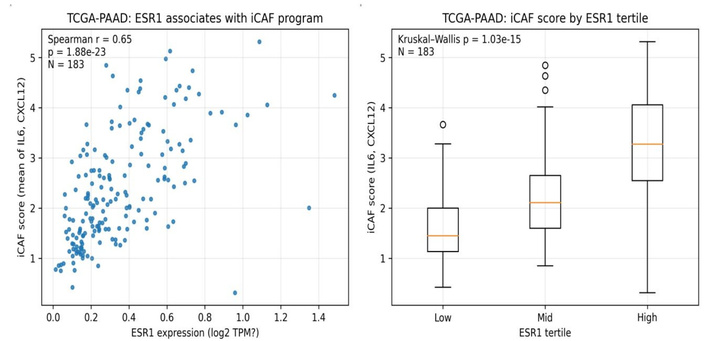
Estrogen receptor (ESR) signaling is associated with tumor-restraining inflammatory stromal programs in TCGA pancreatic ductal adenocarcinoma. (Left) Scatter plot showing the association between ESR1 expression and an inflammatory cancer-associated fibroblast (iCAF) transcriptional score, defined as the mean expression of IL6 and CXCL12, in The Cancer Genome Atlas Pancreatic Adenocarcinoma (TCGA-PAAD) tumors. Correlation was assessed using Spearman rank correlation; each point represents an individual tumor sample. (Right) Boxplot of iCAF scores across ESR1 expression tertiles (low, intermediate, high). Tumors with high ESR1 expression exhibit significantly higher iCAF scores compared with ESR1-low tumors (Kruskal–Wallis test). These transcriptomic associations support a model in which ESR signaling is linked to inflammatory, tumor-restraining stromal states in human pancreatic cancer, consistent with experimental evidence of estrogen-mediated fibroblast reprogramming.
Together, these TCGA transcriptomic findings support a model in which ESR signaling in human pancreatic cancer is associated with inflammatory, tumor-restraining stromal programs rather than contractile myofibroblastic phenotypes, consistent with experimental evidence of estrogen-mediated fibroblast reprogramming.
Taken together, these results demonstrate that pancreatic cancer incidence is not increased among breast cancer survivors at the population level, while real-world pharmacovigilance data reveal a strong inverse estradiol–pancreatic cancer signal. The convergence of these epidemiologic findings with mechanistic evidence supports a model in which estrogen signaling modulates pancreatic tumor behavior through stromal reprogramming rather than increasing cancer risk [8].
In this integrated analysis, SEER data showed no clinically meaningful excess of pancreatic cancer among breast cancer survivors, whereas FAERS demonstrated a strong inverse reporting signal for estradiol. In the UK Biobank, broadly defined ever use of HRT was not significantly associated with incident PDAC in the primary multivariable model, although the point estimate was greater than unity and an age-matched sensitivity analysis produced a modest statistically significant association. TCGA findings linked ESR1 expression to inflammatory CAF programs. These findings indicate that systemic HRT exposure, estradiol pharmacovigilance signals, and intratumoral estrogen-related biology should not be treated as equivalent exposures or estimands.
Using population-based SEER MP-SIR methodology with appropriate latency exclusions, pancreatic cancer incidence among female breast cancer survivors was essentially identical to that of the general population, both overall and when stratified by time since diagnosis. These findings differ from earlier institutional reports suggesting increased pancreatic cancer incidence in selected breast cancer subgroups, which were limited by small sample sizes and lack of population-based denominators or longitudinal follow-up adjustment [16]. However, our results do not establish a therapeutic or preventive role for estradiol.
Importantly, latency-stratified analyses demonstrated no excess risk in either the early post-diagnosis period—where heightened medical surveillance might be expected to inflate incidence estimates—or in later follow-up intervals, where a biologically mediated effect would be more likely to emerge. The absence of both early and late excess risk argues strongly against surveillance bias and against survivor-status–driven carcinogenic effects. Taken together, these results establish breast cancer survivorship as a valid negative control for evaluating hormone-related pancreatic cancer hypotheses.
A salient implication of the SEER MP-SIR analysis is that breast cancer survivorship—despite heterogeneous endocrine histories and frequent exposure to estrogen-suppressive therapies—does not confer a clinically meaningful increase in incident PDAC risk at the population level. In our data, PDAC incidence was essentially identical to general population expectations overall and in latency-stratified analyses, arguing against substantial surveillance inflation and against a delayed survivor-status carcinogenic effect. However, these null incidence findings should not be over-interpreted as evidence against estrogen’s biologic relevance in PDAC. Rather, they underscore that systemic endocrine exposure proxies (including cancer history) may be poorly aligned with the tumor-local estrogen–stroma axis described in recent mechanistic work, and that estrogen signaling may operate predominantly as a tumor-modifying pathway influencing stromal state and aggressiveness rather than tumor initiation.
In contrast to the null survivor-based incidence findings, pharmacovigilance analysis revealed a striking under-representation of pancreatic cancer reports among estradiol users. The magnitude of the disproportionality signal—PRR and ROR approximately 0.1 with CIs well below unity—does not suggest a safety concern and instead aligns with a potential protective association. While spontaneous reporting systems such as FAERS are inherently suggestive rather than causal, inverse signals of this strength are uncommon and warrant attention, particularly when they are biologically plausible and directionally consistent with experimental data.
Our integrated results highlight a conceptual distinction between PDAC initiation (incidence) and PDAC evolution/clinical aggressiveness. Population-based cohorts (SEER, UK Biobank) primarily capture incidence and therefore may be comparatively insensitive to tumor-modifying effects that do not alter the probability of tumor initiation. By contrast, pharmacovigilance systems are enriched for severe and clinically salient outcomes and may therefore be more sensitive to factors that affect tumor behavior, progression, or clinical detectability. Consistent with this, we observe a striking inverse disproportionality signal for estradiol in FAERS, while SEER and UK Biobank show no evidence of increased PDAC incidence with breast cancer survivorship or HRT exposure, respectively.
The strong inverse estradiol signal observed in pharmacovigilance data contrasts with the null association between HRT and pancreatic cancer incidence observed in population-based cohorts. This divergence likely reflects fundamental differences in what these data sources capture. Pharmacovigilance systems are enriched for severe and clinically salient outcomes and are therefore sensitive to drug effects on tumor aggressiveness, progression, and clinical presentation. In contrast, prospective cohorts primarily assess disease incidence and are comparatively insensitive to tumor-modifying effects that do not alter initiation risk. Consistent with experimental evidence demonstrating estrogen-mediated reprogramming of CAFs toward tumor-restraining states, these findings support a model in which estradiol modifies pancreatic cancer biology rather than preventing tumor initiation.
The UK Biobank and FAERS analyses yielded different patterns. FAERS evaluated disproportional reporting associated specifically with estradiol, whereas the UK Biobank exposure was self-reported ever use of HRT, which combines estrogen-only therapy, estrogen–progestogen combinations, different formulations, varying durations, and remote as well as recent use. Consequently, UK Biobank field 2814 is an imprecise proxy for estradiol exposure.
In the primary UK Biobank model, the HR for ever HRT use was 1.16, with a 95% CI spanning unity. This result neither demonstrates a protective association nor provides definitive evidence of increased incidence. The age-matched sensitivity estimate was modestly elevated, but matching only on age left greater potential for confounding. Adjustment for smoking, diabetes, obesity, age, and deprivation attenuated the estimate and increased the p value above 0.05.
The inverse FAERS signal therefore should not be interpreted as replicated by the UK Biobank. Spontaneous reporting analyses estimate drug–event disproportionality rather than incidence and are vulnerable to reporting patterns, drug indication, treatment duration, and the absence of exposure denominators. The inverse estradiol signal remains hypothesis-generating and may reflect differences in exposure specificity, reporting, clinical severity, or tumor behavior rather than prevention of tumor initiation.
The TCGA and experimental findings provide biologic plausibility for an association between ESR signaling and stromal state, but they do not establish that systemic estradiol or HRT reduces PDAC incidence. Intratumoral estrogen synthesis and local receptor signaling may differ substantially from self-reported systemic HRT exposure. The present findings therefore support further investigation of estrogen-related tumor biology but do not justify clinical use of estradiol for PDAC prevention.
Taken together, SEER data showed no meaningful excess of pancreatic cancer following breast cancer, FAERS showed a strong inverse reporting signal for estradiol, and TCGA demonstrated an association between ESR1 expression and inflammatory CAF programs. The UK Biobank analysis did not demonstrate a statistically significant protective association between ever use of HRT and incident PDAC after multivariable adjustment. These data support biologic investigation of estrogen signaling in PDAC but do not establish that systemic estrogen exposure reduces PDAC incidence.
Within this context, estradiol exposure, whether endogenous or exogenous, may not act as a classical carcinogenic driver but instead modulate tumor ecology in a manner that constrains aggressiveness or delays clinical emergence. This model helps explain why population-level incidence is not increased among breast cancer survivors, why pharmacovigilance signals suggest protection rather than harm, and why estrogenic effects may be difficult to detect using traditional epidemiologic designs that do not capture microenvironmental state.
Whether estrogen reduces PDAC incidence, in addition to restraining aggressiveness, remains uncertain. In our study, neither SEER survivorship analyses nor UK Biobank HRT analyses provide evidence for an incidence-increasing effect, but they also do not establish an incidence-reducing effect, particularly given limited event counts after latency exclusion in the UK Biobank landmarked cohort. We therefore interpret the strongest convergent signal in our data as supporting tumor-modifying (microenvironmental) effects of estrogen signaling, while explicitly noting that an incidence-lowering role remains an open question.
The demonstration that PDAC cells can synthesize estrogen de novo [8] provides a mechanistic framework that may reconcile null systemic exposure–incidence associations with measurable differences in tumor biology. Local estrogen production could create a paracrine niche that shapes fibroblast state and stromal composition independent of circulating hormone levels, consistent with transcriptomic evidence in TCGA-PAAD linking ESR1 expression to inflammatory CAF programs (IL6/CXCL12) rather than myofibroblastic markers. At present, it remains unresolved whether intratumoral estrogen synthesis is uniformly tumor-suppressive, compensatory, or context-dependent across molecular subtypes and treatment states; clarifying this will require studies that jointly measure intratumoral estrogen synthesis capacity, stromal state transitions, and clinical endpoints.
Our findings have important implications. First, they caution against interpreting associations between breast cancer history, hormone exposure, and pancreatic cancer risk without rigorous population-based controls and latency analyses. Second, they suggest that estrogenic signaling pathways, long considered peripheral in PDAC, may represent underappreciated modifiers of tumor behavior rather than initiators of disease. Third, they support renewed investigation into stromal reprogramming strategies that mimic or enhance estrogen-mediated tumor restraint, potentially offering therapeutic avenues distinct from direct cytotoxic targeting.
SEER lacks individual-level hormone exposure data; therefore, breast cancer survivorship functions as a population-level comparison rather than a direct measure of estrogen exposure. FAERS lacks exposure denominators and is subject to under-reporting, stimulated reporting, confounding by indication, and differential reporting across drugs and outcomes. An inverse disproportionality signal cannot establish reduced incidence or causality.
In the UK Biobank, HRT exposure was defined as self-reported ever use and did not distinguish estradiol from conjugated estrogens, combined estrogen–progestogen therapy, route of administration, dose, duration, or recency. Residual confounding by reproductive history, hysterectomy or oophorectomy, pancreatitis, alcohol consumption, medication use, and other factors remains possible. Alcohol was not included in the primary model because the available field was collected in a selected questionnaire subset and had extensive missingness. TCGA analyses were cross-sectional and correlational and cannot establish that ESR1 signaling causes CAF reprogramming or improved clinical outcomes.
Across complementary data sources, breast cancer survivorship was not associated with a clinically meaningful excess of pancreatic cancer, and estradiol showed a strong inverse reporting signal in FAERS. However, ever use of HRT was not associated with a statistically significant reduction in incident PDAC in the fully adjusted UK Biobank analysis. TCGA findings linked ESR1 expression to inflammatory CAF programs, supporting continued investigation of estrogen-related stromal biology. Collectively, these findings suggest a potential tumor-modifying role for estrogen signaling but do not establish that systemic estradiol or HRT prevents pancreatic cancer.
CAFs: cancer-associated fibroblasts
CIs: confidence intervals
EAR: excess absolute risk
ESR1: estrogen receptor 1
FAERS: Food and Drug Administration Adverse Event Reporting System
HRs: hazard ratios
HRT: hormone replacement therapy
iCAF: inflammatory cancer-associated fibroblast
MP-SIR: multiple-primary standardized incidence ratio
PDAC: pancreatic ductal adenocarcinoma
PRR: proportional reporting ratio
ROR: reporting odds ratio
RRR: relative reporting ratio
SEER: Surveillance, Epidemiology, and End Results
SIRs: standardized incidence ratios
TCGA: The Cancer Genome Atlas
TCGA-PAAD: The Cancer Genome Atlas Pancreatic Adenocarcinoma
SL: Conceptualization, Methodology, Formal analysis, Data curation, Investigation, Visualization, Writing—original draft, Writing—review & editing. PHR: Conceptualization, Methodology, Data curation, Writing—review & editing. All authors read and approved the final manuscript and agree to be accountable for all aspects of the work.
The authors declare that they have no competing interests.
This study analyzed de-identified, publicly available secondary data and did not involve interaction with human participants or access to identifiable private information. The use of SEER Research Data is governed by the National Cancer Institute Data-Use Agreement, and FAERS data accessed via OpenVigil are publicly available and fully anonymized. In accordance with U.S. federal regulations (45 CFR 46) and institutional policies, this study was determined to be exempt from Institutional Review Board (IRB) review, and informed consent was not required. The study was conducted in accordance with the Declaration of Helsinki.
Not required.
Not required.
The data analyzed in this study are derived from publicly accessible resources. Cancer incidence data were obtained from the Surveillance, Epidemiology, and End Results (SEER) Research Data program (SEER Research Plus Data, 8 Registries, November 2024 submission; diagnoses 1975–2022), available to qualified investigators through the National Cancer Institute upon execution of a SEER Research Data Agreement. Pharmacovigilance analyses were conducted using OpenVigil 2.1, which provides curated access to the U.S. Food and Drug Administration Adverse Event Reporting System (FAERS) database. UK Biobank analyses were conducted under approved application access (application number 57245). UK Biobank data are available to bona fide researchers for health-related research in the public interest upon project approval through the UK Biobank Research Analysis Platform (https://www.ukbiobank.ac.uk/enable-your-research/apply-for-access). Derived variables and analytical code from this study are available from the corresponding author upon reasonable request, subject to compliance with UK Biobank data sharing policies. All analyses were performed on de-identified, aggregated data. No individual-level participant data are publicly shared by the authors.
Not applicable.
© The Author(s) 2026.
Open Exploration maintains a neutral stance on jurisdictional claims in published institutional affiliations and maps. All opinions expressed in this article are the personal views of the author(s) and do not represent the stance of the editorial team or the publisher.
Copyright: © The Author(s) 2026. This is an Open Access article licensed under a Creative Commons Attribution 4.0 International License (https://creativecommons.org/licenses/by/4.0/), which permits unrestricted use, sharing, adaptation, distribution and reproduction in any medium or format, for any purpose, even commercially, as long as you give appropriate credit to the original author(s) and the source, provide a link to the Creative Commons license, and indicate if changes were made.



View: 845
Download: 16
Times Cited: 0


