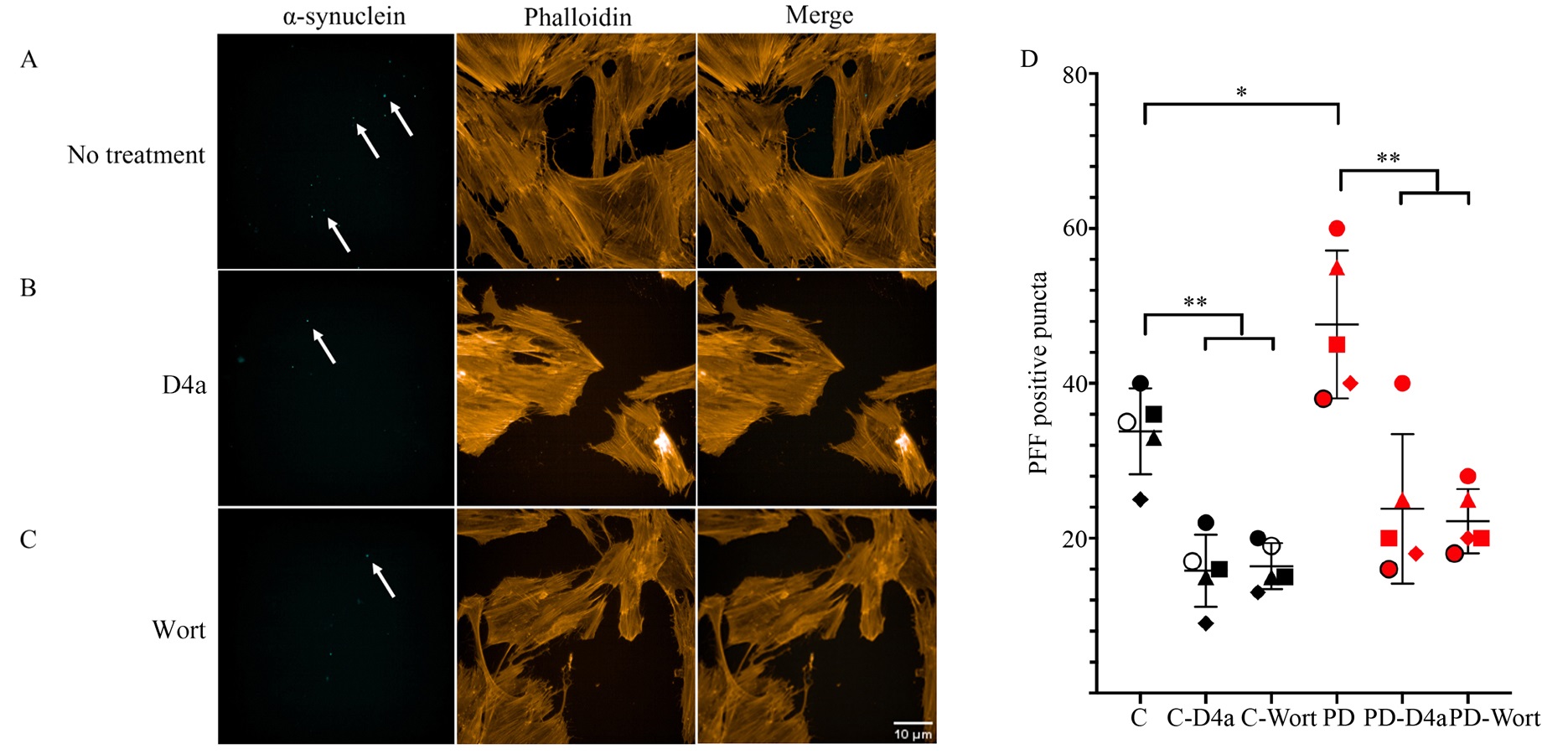
Endocytic uptake of α-synuclein PFFs is mediated by dynamin in ONS. ONS were pre-treated with 25 μmol/L D4a or 1 nmol/L Wort before incubation with 0.1 μmol/L α-synuclein PFF-488 for 4 h. (A) PFF-488 only; (B) D4a treatment; (C) Wort treatment; (D) scatterplot of intracellular PFF-488 puncta counts of 100 cells, n = 5 cell lines indicated by different shapes. Scale bar = 10 μm. Black/white shapes represent control ONS: circle = 1901, square = 1905, triangle = 1803, diamond = 1811, white circle with black border = 11401; Red shapes represent PD ONS: circle = 2803, square = 2810, triangle = 2505, diamond = 2818, circle with black border = 2820. Arrows to PFF-488-positive puncta. C: control. *P < 0.05; **P < 0.01; ***P < 0.001
JKS: Conceptualization, Investigation, Writing—original draft, Writing—review & editing. GDM: Conceptualization, Writing—review & editing, Supervision. AMS: Conceptualization, Investigation, Writing—review & editing, Supervision. All authors read and approved the submitted version.
Conflicts of interest
The authors declare that they have no conflicts of interest.
Ethical approval
All procedures were in accordance with National Health and Medical Research Council Code of Practice for Human Experimentation and approved by the Griffith University Human Experimentation Ethics Committee.
Consent to participate
All donor tissue and information were obtained with informed and written consent of the participants.
Consent to publication
Not applicable.
Availability of data and materials
Not applicable.
Funding
JKS was supported by the Australian Government Research Training Program. The authors acknowledge an unrestricted philanthropic grant to GDM from the AEGIUM Foundation (Queensland). The funders had no role in study design, data collection and analysis, decision to publish, or preparation of the manuscript.
DeMaagd G, Philip A. Parkinson’s disease and its management: part 1: disease entity, risk factors, pathophysiology, clinical presentation, and diagnosis.P T. 2015;40:504–32. [PubMed] [PMC]
Kalia LV, Lang AE. Parkinson’s disease.Lancet. 2015;386:896–912. [DOI]
Deng H, Wang P, Jankovic J. The genetics of Parkinson disease.Ageing Res Rev. 2018;42:72–85. [DOI] [PubMed]
Gibb WR, Lees AJ. The relevance of the Lewy body to the pathogenesis of idiopathic Parkinson’s disease.J Neurol Neurosurg Psychiatry. 1988;51:745–52. [DOI] [PubMed] [PMC]
Tompkins MM, Hill WD. Contribution of somal Lewy bodies to neuronal death.Brain Res. 1997;775:24–9. [DOI] [PubMed]
Spillantini MG, Crowther RA, Jakes R, Hasegawa M, Goedert M. α-synuclein in filamentous inclusions of Lewy bodies from Parkinson’s disease and dementia with Lewy bodies.Proc Natl Acad Sci U S A. 1998;95:6469–73. [DOI] [PubMed] [PMC]
Smith JK, Mellick GD, Sykes AM. The role of the endolysosomal pathway in α-synuclein pathogenesis in Parkinson’s disease.Front Cell Neurosci. 2023;16:1081426. [DOI] [PubMed] [PMC]
Polymeropoulos MH, Lavedan C, Leroy E, Ide SE, Dehejia A, Dutra A, et al. Mutation in the α-synuclein gene identified in families with Parkinson’s disease.Science. 1997;276:2045–7. [DOI] [PubMed]
Singleton AB, Farrer M, Johnson J, Singleton A, Hague S, Kachergus J, et al. α-synuclein locus triplication causes Parkinson’s disease.Science. 2003;302:841. [DOI] [PubMed]
Burré J, Sharma M, Südhof TC. Cell biology and pathophysiology of α-synuclein.Cold Spring Harb Perspect Med. 2018;8:a024091. [DOI] [PubMed] [PMC]
Burré J, Sharma M, Südhof TC. Systematic mutagenesis of α-synuclein reveals distinct sequence requirements for physiological and pathological activities.J Neurosci. 2012;32:15227–42. [DOI] [PubMed] [PMC]
Bisalgia M, Trolio A, Bellanda M, Bergantino E, Bubacco L, Mammi S. Structure and topology of the non-amyloid-β component fragment of human α-synuclein bound to micelles: implications for the aggregation process.Protein Sci. 2006;15:1408–16. [DOI] [PubMed] [PMC]
Meuvis J, Gerard M, Desender L, Baekelandt V, Engelborghs Y. The conformation and the aggregation kinetics of α-synuclein depend on the proline residues in its C-terminal region.Biochemistry. 2010;49:9345–52. [DOI] [PubMed]
Burré J, Sharma M, Tsetsenis T, Buchman V, Etherton MR, Südhof TC. α-synuclein promotes SNARE-complex assembly in vivo and in vitro.Science. 2010;329:1663–7. [DOI] [PubMed] [PMC]
Gribaudo S, Tixador P, Bousset L, Fenyi A, Lino P, Melki R, et al. Propagation of α-synuclein strains within human reconstructed neuronal network.Stem Cell Reports. 2019;12:230–44. [DOI] [PubMed] [PMC]
Liu J, Zhang JP, Shi M, Quinn T, Bradner J, Beyer R, et al. Rab11a and HSP90 regulate recycling of extracellular α-synuclein.J Neurosci. 2009;29:1480–5. [DOI] [PubMed] [PMC]
Zou L, Tian Y, Zhang Z. Dysfunction of synaptic vesicle endocytosis in Parkinson’s disease.Front Integr Neurosci. 2021;15:619160. [DOI] [PubMed] [PMC]
Grozdanov V, Danzer KM. Release and uptake of pathologic alpha-synuclein.Cell Tissue Res. 2018;373:175–82. [DOI] [PubMed]
Gustafsson G, Lööv C, Persson E, Lázaro DF, Takeda S, Bergström J, et al. Secretion and uptake of α-synuclein via extracellular vesicles in cultured cells.Cell Mol Neurobiol. 2018;38:1539–50. [DOI] [PubMed] [PMC]
Bar-On P, Crews L, Koob AO, Mizuno H, Adame A, Spencer B, et al. Statins reduce neuronal α-synuclein aggregation in in vitro models of Parkinson’s disease.J Neurochem. 2008;105:1656–67. [DOI] [PubMed] [PMC]
Hoffmann AC, Minakaki G, Menges S, Salvi R, Savitskiy S, Kazman A, et al. Extracellular aggregated alpha synuclein primarily triggers lysosomal dysfunction in neural cells prevented by trehalose.Sci Rep. 2019;9:544. [DOI] [PubMed] [PMC]
Song JX, Sun YR, Peluso I, Zeng Y, Yu X, Lu JH, et al. A novel curcumin analog binds to and activates TFEB in vitro and in vivo independent of MTOR inhibition.Autophagy. 2016;12:1372–89. [DOI] [PubMed] [PMC]
Murtaza M, Shan J, Matigian N, Todorovic M, Cook AL, Ravishankar S, et al. Rotenone susceptibility phenotype in olfactory derived patient cells as a model of idiopathic Parkinson’s disease.PLoS One. 2016;11:e0154544. [DOI] [PubMed] [PMC]
Matigian N, Abrahamsen G, Sutharsan R, Cook AL, Vitale AM, Nouwens A, et al. Disease-specific, neurosphere-derived cells as models for brain disorders.Dis Model Mech. 2010;3:785–98. [DOI] [PubMed]
Wood SA, Hains PG, Muller A, Hill M, Premarathne S, Murtaza M, et al. Proteomic profiling of idiopathic Parkinson’s disease primary patient cells by SWATH-MS.Proteomics Clin Appl. 2022;16:e2200015. [DOI] [PubMed] [PMC]
Mackay-Sim A. Concise review: patient-derived olfactory stem cells: new models for brain diseases.Stem Cells. 2012;30:2361–5. [DOI] [PubMed]
Xu M, Loa-Kum-Cheung W, Zhang H, Quinn RJ, Mellick GD. Identification of a new α-synuclein aggregation inhibitor via mass spectrometry based screening.ACS Chem Neurosci. 2019;10:2683–91. [DOI] [PubMed]
Volles MJ, Lansbury PT Jr. Relationships between the sequence of α-synuclein and its membrane affinity, fibrillization propensity, and yeast toxicity.J Mol Biol. 2007;366:1510–22. [DOI] [PubMed] [PMC]
Maneca DL, Luo W, Krahn A, Del Cid Pellitero E, Shlaifer I, Beitel LK, et al., editors. Production of recombinant α-synuclein monomers and preformed fibrils (PFFs) [Internet].Zenodo; 2019 [cited 2023 Sep 13]. Available from: https://zenodo.org/record/3738335
Volpicelli-Daley LA, Luk KC, Patel TP, Tanik SA, Riddle DM, Stieber A, et al. Exogenous α-synuclein fibrils induce Lewy body pathology leading to synaptic dysfunction and neuron death.Neuron. 2011;72:57–71. [DOI] [PubMed] [PMC]
McCluskey A, Daniel JA, Hadzic G, Chau N, Clayton EL, Mariana A, et al. Building a better dynasore: the dyngo compounds potently inhibit dynamin and endocytosis.Traffic. 2013;14:1272–89. [DOI] [PubMed] [PMC]
Jones AT, Mills IG, Scheidig AJ, Alexandrov K, Clague MJ. Inhibition of endosome fusion by wortmannin persists in the presence of activated Rab5.Mol Biol Cell. 1998;9:323–32. [DOI] [PubMed] [PMC]
Hunn BHM, Cragg SJ, Bolam JP, Spillantini MG, Wade-Martins R. Impaired intracellular trafficking defines early Parkinson’s disease.Trends Neurosci. 2015;38:178–88. [DOI] [PubMed] [PMC]
Singh NA, Mandal AKA, Khan ZA. Potential neuroprotective properties of epigallocatechin-3-gallate (EGCG).Nutr J. 2016;15:60. [DOI] [PubMed] [PMC]
Andersen CB, Yoshimura Y, Nielsen J, Otzen DE, Mulder FAA. How epigallocatechin gallate binds and assembles oligomeric forms of human alpha-synuclein.J Biol Chem. 2021;296:100788. [DOI] [PubMed] [PMC]
Murray KA, Hu CJ, Pan H, Lu J, Abskharon R, Bowler JT, et al. Small molecules disaggregate alpha-synuclein and prevent seeding from patient brain-derived fibrils.Proc Natl Acad Sci U S A. 2023;120:e2217835120. [DOI] [PubMed] [PMC]
de Lau LML, Breteler MMB. Epidemiology of Parkinson’s disease.Lancet Neurol. 2006;5:525–35. [DOI] [PubMed]
Choi YJ, Sawada K. Physical sensors: fluorescence sensors.In: Narayan R, editor. Encyclopedia of sensors and biosensors. 1st ed. Amsterdam: Elsevier; 2023. pp. 1–19.
Vidyadhara DJ, Lee JE, Chandra SS. Role of the endolysosomal system in Parkinson’s disease.J Neurochem. 2019;150:487–506. [DOI] [PubMed] [PMC]
Zimprich A, Benet-Pagès A, Struhal W, Graf E, Eck SH, Offman MN, et al. A mutation in VPS35, encoding a subunit of the retromer complex, causes late-onset Parkinson disease.Am J Hum Genet. 2011;89:168–75. [DOI] [PubMed] [PMC]
Lilienbaum A. Relationship between the proteasomal system and autophagy.Int J Biochem Mol Biol. 2013;4:1–26. [PubMed] [PMC]
Fakhree MAA, Konings IBM, Kole J, Cambi A, Blum C, Claessens MMAE. The localization of alpha-synuclein in the endocytic pathway.Neuroscience. 2021;457:186–95. [DOI] [PubMed]
Mereles D, Hunstein W. Epigallocatechin-3-gallate (EGCG) for clinical trials: more pitfalls than promises?Int J Mol Sci. 2011;12:5592–603. [DOI] [PubMed] [PMC]