 Perspective


Affiliation:
1Department of Clinical and Experimental Medicine, University of Messina, 98122 Messina, Italy
Email: giulia.picciotto@hotmail.com
ORCID: https://orcid.org/0000-0002-1860-8079


 ,
Affiliation:
2Institute for Cognitive and Brain Sciences (ICBS), Shahid Beheshti University, Tehran 1983969411, Iran
Explor Neuroprot Ther. 2026;6:1004171 DOI: https://doi.org/10.37349/ent.2026.1004171
Received: April 19, 2026 Accepted: September 21, 2026 Published: November 17, 2026
Academic Editor: Rafael Franco, Universidad de Barcelona, Spain
The article belongs to the special issue The New Neurobiology of Neurodevelopmental Disorders: From Neuroinflammation to Neurochemical Modulation
Rett syndrome is a severe neurodevelopmental disorder in which motor impairment, apraxia, and limited expressive language can obscure residual cognitive and communicative abilities. This brief report argues that attention and communication in Rett syndrome should be conceptualized not only as impaired domains, but also as partially hidden functions that may become observable through appropriate assessment and rehabilitation methods. Drawing on research on attention, communication training, eye-tracking, telerehabilitation, and transcranial direct current stimulation (tDCS), we propose that technology-assisted approaches are especially relevant because they reduce motor demands and create alternative pathways for interaction. This perspective integrates selected findings from Rett syndrome intervention studies with broader literature on diagnosis, communication, visual attention, and rehabilitation. The resulting framework suggests that child neuropsychological assessment in Rett syndrome should move beyond overt motor-language limitations and prioritize methods capable of detecting attention, intentionality, and responsiveness under supported conditions. Because the supporting evidence is dominated by pilot, single-case, and small-sample studies, the framework is hypothesis-generating and should not be interpreted as evidence that these technologies are uniformly clinically validated.
Rett syndrome is a rare neurodevelopmental disorder, most commonly associated with pathogenic variants in the methyl-CpG-binding protein 2 (MECP2) gene, and is characterized by developmental regression, severe motor impairment, apraxia, autonomic dysfunction, and marked limitations in expressive language [1–3]. These features make clinical interpretation difficult because reduced overt performance may reflect impaired motor output rather than absent understanding or intentionality. In practice, this means that conventional assessments can underestimate residual cognitive and communicative abilities. However, current evidence remains heterogeneous and should be interpreted cautiously. Rett syndrome is characterized by marked phenotypic variability related to disease severity, developmental stage, and underlying MECP2 variants. Consequently, residual cognitive and communicative abilities are unlikely to be uniformly preserved across individuals, and the concept of partially hidden cognitive and communicative abilities should be regarded as a plausible, rather than universally demonstrated, hypothesis. “Hidden” refers to abilities that may be present but cannot be reliably expressed through conventional motor or verbal responses. This challenge is especially relevant to child neuropsychology. When a child cannot reliably speak, point, or manipulate objects, standard performance measures become less informative. This limitation has also been highlighted in comparative studies of formal and informal assessment methods, which show that conventional tools may underestimate communicative and cognitive abilities in children with Rett syndrome under standard testing conditions [4]. For this reason, methods that reduce motor demands and instead rely on gaze, attention, assisted communication, and structured interaction are particularly valuable. The present brief report advances a simple argument: in Rett syndrome, attention and communication, though impaired, may be observed through assessments and interventions that minimize motor demands. “Impaired” refers to functions that are genuinely reduced because of neurological dysfunction. This view is consistent with broader Rett syndrome literature. Revised diagnostic criteria emphasize the complexity and heterogeneity of the syndrome [3], while later reviews have underlined the importance of individualized functional assessment and rehabilitation [1, 5]. Communication-focused reviews have likewise shown that successful intervention depends heavily on adapting methods to the phenotype rather than relying on conventional speech-based expectations [6, 7]. As this article is a mini-perspective rather than a systematic review, the literature was selected narratively to provide representative evidence for the proposed access-based framework. Selection was guided by direct relevance to attention, communication, augmentative and alternative communication (AAC), eye-tracking, telerehabilitation, and neuromodulation in Rett syndrome. Priority was given to systematic reviews, peer-reviewed empirical studies, and recent pilot or feasibility studies. Broader pediatric telerehabilitation literature was used only to define technologies or implementation criteria. Purely molecular or pharmacological reports and papers without direct relevance to assessment or rehabilitation access were not included. The evidence was interpreted with attention to study design, sample size, the presence of a comparator or sham condition, reporting of clinical phenotype or MECP2 variation, and independence of the research group. No exhaustive search, formal risk-of-bias assessment, or meta-analysis was undertaken. Therefore, the aim is not to provide an exhaustive evidence synthesis, but to integrate selected findings into a clinically useful conceptual framework. Accordingly, the proposed framework should be regarded as an author-derived, hypothesis-generating synthesis rather than a clinically validated model. Importantly, the original contribution of the present perspective is not the introduction of eye-tracking, AAC, or other technology-assisted approaches, which are already represented in the Rett syndrome literature. Rather, the access-based framework brings these approaches together around a common conceptual question: whether an individual’s apparent level of functioning changes when the response pathway is matched to their motor, visual, communicative, and attentional profile. In this framework, technology is considered not simply as an intervention tool, but as an access mechanism that may make attention, intentionality, choice, and communication more observable and usable. This shifts the focus from whether a specific technology is effective to which access conditions allow an individual to demonstrate and use residual abilities. The proposed access-based conceptual framework is summarized in Figure 1.
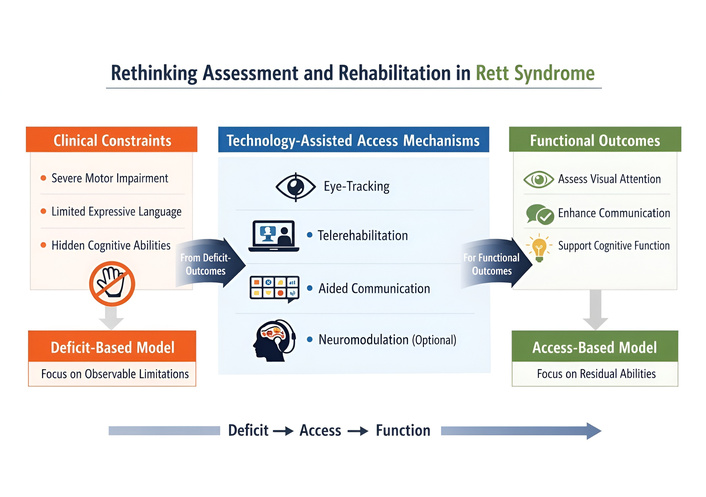
Access-based conceptual framework in Rett syndrome. The figure illustrates a shift from a deficit-based model to an access-based framework in Rett syndrome. Clinical constraints include severe motor impairment, limited expressive language, and potential masking of cognitive abilities. These can be partially addressed through technology-assisted access mechanisms: (1) eye-tracking systems, enabling assessment and communication via gaze without motor responses; (2) telerehabilitation platforms, supporting remote delivery of interventions in naturalistic contexts; (3) augmentative and alternative communication (AAC) systems, allowing expression through symbols or device-mediated output; and (4) neuromodulation techniques (e.g., tDCS), used as adjuncts to support cortical excitability and cognitive training outcomes. Overall, these tools reduce motor demands and enable the detection and reinforcement of residual abilities. The framework is conceptual rather than empirically validated. Future studies should test whether matching access methods to an individual phenotype improves measurement reliability, goal attainment, participation, and functional outcomes compared with conventional assessment or non-personalized technology selection. tDCS: transcranial direct current stimulation.
The idea that communicative functioning in Rett syndrome is broader than overt speech output suggests has been supported by several studies [8]. Fabio et al. [9] examined attention and communication in Rett syndrome and emphasized the role of selective attention in understanding communicative engagement. This line of work is important because it shifts the focus from overt deficits to the conditions under which intentional behavior may still be expressed. Moreover, Fabio et al. [10] reported increased attention in Rett syndrome in a pre-test/post-test design. Their findings suggest that attention is not a fixed and uniformly diminished trait, but a domain that may improve under structured intervention conditions. Clinically, this is an important point: low responsiveness should not automatically be interpreted as lack of competence if the assessment context itself does not provide accessible response channels. Fabio et al. [11] further extended this argument by showing that communication abilities can be trained through reading and writing-based approaches. Although severe expressive impairments remain a defining feature of Rett syndrome, their findings support the view that communication potential may in some cases be greater than outward behavior alone suggests. This interpretation is strongly aligned with the external literature. Sigafoos et al. [6], in a systematic review of communication intervention in Rett syndrome, concluded that available evidence was limited but promising. These findings require cautious interpretation because the underlying studies used small samples and pre-test/post-test or single-case designs, and several lacked randomization, blinded assessment, or an independent control condition. More recently, Sigafoos et al. [7] updated that review and reported additional positive outcomes, particularly in studies using aided and individualized communication methods. The same review also documented heterogeneous methods, limited reporting of participant characteristics, and at least one eye-gaze software study without a treatment effect; publication bias and selective reporting therefore remain plausible concerns. Aided communication includes the use of external supports such as communication boards, symbol-based systems, or speech-generating devices, which allow individuals with limited verbal abilities to express choices, intentions, and communicative acts through alternative modalities [12]. Additional support comes from work on visual attention and aided communication. Wandin et al. [13] developed a tool to assess visual attention in Rett syndrome and argued that gaze-controlled devices should be considered in communication intervention. Related work by Wandin et al. [14] showed that aided language modelling and responsive communication combined with eye-gaze technology may support communicative expression in people with Rett syndrome. Together, these studies reinforce the idea that communication in Rett syndrome is often constrained less by absence of social or cognitive interest than by the lack of accessible output pathways. Communication access should consequently be understood as individual and context-dependent, and observable gaze or device use should not be treated as a direct proxy for globally preserved cognition.
If attention and communication are partly hidden by motor limitations, assessment must minimize motor demands. Eye-tracking is especially promising in this respect because it enables evaluation of visual attention, preference, and intentional responding without requiring speech or functional hand use [15]. Structurally, remote video-based eye-trackers use infrared cameras to estimate point of gaze and can be configured with enlarged targets, adjustable spacing, individualized dwell times, repeated or simplified calibration, and gaze-contingent visual or auditory feedback. These features can mitigate limb and speech apraxia by bypassing the need to plan and execute pointing, reaching, or verbal responses and by converting a sustained fixation into a selectable response. Nevertheless, eye-tracking should not be regarded as a direct measure of underlying cognitive abilities. Its effective application requires adequate calibration, sustained visual attention, and sufficient cooperation, while oculomotor abnormalities and attentional fluctuations may influence both performance and the interpretation of findings. Head-position instability, visual fatigue, involuntary gaze shifts, and the risk that prolonged looking is interpreted as intentional selection can further reduce validity. Repeated calibration checks and confirmation of selections across trials are therefore essential. For repeated assessments, the reproducibility of gaze-based parameters should also be considered, as fixation duration, response latency, selection accuracy, and gaze stability may vary with calibration quality, attentional state, and testing conditions. Standardizing device position, viewing distance, target presentation, instructions, response criteria, and session duration across sessions can improve the comparability and interpretability of longitudinal eye-tracking data. In practice, eye-tracking systems record gaze position and duration, allowing individuals to select stimuli, communicate choices, or interact with digital interfaces using eye movements alone, thereby providing an alternative access channel for both assessment and intervention [16]. Fabio et al. [17] reported longitudinal cognitive rehabilitation applied with an eye-tracker for patients with Rett syndrome. Their study is important not only for its results, but for its broader implication: gaze can function as an alternative route for both cognitive assessment and therapeutic engagement. The child’s visual behavior becomes the medium through which responsiveness and learning can be observed. This principle was extended to distance-based intervention by Iannizzotto et al. [18], who described remote eye-tracking for cognitive telerehabilitation and interactive school tasks during COVID-19. Telerehabilitation can be defined as the use of information and communication technologies to deliver rehabilitation services at a distance, including assessment, intervention, and follow-up, within the individual’s everyday environment (e.g., home or school) [19]. In practice, telerehabilitation systems enable real-time or asynchronous interaction between clinicians and patients through digital platforms such as video conferencing, internet-based applications, and integrated communication devices, thereby supporting structured cognitive and communicative activities outside traditional clinical settings [20, 21]. The value of this work extends beyond the pandemic context. For rare disorders such as Rett syndrome, remote technologies can increase continuity of care, reduce geographic barriers, and support school participation in more natural settings. A related contribution comes from Fabio et al. [22], who compared advanced with basic telerehabilitation technologies in Rett syndrome. In that study, basic telerehabilitation consisted mainly of videoconference-based observation and guidance, whereas the advanced system incorporated bidirectional interaction with eye-gaze acquisition, multiple camera views, computer-vision-based skeletal reconstruction, integrated rehabilitation software, and objective session data. More generally, the distinction can be operationalized across four criteria: sensing and data capture, real-time interactivity and feedback, capacity for task personalization, and availability of objective performance logs. Their findings suggest that the most important issue is not merely technological sophistication, but whether a system allows measurable participation and behavioral change. This is clinically relevant because it means that both high-tech and lower-tech systems may be useful if they provide a workable access route for attention and communication. Advanced technology should therefore not be assumed to be superior for every individual; setup burden, calibration success, sensory tolerance, caregiver competence, connectivity, and the child’s fatigue may favor a simpler platform. For real-world clinical implementation, the most appropriate system should be selected according to the individual’s functional profile and practical needs rather than the number or sophistication of technological features available. External literature supports this direction. Passaro et al. [16] reviewed the role of eye-tracking in Rett syndrome and highlighted its value for uncovering residual abilities that may remain undetected in conventional assessments. Wandin et al. [13] likewise emphasized that gaze-controlled communication systems can be a meaningful part of intervention, not simply an assessment device. Taken together, these findings support an access-based model of neuropsychological evaluation: the goal is not merely to measure overt behavior, but to identify how the child can best show attention, choice, and responsiveness. However, despite these potential advantages, evidence supporting telerehabilitation in Rett syndrome remains limited and is currently derived from a small number of feasibility and pilot studies. Larger controlled investigations are needed before broad clinical recommendations can be made.
Technology-assisted rehabilitation in Rett syndrome is not limited to gaze-based systems. Neuromodulation techniques such as transcranial direct current stimulation (tDCS) involve the application of low-intensity electrical currents to modulate cortical excitability and are hypothesized to enhance cognitive and communicative functions when combined with behavioral interventions [23, 24]. Another line of work has explored whether neuromodulation can support cognitive and communicative performance when paired with structured intervention. Fabio et al. [23] investigated neurophysiological and cognitive effects of tDCS in three girls with Rett syndrome with chronic language impairments. Although the study was exploratory and based on a very small sample, it is relevant because it linked neurophysiological change with cognitive-communicative outcomes. Fabio et al. [24] later examined combined tDCS with cognitive training, moving toward a more integrated intervention framework. The published Rett syndrome protocols were study-specific rather than optimized regimens. The 2018 three-case study used 2 mA for 20 minutes across 10 consecutive sessions, with anodal stimulation directed to the left-hemisphere language region (Broca’s area) and the cathode placed over the contralateral right region. The later sham-controlled study used 2 mA for 20 minutes across 10 sessions delivered over one week, with the anode over C3 in the international 10-20 system and the cathode over the right supraorbital region, concurrently with cognitive training. These parameters describe the protocols that have been tested; they should not be presented as optimal cortical positioning, dosage, or frequency for Rett syndrome. Target selection also differed between studies, and current evidence does not establish whether language-region, primary motor-cortex, or individualized electric-field-guided montages are preferable. At present, tDCS should be considered an experimental adjunctive intervention rather than an established therapeutic approach for Rett syndrome. Evidence is limited by very small samples, heterogeneous protocols, and uncertainty regarding optimal stimulation parameters, long-term safety, and clinical efficacy in pediatric neurodevelopmental disorders. Future trials should predefine stimulation intensity, current density, electrode size and montage, session number, concurrent task, medication and epilepsy status, adverse-event monitoring, and follow-up duration; individualized modelling may also be needed because age, skull anatomy, cortical atrophy, and phenotype can alter current distribution. However, the significance of these studies lies less in claiming definitive efficacy and more in demonstrating that residual function may be more modifiable than overt behavior would suggest. In this respect, combined interventions are especially important because they avoid treating neuromodulation as a stand-alone solution. Instead, they place it within a broader rehabilitative context that includes cognitive and communicative goals. This integrated approach is consistent with the wider rehabilitation literature. Lotan and Hanks [5] and Bisgaard et al. [25] emphasized the importance of individualized physical and functional intervention in Rett syndrome, while Romano et al. [26] reviewed tools for evaluating gross motor, physical activity, and musculoskeletal domains, highlighting the multidimensional nature of rehabilitation needs. The broader message is that intervention in Rett syndrome should not target isolated deficits. It should instead identify the pathways through which participation, responsiveness, and adaptive functioning can be supported.
The clinical implications of this brief perspective are straightforward. First, assessment in Rett syndrome should go beyond overt language and motor output. Attention, gaze behavior, response latency, and aided interaction may provide more valid indicators of residual function than traditional performance measures alone. Second, communication should be approached as a domain that is often difficult to detect rather than simply absent. Systematic reviews of communication intervention have shown that positive outcomes are possible, especially when individualized and aided approaches are used [6, 7]. Third, technology-assisted methods may be considered as structured access options within specialist assessment and rehabilitation, but the present evidence does not justify treating them as uniformly validated standard care. A key practical contribution of the access-based framework is a four-step clinical protocol designed to translate its principles into individualized assessment and rehabilitation. The protocol comprises four linked stages. First, clinicians should define the phenotype and access profile, including developmental stage, MECP2 variant when available, epilepsy and autonomic stability, vision and oculomotor function, posture, hand use, fatigue, sensory preferences, and current communication methods. Second, more than one access route should be trialled, such as low-tech AAC, partner-assisted scanning, switches, and eye-tracking, with repeated sessions used to assess calibration success and response reliability. Third, the team should select a small set of operationalized outcomes that combine objective measures (e.g., fixation accuracy, response latency, independent selections, task completion) with functional goals reported across home, school, and clinical settings. Fourth, the access method, target size, dwell time, session duration, prompting, and caregiver support should be reviewed iteratively and modified when performance is inconsistent or burdensome. However, the level of empirical support is not uniform across approaches. AAC and eye-tracking-based methods are supported by a relatively larger body of studies, whereas telerehabilitation is mainly grounded in pilot and feasibility work, and neuromodulatory techniques remain highly experimental. Despite this heterogeneity, these approaches are particularly suitable for Rett syndrome because they reduce the burden of motor output while preserving opportunities for attention and intentionality to emerge, thereby supporting both assessment and intervention within an access-based framework. The heterogeneity of study designs, sample sizes, and outcome measures substantially limits the ability to draw definitive conclusions across intervention domains. As a result, the present framework should be interpreted as a conceptual integration of available evidence rather than a model supported by uniform empirical validation. This also constrains the generalizability of reported effects and highlights the need for controlled, longitudinal studies. Finally, future research would benefit from more consistent outcome measures, stronger longitudinal designs, and clearer integration of behavioral, neuropsychological, and functional endpoints. Because Rett syndrome is rare, methodological flexibility is unavoidable. Even so, a more unified framework would further improve comparability across studies and clinical interpretability of findings.
The evidence base is vulnerable to several recurrent sources of bias. Recruitment often relies on convenience samples, specialist centers, or highly engaged families, creating selection bias and limiting representation of individuals who cannot tolerate or access the technology. Many studies lack control groups, randomization, allocation concealment, blinded outcome assessment, or prespecified primary outcomes. Small samples also prevent meaningful stratification by clinical stage, mutation type, epilepsy, age, or baseline communication level. In addition, several outcomes are based on caregiver or therapist ratings, instruments with limited validation for Rett syndrome, or gaze-derived measures whose reliability depends on calibration and oculomotor stability. These features can amplify expectancy effects, regression to the mean, and selective reporting of favorable outcomes. Publication bias is also a relevant concern, particularly because small studies of innovative technology-assisted interventions may be more likely to be published when they report promising or positive findings. Conversely, null or unsuccessful results may remain unpublished or receive less attention, potentially leading to an overly favorable impression of the available evidence.
Independent studies provide useful but still preliminary support and also illustrate these constraints. Family surveys of eye-gaze technology reported perceived communication gains but also technical frustrations, variable professional support, and instances in which the system was considered unsuitable [27]. A four-participant multiple-case study reported individualized communication improvements, while explicitly calling for more rigorous designs [28]. A remotely supervised motor program involving a larger cohort suggested functional gains, but used a single-cohort design without a concurrent control group [29]. Independent EEG work has shown task-related spectral changes during repeated cognitive stimulation, although neurophysiological change cannot by itself establish durable functional improvement [30]. Thus, the international literature is not uniformly positive and does not yet permit strong comparative conclusions.
The access-based framework can be validated prospectively through preregistered, multicenter studies that compare access-matched assessment or intervention with usual assessment and with non-personalized technology selection. Participants should be characterized by mutation, clinical severity, developmental stage, oculomotor function, and baseline communication profile. Repeated-baseline or randomized designs, blinded scoring where feasible, standardized adverse-event and feasibility reporting, and outcomes spanning reliability, goal attainment, participation, caregiver burden, and generalization across settings would allow the framework to be tested rather than assumed. External replication by independent groups would be essential before the framework could support clinical guidelines.
In Rett syndrome, severe motor and expressive-language impairment can conceal attention, communicative intent, and learning potential. A child neuropsychological approach must therefore move beyond overt output and prioritize methods that reduce motor demands while enhancing access to measurable response channels. The available evidence suggests that, in some individuals, structured communication training and eye-tracking-based approaches may help, whereas other interventions such as telerehabilitation and neuromodulation remain preliminary or experimental. The most useful clinical shift is therefore from a deficit-only interpretation toward an access-based model, in which the central question is not only what functions are impaired, but how attention and communication can become observable and supportable despite profound motor limitations. A particularly practical element of this framework is the proposed four-step clinical protocol, which provides a structured approach to defining the individual access profile, trialling alternative response pathways, selecting functional outcomes, and adapting the intervention iteratively. Importantly, a distinction should be made between levels of evidence across intervention approaches. AAC and eye-tracking-based methods are supported by a relatively larger and more consistent body of empirical studies, including systematic reviews. In contrast, telerehabilitation approaches are currently supported primarily by feasibility and pilot studies, while neuromodulatory interventions such as tDCS remain experimental, with limited sample sizes and heterogeneous protocols. This distinction is essential for appropriate clinical interpretation and translation into practice. Overall, the framework is intended to organize testable clinical questions and personalize access trials; it is not a claim that any technology is effective for all individuals or ready for routine use without specialist assessment and further validation.
AAC: augmentative and alternative communication
MECP2: methyl-CpG-binding protein 2
tDCS: transcranial direct current stimulation
GP: Project administration, Conceptualization, Investigation, Writing—original draft, Writing—review & editing. MHF: Investigation, Validation, Visualization, Writing—review & editing. Both authors read and approved the submitted version.
The authors declare that they have no conflicts of interest.
Not applicable.
Not applicable.
Not applicable.
Not applicable.
No funding was received for this work.
© The Author(s) 2026.
Open Exploration maintains a neutral stance on jurisdictional claims in published institutional affiliations and maps. All opinions expressed in this article are the personal views of the author(s) and do not represent the stance of the editorial team or the publisher.
Copyright: © The Author(s) 2026. This is an Open Access article licensed under a Creative Commons Attribution 4.0 International License (https://creativecommons.org/licenses/by/4.0/), which permits unrestricted use, sharing, adaptation, distribution and reproduction in any medium or format, for any purpose, even commercially, as long as you give appropriate credit to the original author(s) and the source, provide a link to the Creative Commons license, and indicate if changes were made.



View: 61
Download: 8
Times Cited: 0


