 Case Report


Affiliation:
1Department of Neuroscience, Rehabilitation, Ophthalmology, Genetics, Maternal and Child Health, University of Genoa, 16132 Genoa, Italy
ORCID: https://orcid.org/0009-0009-4509-9474

 ,
Affiliation:
1Department of Neuroscience, Rehabilitation, Ophthalmology, Genetics, Maternal and Child Health, University of Genoa, 16132 Genoa, Italy
2AOM-IRCCS Ospedale Policlinico San Martino, 16132 Genova, Italy
ORCID: https://orcid.org/0000-0001-6637-4425
,
Affiliation:
2AOM-IRCCS Ospedale Policlinico San Martino, 16132 Genova, Italy
ORCID: https://orcid.org/0000-0001-6021-6805
,
Affiliation:
1Department of Neuroscience, Rehabilitation, Ophthalmology, Genetics, Maternal and Child Health, University of Genoa, 16132 Genoa, Italy
ORCID: https://orcid.org/0009-0008-9063-3528
,
Affiliation:
1Department of Neuroscience, Rehabilitation, Ophthalmology, Genetics, Maternal and Child Health, University of Genoa, 16132 Genoa, Italy
ORCID: https://orcid.org/0009-0001-3526-2073
,
Affiliation:
1Department of Neuroscience, Rehabilitation, Ophthalmology, Genetics, Maternal and Child Health, University of Genoa, 16132 Genoa, Italy
ORCID: https://orcid.org/0009-0003-9938-8163
,
Affiliation:
1Department of Neuroscience, Rehabilitation, Ophthalmology, Genetics, Maternal and Child Health, University of Genoa, 16132 Genoa, Italy
2AOM-IRCCS Ospedale Policlinico San Martino, 16132 Genova, Italy
Email: lucio.marinelli@unige.it
ORCID: https://orcid.org/0000-0003-0620-7654

Explor Neuroprot Ther. 2026;6:1004169 DOI: https://doi.org/10.37349/ent.2026.1004169
Received: April 10, 2026 Accepted: September 14, 2026 Published: October 26, 2026
Academic Editor: Rodrigo Pacheco, Fundación Ciencia & Vida, Universidad San Sebastián, Chile
Myasthenia gravis (MG) is an autoimmune neuromuscular junction disorder occasionally triggered by immunomodulatory therapies. While immune checkpoint inhibitors are well-recognized culprits, traditional antineoplastic treatments like intravesical Bacillus Calmette-Guerine (BCG) can also precipitate severe immune-related adverse events. We describe a rare presentation of BCG-induced MG, emphasizing the crucial diagnostic role of clinical neurophysiology in evaluating atypical focal onset. A 76-year-old male with high-grade urothelial carcinoma underwent transurethral resection followed by a standard six-week induction of intravesical BCG. Twelve days after the final instillation, he developed isolated, severe neck extensor weakness resulting in dropped head syndrome (antecollis). Following an unrevealing cervical magnetic resonance imaging scan and the failure of empirical conservative management, a comprehensive neurophysiological evaluation was strictly performed. Concentric needle electromyography of the splenius capitis muscle revealed focal myopathic alterations, including early recruitment of small motor unit potentials, positive sharp waves, and fibrillation potentials. Crucially, low-frequency repetitive nerve stimulation (RNS) of the spinal accessory nerve, recording from the trapezius, demonstrated a significant, diagnostic decremental response of the compound muscle action potential amplitude. Serological assays confirmed highly elevated anti-acetylcholine receptor antibodies. Chest computed tomography excluded thymoma, establishing the diagnosis of very late-onset generalized MG (MGFA class IIb). Initial symptomatic monotherapy with pyridostigmine lacked efficacy. However, targeted therapy combining oral prednisone (0.5 mg/kg/day) and pyridostigmine induced a dramatic, rapid resolution of the antecollis and subsequent dysphagia. Corticosteroids were progressively tapered and definitively discontinued after six months, achieving sustained clinical remission without relapses. We report the third formally documented case of very late-onset generalized MG triggered by intravesical BCG immunotherapy, hypothetically mediated by pathogenic epitope sharing between mycobacterial and self-antigens. This case distinctly highlights the pivotal diagnostic utility of RNS in differentiating acute atypical axial weakness. Furthermore, it demonstrates that BCG-induced MG exhibits a highly favourable, fully reversible prognosis following prompt, targeted corticosteroid intervention.
Myasthenia gravis (MG) is a rare neuromuscular junction disorder characterized by fatigable weakness of muscles. Acetylcholine receptor (AChR) antibodies can be detected in about 85% of patients with MG [1], with anti-muscle-specific tyrosine kinase (MuSK) and lipoprotein-related peptide 4 (LRP4) antibodies found in about 5% and 1–5%, respectively [2].
Congenital or transient neonatal forms due to the passive placental transfer of antibodies from mothers with MG may occur; however, the majority of cases occur during the third and sixth decades, with a slight female predominance seen in the younger group, similar to other autoimmune conditions, and a male predominance in the older age group [3]. Based on the age of onset, adult-onset MG is divided into early onset MG (18–50 years), late onset MG (50–65 years) and very late onset MG (> 65 years) [4], the latter associated with a more aggressive onset but a more favourable prognosis [5].
Drugs that alter the immune response may also cause de novo MG or MG exacerbation. Immune checkpoint inhibitors, D-penicillamine, interferons and statins can affect T and B cell activation or cytokine production, triggering autoimmune responses [6].
In patients with antibodies to AChR, fatigable weakness characteristically involves the extraocular, bulbar, or proximal limb muscles. Ptosis and extraocular muscle weakness occur in more than 50% of patients at the time of presentation and develop in more than 90% of patients sometime during their illness [7]. Bulbar muscle weakness is the next most common, resulting in difficulty swallowing, chewing, and speaking. Involvement of head and neck extensors may manifest with dropped head, which is considered an unusual presentation, mimicking other neurological conditions such as myopathy or motor neuron diseases [8].
Neurophysiological tests such as repetitive nerve stimulation (RNS) may represent a quick first-line exam to confirm neuromuscular transmission impairment, showing sufficient sensitivity when performed in affected muscles. A decremental response characterized by an amplitude reduction of the fourth compound muscle action potential higher than 10% compared to the first is suggestive of MG. A higher sensitivity can be obtained by assessing time-locked variability of discharge of muscle fibres (jitter) using single-fibre electromyography (EMG) techniques [7]. In seropositive patients, antibody detection in the plasma supports the definitive diagnosis.
Intravesical Bacillus Calmette-Guerine (BCG) is a common and highly effective treatment for non-muscle invasive urothelial carcinoma of the urinary bladder. Initially developed as a tuberculosis vaccine, BCG is an attenuated strain of mycobacterium bovis, capable of activating the immune system against tumor cells [9]. This therapeutic effect of BCG may, however, be accompanied by side effects related to an autoimmune response. According to a recent review, a total of 130 patients presented with reactive arthritis, 61 patients with ocular manifestations, and 19 patients with other rheumatologic diseases following BCG treatment [10]. Several cases of different types of vasculitis were described, with occasional involvement of the central nervous system. Notably, new-onset MG was reported in two patients. To our knowledge, this is the third reported case of very late-onset generalised MG following intravesical BCG.
A graphical timeline of the events is shown in Figure 1.
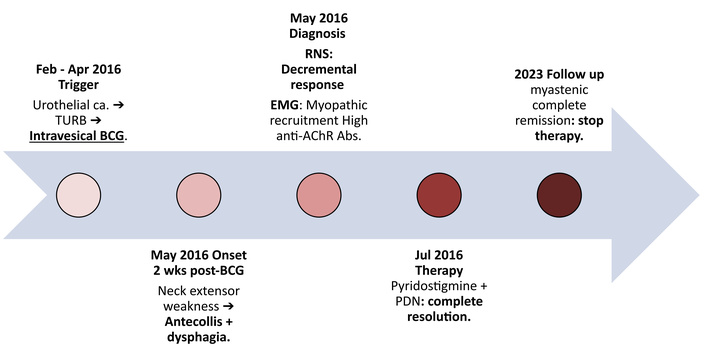
Graphical timeline of the main clinical events. BCG: Bacillus Calmette-Guerine; EMG: electromyography; PDN: prednisone; RNS: repetitive nerve stimulation.
In May 2016, a 76-year-old male presented to our observation. His family history was negative for neuromuscular or movement disorders, although a brother was affected by Alzheimer’s disease. His past medical history was notable for prior episodes of sciatica, as well as dyslipidemia with an asymptomatic carotid stenosis managed with antiplatelet therapy. In February 2016, following an episode of hematuria, the patient was diagnosed with a high-grade urothelial carcinoma and subsequently underwent a transurethral resection of the bladder tumour. As adjuvant therapy, he received a six-week induction course of intravesical BCG immunotherapy in April 2016. Approximately two weeks after his final BCG instillation, the patient developed progressive posterior neck pain, which was rapidly followed by severe weakness of the neck extensor muscles (scoring 2 on the Medical Research Council scale), culminating in dropped head syndrome (antecollis). Initial conservative management, consisting of thiocolchicoside and betamethasone for six days, yielded no clinical benefit. Given the persistent symptomatology and suspected primary muscle pathology, the patient was admitted to the University Neurology Unit of San Martino Hospital (Genova, Italy) in May 2016. Initial symptomatic therapy with low-dose pyridostigmine was discontinued after 10 days due to a perceived lack of clinical efficacy. In July 2016, the patient was readmitted with fever secondary to pleurisy, accompanied by severe cervical pain and new-onset dysphagia. Treatment was subsequently escalated to a combined regimen of oral pyridostigmine and prednisone (0.5 mg/kg/day), which resulted in a dramatic clinical improvement. By August 2016, the neck extensor weakness had completely resolved, allowing for a gradual tapering of the corticosteroid to 25 mg/day. During long-term follow-up (2016–2023), the patient experienced no recurrence of the urothelial carcinoma. In June 2017, he was diagnosed with prostate adenocarcinoma following an isolated PSA elevation and commenced androgen deprivation therapy. Concurrently, the patient exhibited a progressive cognitive decline, although neuroimaging (brain CT) and carotid Doppler ultrasound were unremarkable for acute alterations. Neuromuscularly, the patient maintained a sustained clinical remission of both antecollis and dysphagia. Due to episodic diarrhoea and the stability of the myasthenic symptoms, his general practitioner gradually reduced the pyridostigmine dosage over the years. Ultimately, following severe muscarinic side effects, specifically diarrhoea and sialorrhea, in 2023, the patient’s caregiver independently discontinued the pyridostigmine entirely. A subsequent neurological evaluation confirmed the complete resolution of the muscarinic symptoms without any clinical exacerbation of muscle weakness.
Following the onset of head drop, a cervical spine magnetic resonance imaging scan, prescribed to rule out structural pathology, was unremarkable. Concentric needle EMG initially revealed isolated myopathic suffering in the right splenius capitis muscle, with early recruitment of small motor unit potentials and some positive sharp waves and fibrillation potentials (pathologic spontaneous muscle activity). The early recruitment of small motor unit potentials during voluntary effort is a typical finding in myopathic conditions. The serum creatine phosphokinase level was normal. Low-frequency RNS of the right spinal accessory nerve demonstrated a clear decremental response of the compound muscle action potential amplitude, indicative of a defect in neuromuscular transmission (Figure 2). Using surface electrodes to record from the right trapezius muscle, a consistent and reproducible decrease in the amplitude of the compound muscle potential can be observed, as the amplitude of the fourth potential is more than 10% lower than that of the first. Serum assays subsequently confirmed highly elevated titers of anti-AChR antibodies. A chest computed tomography scan ruled out thymoma, showing only an indeterminate pulmonary micronodule, which remained stable on subsequent follow-ups and showed no pathological uptake on a whole-body positron emission tomography scan. A repeat neurophysiological study confirmed the RNS decremental response, this time tested bilaterally on the trapezius muscles.
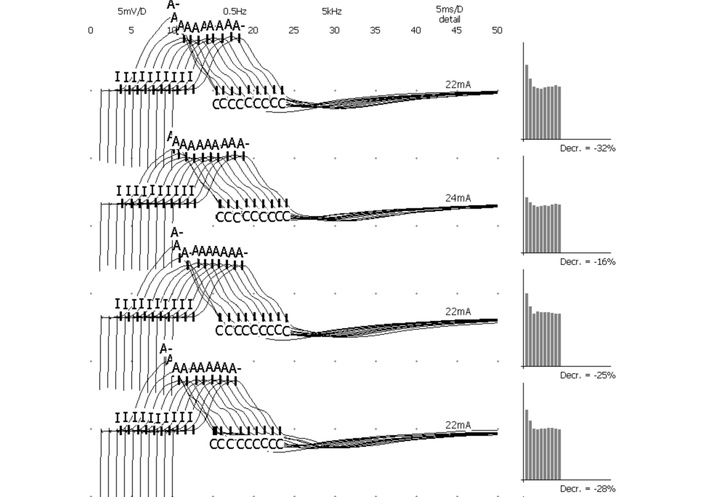
Right spinal accessory nerve: 3 Hz repetitive stimulation. Recording from the trapezius muscle using surface electrodes shows a reproducible decremental response (the amplitude of the fourth potential is more than 10% lower than the first) in the baseline condition.
The patient reported progressive difficulty maintaining head posture due to weakness of the neck extensor muscles but did not express particular concern about this symptom. Throughout the diagnostic workup and treatment, he remained fully adherent to medical recommendations and consistently complied with the prescribed therapy and follow-up evaluations. He reported satisfaction with the clinical management and appreciated the improvement in his symptoms after initiation of oral pyridostigmine and prednisone.
Two cases of MG following intravesical BCG have been previously published. Both cases can be considered very late-onset (69-year-old patients), but the first one showed only ocular symptoms, consistent with ocular MG [11], while a generalized picture including dysphagia characterized the second case [12]. Our patient is slightly older (76) and showed mainly neck extensors weakness, not reported in the other cases, without showing ocular symptoms or generalized weakness.
Antecollis refers to the flexed position of the neck, which can be caused by various conditions mainly related to weakness of the neck extensors. This condition is also referred to as “dropped head” and can be caused by different myopathic disorders, impaired neuromuscular transmission, motor neuron diseases, or parkinsonism. It can also be caused by dystonic activation of the neck flexor muscles. Among myopathic disorders, inflammatory and genetic myopathies (e.g., myofibrillar or LMNA-associated) show features that were absent in our patients, such as elevated serum creatine phosphokinase in inflammatory myopathies and a progressive chronic course in genetic myopathies. The other possible diagnoses were unlikely, since the progressive worsening and associated clinical features suggestive of motor neuron disease or parkinsonism were lacking. The same applies to the hypothesis of dystonia, since there was no increase in neck flexor hyperactivity. It should be noted that a tendency towards neck flexion is often observed in the normal ageing process in relation to cervical spondylosis, or so-called ‘age-related weakness’. However, neurological conditions should be considered when antecollis is severe and unexpected.
Following a diagnosis of bladder cancer, BCG treatment lasted six weeks in all cases. Symptom onset always occurred after the final injection, with the shortest latency period being four days in the first case and the longest being one month in the second case, while the latency period was intermediate in our patient (two weeks). According to Anis et al. [10], autoimmune complications following BCG treatment peak during the second week (i.e., the fifth instillation when considering a total of 18 instillations over the six-week period), meaning that MG symptoms appear to take longer to develop than other systemic effects.
Neurophysiological examinations were not reported in the first two cases, while in our case RNS of the right accessory nerve recording from the trapezius muscle disclosed a decremental response in the baseline condition, and needle EMG showed mild myopathic findings in the right splenius collis but not in other neck extensor muscles. Neurophysiological tests are particularly useful because they allow to quickly confirm neuromuscular junction dysfunction without waiting for antibody assay results and also allow differential diagnosis with other conditions mimicking MG. The coexistence of mild myopathic signs and decremental response at RNS may occur in MG and support more severe disease characteristics [13].
Anti-AChR antibodies were elevated in all three cases, supporting the autoimmune pathogenetic mechanism ultimately leading to the production of antibodies binding the post-synaptic AChRs, as commonly seen in patients with MG. On the other side, pyridostigmine treatment alone (not in association with other drugs) was attempted both in the first and in our patient, but without significant benefit. Myasthenic symptom improvement was observed in all three cases only after corticosteroid therapy was started. Poor response to pyridostigmine may occur in MuSK-positive MG [14]; however, MuSK antibodies were not tested in our case nor in the other two cases. It must be noticed that once anti-AChR antibodies are found, other antibodies are unlikely to be tested, considering that double-seropositive MG is very rare [15].
Low-dose prednisone was sufficient to induce symptom remission after a few months in our patient, while higher dosages were required in the first patient (methylprednisolone 1 g/day for 3 days repeated twice). Intravenous immunoglobulin treatment associated with prednisone was required for the second patient to reach complete symptom remission over a period of more than 14 months.
Overall, all three cases reached a positive outcome, reflected by a sustained clinical remission, suggesting that the neuromuscular stability was likely maintained by the corticosteroid therapy rather than ongoing acetylcholinesterase inhibition.
As reported by Anis et al. [10], other clinical manifestations may be associated with BCG treatment. These include arthritis, which more frequently affects the knee joints, as well as ocular disorders such as conjunctivitis and uveitis, and systemic involvement, which is mostly due to vasculitis.
Although the temporal relationship between intravesical BCG instillation and the onset of MG is suggestive, this case report cannot establish a causal relationship. A coincidental onset of late-onset MG remains a plausible alternative explanation. Nevertheless, the close temporal association, together with the immunostimulatory effects of BCG and the absence of other identifiable precipitating factors, suggests a possible association, although a causal relationship cannot be established. Further studies and additional case reports are needed to clarify whether intravesical BCG may act as a trigger for autoimmune neuromuscular disease in susceptible individuals.
Intravesical BCG therapy stimulates a strong immune response that can help to reduce the risk of bladder cancer recurrence and progression, but it can also trigger autoimmune conditions, including MG. To our knowledge, this is the third case to be published in the scientific literature confirming a positive response to corticosteroids and a favourable outcome. However, generalisation of the prognosis should be treated with caution due to the very limited number of cases. This case highlights a possible association between intravesical BCG therapy and the subsequent development of MG. While causality cannot be inferred from a single case, clinicians should be aware of this potential association and consider MG in patients who develop compatible symptoms following BCG treatment. Additional reports and mechanistic studies are required to better define this relationship. RNS may facilitate an early diagnosis while awaiting the results of the anti-AChR assay.
AChR: acetylcholine receptor
BCG: Bacillus Calmette-Guerine
EMG: electromyography
LRP4: lipoprotein-related peptide 4
MG: myasthenia gravis
MuSK: muscle-specific tyrosine kinase
RNS: repetitive nerve stimulation
GB: Writing—original draft. MG: Supervision, Writing—review & editing. MB: Supervision, Writing—review & editing. EF: Validation, Writing—review & editing. CB: Validation, Writing—review & editing. SM: Validation, Writing—review & editing. LM: Conceptualization, Investigation, Writing—original draft, Writing—review & editing. All authors read and approved the submitted version.
Lucio Marinelli, who is the Editorial Board Member of Exploration of Neuroprotective Therapy, had no involvement in the decision-making or the review process of this manuscript. The other authors declare no conflicts of interest.
According to the guidelines published in the “Gazzetta Ufficiale della Repubblica Italiana” (serie generale n. 76. March 31st, 2008) ethical approval for observational retrospective studies is not required. All study procedures adhered to the principles of the Declaration of Helsinki.
Informed consent to participate in the study was obtained from the patient.
Informed consent to publication was obtained from the patient.
The datasets supporting the findings of this study are available from the corresponding author upon reasonable request.
Not applicable.
© The Author(s) 2026.
Open Exploration maintains a neutral stance on jurisdictional claims in published institutional affiliations and maps. All opinions expressed in this article are the personal views of the author(s) and do not represent the stance of the editorial team or the publisher.
Copyright: © The Author(s) 2026. This is an Open Access article licensed under a Creative Commons Attribution 4.0 International License (https://creativecommons.org/licenses/by/4.0/), which permits unrestricted use, sharing, adaptation, distribution and reproduction in any medium or format, for any purpose, even commercially, as long as you give appropriate credit to the original author(s) and the source, provide a link to the Creative Commons license, and indicate if changes were made.



View: 106
Download: 9
Times Cited: 0


