 Original Article


Affiliation:
Graduate School of Nursing, Osaka Metropolitan University, Osaka 545-0051, Japan
Email: raireiri@gmail.com
ORCID: https://orcid.org/0009-0007-4489-1393


 ,
,
Affiliation:
Graduate School of Nursing, Osaka Metropolitan University, Osaka 545-0051, Japan
ORCID: https://orcid.org/0000-0002-1100-8839
,
Affiliation:
Graduate School of Nursing, Osaka Metropolitan University, Osaka 545-0051, Japan
ORCID: https://orcid.org/0000-0003-2254-7536
,
Affiliation:
Graduate School of Nursing, Osaka Metropolitan University, Osaka 545-0051, Japan
ORCID: https://orcid.org/0000-0001-5960-0180
Explor Digit Health Technol. 2026;4:101198 DOI: https://doi.org/10.37349/edht.2026.101198
Received: March 11, 2026 Accepted: June 04, 2026 Published: July 20, 2026
Academic Editor: Yousef Khader, University of Science and Technology, Jordan
Aim: The global promotion of digital health is accelerating the transformation of healthcare systems. Consequently, in contemporary healthcare environments characterized by information overload, nurses are increasingly demanded to possess advanced information-processing abilities to appropriately search for, critically appraise, apply, and disseminate health information. Therefore, in this study, we aimed to investigate the current state of digital health literacy among hospital nurses and examine its association with nursing informatics competency.
Methods: We conducted this cross-sectional, web-based survey between May and August 2025. We recruited participants from 50 randomly selected large hospitals (≥ 400 beds) in the Kansai region of Japan. We measured digital health literacy and nursing informatics competency using the validated Japanese versions of the Digital Health Literacy Instrument and the Nursing Informatics Competency Scale, respectively, and then described the total digital health literacy score (mean of all items) and its subscale scores. We applied Pearson correlation and multiple regression analyses to evaluate the association between these variables, adjusting for potential confounders.
Results: We included 113 nurses in the final analysis. The overall mean score for digital health literacy was 2.8. While operational skills and privacy protection scored the highest, the evaluation of reliability and addition of self-generated content were the lowest-scoring domains. Digital health literacy was positively correlated with nursing informatics competency. In the multivariable model, digital health literacy was independently and positively associated with nursing informatics competency, indicating the strongest association among all examined factors.
Conclusions: Nurses displayed moderate digital health literacy, with proficiency largely limited to basic information-access skills. Beyond demographic and occupational factors, individual digital health literacy may represent an important enabling factor for professional nursing informatics competency. Future research is needed to clarify how digital health literacy is related to nursing informatics competency and to examine the broader mechanisms and contextual factors underlying this association.
The recent global promotion of digital health has accelerated the transformation of healthcare systems. By adopting the Digital Health Resolution and publishing the Global Strategy on Digital Health 2020–2025, the World Health Organization has emphasized digital health as a key driver for achieving health-related sustainable development goals and advancing health for all [1]. As the largest group of healthcare professionals, nurses are central to this digital health transformation [2, 3]. In this context, previous studies on the digital capabilities of nurses have primarily focused on nursing informatics competency [4, 5]. Nursing informatics competency refers to the ability of nurses to integrate information technology and resources into their professional practice to support data management, clinical decision-making, and knowledge application [6, 7]. Higher levels of this competency are reportedly associated with improved clinical decision-making, enhanced patient-centered care, and workflow optimization [8, 9]. Therefore, enhancing nursing informatics competency among nurses is crucial for ensuring high-quality care and patient safety.
Several factors are reportedly associated with nursing informatics competency, including educational level, number of years of clinical experience, participation in informatics education, computer skills, information and communication technology (ICT) literacy, and attitudes toward and confidence in using digital devices [10–12]. Beyond these factors, contemporary healthcare environments, characterized by information overload, increasingly demand comprehensive capabilities to appropriately search for, critically appraise, apply, and disseminate health information [13]. Recently, digital health literacy has garnered attention as a concept capturing these capabilities. Digital health literacy is defined as the ability to seek, find, understand, appraise, and apply health information from electronic sources [14]. This concept integrates and extends several preceding concepts, including computer literacy, information literacy, ICT literacy, digital literacy, and eHealth literacy [15]. Given that digital health literacy provides the foundational skills for processing health information, while nursing informatics competency involves the professional integration of this information into clinical practice, the former may serve as an important enabling factor for the latter. However, to date, no studies have evaluated the association between these two concepts. Furthermore, research investigating the current state of digital health literacy among nurses remains particularly limited.
Therefore, in this study, we (1) assessed the level of digital health literacy among nurses and (2) examined the relationship between digital health literacy and nursing informatics competency.
This cross-sectional study was conducted from May to August 2025 using a self-administered, web-based questionnaire created in Google Forms. Eligible participants were nurses working in large hospitals (≥ 400 beds) in the Kansai region of Japan who were directly involved in patient care. We focused on large hospitals with 400 or more beds in Japan because the adoption rate of electronic health record systems is markedly higher in hospitals of this size (91%) than in hospitals with less than 200 beds (49%) or in general clinics (50%), suggesting that the digital health infrastructure is more widely established in large hospital settings [16]. Directors of nursing, assistant directors of nursing, head nurses, and novice nurses were excluded. Hospitals were identified from the Survey of Medical Institutions list published by the Ministry of Health, Labour and Welfare (2024), which served as the sampling frame [17]. From this frame, 50 large hospitals in the Kansai region were randomly selected. A written request for cooperation, along with study materials intended for eligible nurses (including study information and 30 copies of a leaflet that provided a link to the web survey), was mailed to the director of nursing at each selected hospital. If the director of nursing agreed to their staff participating in the study, they were asked to distribute the study materials to eligible nurses via the head nurses of the units. Eligible nurses voluntarily accessed the survey via the link and completed the questionnaire anonymously. Because this multi-step distribution process depended on the discretion of the nursing directors and head nurses at each hospital, the exact number of eligible nurses who actually received the leaflets could not be ascertained. Consequently, an accurate denominator could not be determined, precluding the calculation of a formal response rate.
Digital health literacy was assessed using the Japanese version of the Digital Health Literacy Instrument (J-DHLI) [18], a validated translation of the Digital Health Literacy Instrument developed by van der Vaart and Drossaert (2017) [14]. Both versions have indicated high reliability and validity [14, 18]. The J-DHLI was used in its original published form, with no additional modifications, translations, or adaptations made in the present study. The instrument consists of 21 items across seven subscales: operational skills, navigation skills, information searching, evaluation of reliability, determination of relevance, addition of self-generated content, and privacy protection. Items are rated on a four-point Likert scale. Based on the scoring approach used in the original DHLI and the study in which the Japanese version was developed, responses to all items were reverse-coded. Thus, for both the total and subscale scores, higher values reflect higher levels of digital health literacy. The total score was calculated as the mean of all 21 items (theoretical range: 1–4), and subscale scores were calculated as the mean of the three items within each subscale. In this study, the Cronbach’s alpha for the J-DHLI total score was 0.89.
Nursing informatics competency was measured using the Japanese version of the Nursing Informatics Competency Scale (J-NICS) [7], a validated translation of the Nursing Informatics Competency Scale developed by Jiang et al. (2004) [6]. Both versions have demonstrated high reliability and validity [6, 7]. The J-NICS was used in its original published form, with no additional modifications, translations, or adaptations made in the present study. The instrument consists of 22 items across five subscales: attitudes toward and utilization of information systems, utilization of applications, operation of peripheral devices and applications, basic principles of hardware and software, and utilization of computers in nursing practice. Items are rated on a four-point Likert scale. Item scores were summed to yield a total score (theoretical range: 22–88). Thus, for both the total and subscale scores, higher values reflect greater nursing informatics competency. Subscale score ranges for the Japanese version of the scale are as follows: attitudes toward and utilization of information systems (score range: 7–28), utilization of applications (score range: 4–16), operation of peripheral devices and applications (score range: 4–16), basic principles of hardware and software (score range: 3–12), and utilization of computers in nursing practice (score range: 4–16). In this study, the Cronbach’s alpha for the J-NICS total score was 0.93.
Digital health literacy is associated with age, sex, and educational level [14, 18, 19]. Similarly, nursing informatics competency is associated with age, sex, educational level, number of years of clinical experience, position, certification, participation in informatics education, and attitudes toward and confidence in using digital devices at work [10–12, 20–22]. Thus, the following demographic characteristics and covariates related to digital health literacy or nursing informatics competency among nurses were collected: age; sex; educational level (diploma, associate, bachelor’s, or master’s degree); number of years of clinical nursing experience; position (i.e., staff, charge, or assistant head nurse); advanced practice certification (no certification or certified nurse); participation in nursing informatics education (yes or no); attitude toward using digital devices at work (“Do you have a positive attitude toward using digital devices at work?”, assessed on a 5-point scale and dichotomized as non-positive [not positive, not very positive, or neither positive nor negative] or positive [moderately positive or positive]); and confidence in using digital devices at work (“Do you have confidence in using digital devices at work?”, assessed on a 5-point scale and dichotomized as non-confident [not confident, not very confident, or neither confident nor unconfident] or confident [moderately confident or confident]).
First, descriptive statistics were used to summarize participant characteristics. Categorical variables were presented as frequencies and percentages, and continuous variables were presented as mean (standard deviation [SD]) or median (25th, 75th percentiles). Subsequently, the total digital health literacy score (mean of all items) and subscales scores were summarized as mean (SD).
Second, as an exploratory analysis, participants were dichotomized at the median total digital health literacy score to examine differences in participant characteristics between those with lower and higher levels of digital health literacy (score range: the low group, 1.0–2.8; high group, 2.9–4.0). Group differences were assessed using an independent-sample t or Mann-Whitney U test for continuous variables and the chi-squared or Fisher’s exact test for categorical variables.
Third, a scatterplot was generated to assess the association between digital health literacy and nursing informatics competency, and Pearson correlation coefficient (r) was calculated. Multiple regression analyses were then used to evaluate the association between digital health literacy and nursing informatics competency, estimating the standardized coefficients (β), unstandardized coefficients (B), 95% confidence intervals, and P-values. Both variables were treated as continuous. Covariates included in the multivariable model were selected a priori based on principles of confounder selection [23], which recommend adjustment based on substantive knowledge of variables related to the exposure, the outcome, or both. Accordingly, variables previously reported to be associated with digital health literacy and/or nursing informatics competency were included in the regression model as potential confounders. Categorical variables (sex, educational level, position, advanced practice certification, participation in nursing informatics education, attitudes toward using digital devices at work, and confidence in using digital devices at work) were dummy coded, and number of years of clinical nursing experience was included as a log-transformed continuous variable. In the regression analyses, variance inflation factors (VIFs) were calculated to assess multicollinearity among the independent variables. All VIFs were below 2.0, indicating that multicollinearity was not a concern [24].
All data were analyzed using the IBM SPSS Statistics for Windows version 29 software (IBM SPSS Japan, Tokyo, Japan). The scatterplot was generated using R version 4.4.2 (R Foundation for Statistical Computing, Vienna, Austria). All reported P-values were two-tailed, and values of < 0.05 were considered statistically significant.
The survey link was accessed by 115 nurses; of these, the data of 113 nurses who completed the questionnaire were included in the final analyses. Table 1 shows the participants’ characteristics. The mean age (SD) was 37.6 years (10.1), and most participants were female. Most participants had a diploma or associate degree, and the median number of years of clinical nursing experience was 13.0. Almost all participants did not possess certification for advanced practice. Approximately 40% of participants reported receiving education on nursing informatics. Attitudes toward the use of digital devices at work were generally positive; however, confidence in using such devices was less commonly reported.
Characteristics of the 113 participants.
| Variable | Values |
|---|---|
| Age (years) | 37.6 (10.1) |
| Sex | |
| Female | 95 (84.1) |
| Male | 18 (15.9) |
| Educational level | |
| Diploma or associate degree | 80 (70.8) |
| Bachelor’s degree | 32 (28.3) |
| Master’s degree | 1 (0.9) |
| Number of years of clinical nursing experience (years) | 13.0 (6.5, 20.0) |
| Position | |
| Staff nurse | 66 (58.4) |
| Charge or assistant head nurse | 47 (41.6) |
| Advanced practice certification | |
| None | 109 (96.5) |
| Certified nurse | 4 (3.5) |
| Participation in nursing informatics education | |
| No | 68 (60.2) |
| Yes | 45 (39.8) |
| Attitudes toward using digital devices at worka | |
| Non-positive | 36 (31.9) |
| Positive | 77 (68.1) |
| Confidence in using digital devices at worka | |
| Non-confident | 87 (77.0) |
| Confident | 26 (23.0) |
| Nursing informatics competency scoreb | 53.5 (12.7) |
| Attitudes toward and utilization of information systems | 19.8 (4.7) |
| Application utilization | 8.4 (3.2) |
| Operation of peripheral devices and applications | 10.6 (2.9) |
| Principles of hardware and software | 4.7 (2.1) |
| Utilization of computers in nursing practice | 10.0 (2.7) |
Dichotomous and categorical data are presented as number (%). Age and the nursing informatics competency score are presented as mean (standard deviation). Number of years of clinical experience is presented as median (25th, 75th percentiles).
a: Digital devices used at work included electronic health records, work smartphones, and tablets. Attitudes toward using digital devices at work were dichotomized into non-positive [not positive, not very positive, or neither positive nor negative] and positive [moderately positive or positive]. Confidence in using digital devices at work was dichotomized into non-confident [not confident, not very confident, or neither confident nor unconfident] and confident [moderately confident or confident].
b: Nursing informatics competency was measured using the Japanese version of the Nursing Informatics Competency Scale. The total score for nursing informatics competency ranges from 22 to 88; higher scores indicate greater competency in nursing informatics.
The total, subscale, and item-level scores achieved for digital health literacy are presented in Table 2. The mean (SD) score for total digital health literacy was 2.8 (0.4); among the subscales, operational skills and privacy protection showed the highest mean scores, followed by navigation skills. Information searching and determination of relevance ranked in the middle. Evaluation of reliability and addition of self-generated content were the lowest-scoring domains.
Total, subscale, and item scores for digital health literacya of the 113 participants.
| Item | Mean (SD) |
|---|---|
| Total | 2.8 (0.4) |
| Operational skills | 3.2 (0.6) |
| Use the keyboard of a computer (e.g., to type words) | 3.1 (0.7) |
| Use the mouse (e.g., to put the cursor in the right field or to click) | 3.4 (0.6) |
| Use the buttons or links and hyperlinks on websites | 3.1 (0.8) |
| Information searching | 2.7 (0.6) |
| Make a choice from all the information you find | 2.8 (0.6) |
| Use the proper words or search query to find the information you are looking for | 2.8 (0.6) |
| Find the exact information you are looking for | 2.6 (0.7) |
| Evaluation of reliability | 2.3 (0.6) |
| Decide whether the information is reliable or not | 2.2 (0.6) |
| Decide whether the information was written with commercial interests (e.g., by people trying to sell a product) | 2.4 (0.7) |
| Check different websites to establish whether they provide the same information | 2.4 (0.7) |
| Determination of relevance | 2.6 (0.5) |
| Decide if the information you found is applicable to you | 2.6 (0.7) |
| Apply the information you found in your daily life | 2.6 (0.6) |
| Use the information you found to make decisions about your health (e.g., on nutrition or medication, or to decide whether to ask a doctor’s opinion) | 2.6 (0.6) |
| Navigation skills | 3.0 (0.8) |
| You lose track of where you are on a website or the Internet | 3.2 (1.0) |
| You do not know how to return to a previous page | 3.1 (1.0) |
| You click on something and see something different than you expected | 2.6 (1.0) |
| Addition of self-generated content | 2.3 (0.6) |
| Clearly formulate your question or health-related concern | 2.5 (0.8) |
| Express your opinion, thoughts, or feelings in writing | 2.4 (0.7) |
| Write your message as such, for people to understand exactly what you mean | 2.1 (0.6) |
| Privacy protection | 3.2 (0.7) |
| Do you find it difficult to judge who can read along | 2.8 (1.0) |
| Do you (intentionally or unintentionally) share your own private information (e.g., name or address) | 3.4 (0.9) |
| Do you (intentionally or unintentionally) share someone else’s private information | 3.5 (0.8) |
a: Digital health literacy was measured using the Japanese version of the Digital Health Literacy Instrument. The total, subscale, and item scores range from 1 to 4, with higher scores indicating greater digital health literacy.
Table 3 presents the differences in participant characteristics between the low and high groups of the digital health literacy scores of nurses, categorized based on the median. Statistically significant between-group differences were observed for the scores for position, confidence in using digital devices at work, and nursing informatics competency. No significant differences were found in age, sex, educational level, number of years of clinical nursing experience, advanced practice certification, participation in nursing informatics education, or attitudes toward using digital devices at work.
Differences in the characteristics of the 113 participants between those with low and high digital health literacy scores.
| Variable | Digital health literacy scorea | P-value | |
|---|---|---|---|
| Low group(n = 57) | High group(n = 56) | ||
| Age (years) | 39.4 (10.0) | 35.8 (9.9) | 0.059 |
| Sex | 0.285 | ||
| Female | 50 (87.7) | 45 (80.4) | |
| Male | 7 (12.3) | 11 (19.6) | |
| Educational level | 0.131 | ||
| Diploma or associate degree | 44 (77.2) | 36 (64.3) | |
| Bachelor’s or master’s degree | 13 (22.8) | 20 (35.7) | |
| Number of years of clinical nursing experience (years) | 16.0 (7.5, 21.5) | 10.5 (5.0, 18.0) | 0.069 |
| Position | 0.005 | ||
| Staff nurse | 26 (45.6) | 40 (71.4) | |
| Charge or assistant head nurse | 31 (54.4) | 16 (28.6) | |
| Advanced practice certification | > 0.999 | ||
| None | 55 (96.5) | 54 (96.4) | |
| Certified nurse | 2 (3.5) | 2 (3.6) | |
| Participation in nursing informatics education | 0.908 | ||
| No | 34 (59.6) | 34 (60.7) | |
| Yes | 23 (40.4) | 22 (39.3) | |
| Attitudes toward using digital devices at workb | 0.251 | ||
| Non-positive | 21 (36.8) | 15 (26.8) | |
| Positive | 36 (63.2) | 41 (73.2) | |
| Confidence in using digital devices at workb | < 0.001 | ||
| Non-confident | 54 (94.7) | 33 (58.9) | |
| Confident | 3 (5.3) | 23 (41.1) | |
| Nursing informatics competency scorec | 49.1 (11.9) | 57.9 (12.0) | < 0.001 |
Age and the nursing informatics competency score were analyzed using an independent sample t test and are presented as mean (standard deviation). Number of years of clinical nursing experience was analyzed using the Mann-Whitney U test and is presented as median (25th, 75th percentiles). Dichotomous and categorical data were analyzed using the chi-squared or Fisher’s exact test and are presented as number (%).
a: Digital health literacy was assessed using the Japanese version of the Digital Health Literacy Instrument (score range: 1–4). The digital health literacy score was dichotomized at the median into the low (score range: 1.0–2.8) and high (score range: 2.9–4.0) groups.
b: Digital devices used at work included electronic health records, work smartphones, and tablets. Attitudes toward using digital devices at work were dichotomized into non-positive [not positive, not very positive, or neither positive nor negative] and positive [moderately positive or positive]. Confidence in using digital devices at work was dichotomized into non-confident [not confident, not very confident, or neither confident nor unconfident] and confident [moderately confident or confident].
c: Nursing informatics competency was assessed using the Japanese version of the Nursing Informatics Competency Scale, which has a total score for competency ranging from 22 to 88; higher scores indicate greater competency.
Figure 1 shows the association between the scores for digital health literacy and nursing informatics competency. The score for digital health literacy was positively correlated with that for competency in nursing informatics (r = 0.490; P < 0.001).
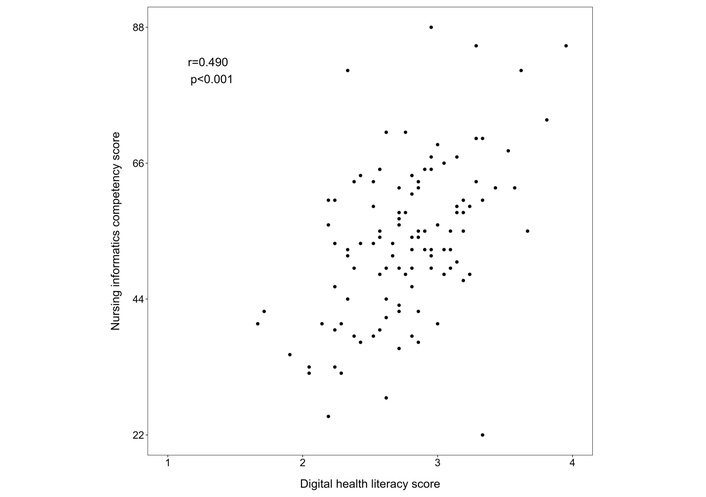
Association between digital health literacy and nursing informatics competency scores. Digital health literacy was measured using the Japanese version of the Digital Health Literacy Instrument, and nursing informatics competency was measured using the Japanese version of the Nursing Informatics Competency Scale. Scores were positively correlated (r = 0.490; P < 0.001).
Table 4 shows the standardized coefficients (β), unstandardized coefficients (B), 95% confidence intervals, P-values, and VIFs for the digital health literacy score and covariates in relation to the nursing informatics competency score. After adjusting for potential confounders, the total digital health literacy score was positively associated with the nursing informatics competency score (β = 0.383, B = 11.537, 95% CI: 5.653–17.421, P < 0.001).
Association between digital health literacya and nursing informatics competencyb.
| Factors | Comparator | β | B (95% CI) | P-value | VIF |
|---|---|---|---|---|---|
| Digital health literacy scorea | per 1 point | 0.383 | 11.537 (5.653, 17.421) | < 0.001 | 1.514 |
| Male | vs. Female | 0.156 | 5.379 (−0.236, 10.995) | 0.060 | 1.050 |
| Educational level: Bachelor’s or master’s degree | vs. Diploma or associate degree | 0.222 | 6.170 (1.184, 11.156) | 0.016 | 1.278 |
| Number of years of clinical nursing experiencec | per 1-unit increase in log (years) | 0.272 | 8.905 (2.094, 15.716) | 0.011 | 1.711 |
| Position: Charge or assistant head nurse | vs. Staff nurse | −0.163 | −4.174 (−9.144, 0.796) | 0.099 | 1.492 |
| Advanced practice certification: Certified nurse | vs. None | 0.045 | 3.071 (−8.232, 14.374) | 0.591 | 1.084 |
| Participation in nursing informatics education: Yes | vs. No | 0.017 | 0.443 (−3.837, 4.723) | 0.838 | 1.091 |
| Attitudes toward using digital devices at work: Positive | vs. Non-positive | 0.118 | 3.189 (−1.345, 7.723) | 0.166 | 1.109 |
| Confidence in using digital devices at work: Confident | vs. Non-confident | 0.021 | 0.640 (−4.983, 6.263) | 0.822 | 1.393 |
Dummy variables were coded 0 for female and 1 for male (sex); 0 for diploma or associate degree and 1 for bachelor’s or master’s degree (educational level); 0 for staff nurse and 1 for charge or assistant head nurse (position); 0 for none and 1 for certified nurse (advanced practice certification); 0 for no and 1 for yes (participation in nursing informatics education); 0 for non-positive [not positive, not very positive, or neither positive nor negative] and 1 for positive [moderately positive or positive] (attitudes toward using digital devices at work); 0 for non-confident [not confident, not very confident, or neither confident nor unconfident] and 1 for confident [moderately confident or confident] (confidence in using digital devices at work).
R2 = 0.339; adjusted R2 = 0.281.
a: Digital health literacy was measured using the Japanese version of the Digital Health Literacy Instrument. The digital health literacy score ranges from 1 to 4, with higher scores indicating greater digital health literacy.
b: Nursing informatics competency was measured using the Japanese version of the Nursing Informatics Competency Scale. The total score for this scale ranges from 22 to 88, with higher scores indicating greater nursing informatics competency.
c: The number of years of experience as a clinical nurse was log-transformed before being included in the regression model.
β: standardized coefficient; B: unstandardized coefficient; CI: confidence interval; VIF: variance inflation factor.
In this study, we investigated the current state of digital health literacy among hospital nurses as well as its association with nursing informatics competency. Our analysis provides two key findings. First, nurses demonstrated moderate digital health literacy, though their proficiency was largely limited to basic information-access skills. Second, digital health literacy was independently and positively associated with nursing informatics competency, remaining the most robust predictor in the multivariable model. These results suggest that individual digital health literacy may represent an important enabling factor for professional nursing informatics competency.
In this study, the total score for digital health literacy among nurses remained at a moderate level. Concerning the subscales, scores for domains such as operational and navigation skills were relatively high, whereas those for domains such as evaluating reliability, determining relevance, and adding self-generated content were comparatively low. Conceptually, these subscales could be grouped into three sequential stages based on the DHLI developers’ framework: (1) information access (operational and navigation skills), (2) information processing (information searching, evaluating reliability, and determining relevance), and (3) information dissemination (adding self-generated content, protecting privacy) skills [14]. Based on this framework, our results indicate that the proficiency of the nurses decreases as the required skills become more complex and interactive. The importance of information processing and dissemination skills has long been emphasized [25]. In particular, information dissemination skills were positioned as a core domain underpinning interactive communication in the concept of “Health 2.0,” proposed in the 2000s, and their significance was recognized early on [26]. However, the persistently low levels of these skills observed in this 2025 study represent a serious concern, suggesting that comprehensive initiatives to improve all the digital health literacy dimensions of the nurses have been insufficient.
Our findings indicated that digital health literacy was positively associated with nursing informatics competency after adjusting for potential confounding factors. Furthermore, digital health literacy exhibited the strongest association with nursing informatics competency in the multivariable model. Effective integration of data, information, and related resources into nursing practice requires the ability to acquire, critically appraise, and disseminate appropriate information [4]. Taken together, our findings suggest that, more than demographic or occupational factors, digital health literacy (i.e., a generic capacity of an individual to use health information) may serve as one important foundational component of nursing informatics competency, a professional information practice skill. However, as highlighted by established frameworks such as the TIGER initiative [4], translating general digital health literacy into professional informatics competency is not a simple linear process. Recent scholarship has also emphasized that advanced informatics competency emerges from complex, interdisciplinary processes [27, 28]. It requires not only the foundational ability to access and evaluate information but also the capacity to integrate, reinterpret, and operationalize knowledge across disciplinary boundaries—combining clinical reasoning with computational and systems perspectives for applied problem-solving. From this perspective, digital health literacy may represent one important enabling component of nursing informatics competency rather than a sufficient explanation for it. Therefore, rather than assuming a straightforward causal relationship from digital health literacy to nursing informatics competency, future research should examine how this association is shaped by broader underlying mechanisms, including interdisciplinary knowledge integration and various contextual factors.
This study retains several limitations. First, the cross-sectional design cannot establish causality; a longitudinal study would be required to confirm the association between digital health literacy and nursing informatics competency. Second, because the exact number of nurses who received the study invitation could not be ascertained, a response rate could not be calculated. This recruitment process may have introduced selection bias, for example, if nurses or institutions with a greater interest in digital technologies or informatics-related topics were more likely to participate. Accordingly, the findings may overestimate the levels of digital health literacy and nursing informatics competency and should be interpreted with caution. Third, although we randomly selected the hospitals, the sample was limited to nurses working in large hospitals, potentially limiting the generalizability of the findings to other regions and healthcare settings. Despite these limitations, this study adds to the emerging literature by showing that digital health literacy was positively associated with nursing informatics competency even after adjustment for potential confounding factors. Given that nursing informatics competency is a broader professional capability that extends beyond the use of digital health information alone, these findings should be interpreted as identifying one potentially important component rather than a sufficient explanation. To build on these correlational findings, future research should employ longitudinal designs to establish directionality. Additionally, intervention studies are needed to evaluate educational strategies that bridge the gap between foundational literacy and applied clinical practice. Such efforts will be vital for developing training programs that effectively translate digital health literacy into higher-order informatics competency.
J-DHLI: Japanese version of the digital health literacy instrument
VIFs: variance inflation factors
We are grateful to all the participants who participated in this study. We thank Aina Muta and Liqian Sun for their contributions to questionnaire design and item review.
All authors listed meet the authorship criteria according to the guidelines of the International Committee of Medical Journal Editors and agree with the manuscript. LL: Conceptualization, Methodology, Formal analysis, Investigation, Data curation, Writing—original draft, Writing—review & editing, Project administration. HF: Conceptualization, Methodology, Formal analysis, Investigation, Data curation, Writing—review & editing, Project administration, Supervision. NS: Conceptualization, Methodology, Formal analysis, Investigation, Data curation, Writing—review & editing, Project administration, Supervision. AM: Conceptualization, Methodology, Formal analysis, Investigation, Data curation, Writing—review & editing, Project administration, Supervision. All authors read and approved the submitted version.
All authors declare no conflicts of interest.
The study protocol was prepared in accordance with the Declaration of Helsinki and approved by the Institutional Review Board of Osaka Metropolitan University (approval date: March 24, 2025; approval number 2024–66).
Informed consent, considered “appropriate consent” under relevant ethical guidelines [29], was obtained by asking participants to check a box in the consent section of the questionnaire to indicate their agreement. Participation was entirely voluntary, and participants were informed that non-participation would involve no penalty or disadvantage. Although recruitment was conducted through nursing leadership, individual responses were accessible only to the research team and were not shared with nursing managers or hospital administrators. No information that could be used to identify individual participants (e.g., names, personal email addresses) was collected.
Not applicable.
The data are not publicly available because of confidentiality agreements with the study participants, in accordance with the study protocol approved by the Institutional Review Board of our university.
No external funding.
© The Author(s) 2026.
Open Exploration maintains a neutral stance on jurisdictional claims in published institutional affiliations and maps. All opinions expressed in this article are the personal views of the author(s) and do not represent the stance of the editorial team or the publisher.
Copyright: © The Author(s) 2026. This is an Open Access article licensed under a Creative Commons Attribution 4.0 International License (https://creativecommons.org/licenses/by/4.0/), which permits unrestricted use, sharing, adaptation, distribution and reproduction in any medium or format, for any purpose, even commercially, as long as you give appropriate credit to the original author(s) and the source, provide a link to the Creative Commons license, and indicate if changes were made.


View: 1435
Download: 36
Times Cited: 0


