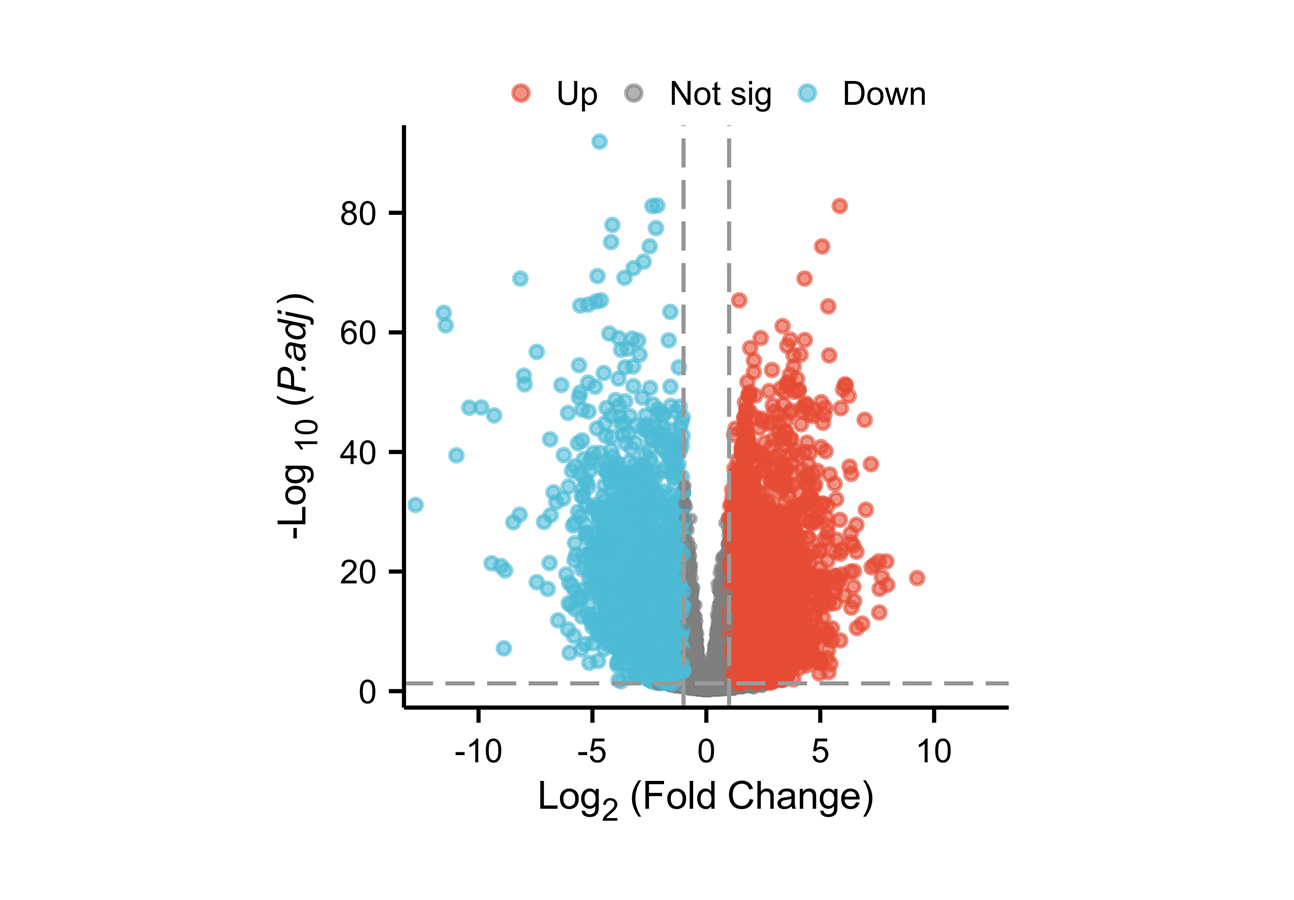
Differential expression analysis of the TCGA data set. Volcano plot of differential expression analysis of the HNSC data set. Not sig: genes that did not meet the significance criteria in the statistical analysis; HNSC: head and neck squamous cell carcinoma
The authors declare that they have no conflicts of interest.
Ethical approval
The data was obtained from the TCGA public database and has no privacy or ethical implications. Ethics approval is therefore not required.
Consent to participate
The data was obtained from the TCGA public database and has no privacy or ethical implications. Consent to participate is therefore not required.
Consent to publication
Not applicable.
Availability of data and materials
The raw data supporting the conclusions of this manuscript will be made available by the authors, without undue reservation, to any qualified researcher.
Riva G, Pecorari G, Biolatti M, Pautasso S, Lo Cigno I, Garzaro M, et al. PYHIN genes as potential biomarkers for prognosis of human papillomavirus-positive or -negative head and neck squamous cell carcinomas.Mol Biol Rep. 2019;46:3333–47. [DOI] [PubMed]
Rahman S, Kraljević Pavelić S, Markova-Car E. Circadian (De)regulation in Head and Neck Squamous Cell Carcinoma.Int J Mol Sci. 2019;20:2662. [DOI] [PubMed] [PMC]
Gatta G, Botta L, Sánchez MJ, Anderson LA, Pierannunzio D, Licitra L, et al.; EUROCARE Working Group:. Prognoses and improvement for head and neck cancers diagnosed in Europe in early 2000s: The EUROCARE-5 population-based study.Eur J Cancer. 2015;51:2130–43. [DOI] [PubMed]
Duran G, Aguín S, Cruz R, Barros F, Giráldez JM, Bernárdez B, et al. Association of GSTP1 and ERCC1 polymorphisms with toxicity in locally advanced head and neck cancer platinum-based chemoradiotherapy treatment.Head Neck. 2019;41:2704–15. [DOI] [PubMed]
Ferlay J, Colombet M, Soerjomataram I, Dyba T, Randi G, Bettio M, et al. Cancer incidence and mortality patterns in Europe: Estimates for 40 countries and 25 major cancers in 2018.Eur J Cancer. 2018;103:356–87. [DOI] [PubMed]
Lampri ES, Chondrogiannis G, Ioachim E, Varouktsi A, Mitselou A, Galani A, et al. Biomarkers of head and neck cancer, tools or a gordian knot?Int J Clin Exp Med. 2015;8:10340–57. [PubMed] [PMC]
Budach V, Tinhofer I. Novel prognostic clinical factors and biomarkers for outcome prediction in head and neck cancer: a systematic review.Lancet Oncol. 2019;20:e313–26. [DOI] [PubMed]
Ohmuraya M, Yamamura K. The Roles of Serine Protease Inhibitor Kazal Type 1 (SPINK1) in Pancreatic Diseases.Exp Anim. 2011;60:433–44. [DOI] [PubMed]
Lu SM, Lu W, Qasim MA, Anderson S, Apostol I, Ardelt W, et al. Predicting the reactivity of proteins from their sequence alone: Kazal family of protein inhibitors of serine proteinases.Proc Natl Acad Sci U S A. 2001;98:1410–5. [DOI] [PubMed] [PMC]
Rawlings ND, Tolle DP, Barrett AJ. Evolutionary families of peptidase inhibitors.Biochem J. 2004;378:705–16. [DOI] [PubMed] [PMC]
Laskowski M Jr, Kato I. Protein inhibitors of proteinases.Annu Rev Biochem. 1980;49:593–626. [DOI] [PubMed]
Hoefnagel JJ, Dijkman R, Basso K, Jansen PM, Hallermann C, Willemze R, et al. Distinct types of primary cutaneous large B-cell lymphoma identified by gene expression profiling.Blood. 2005;105:3671–8. [DOI] [PubMed]
Stenman UH. Role of the tumor-associated trypsin inhibitor SPINK1 in cancer development.Asian J Androl. 2011;13:628–9. [DOI] [PubMed] [PMC]
Hänzelmann S, Castelo R, Guinney J. GSVA: gene set variation analysis for microarray and RNA-seq data.BMC Bioinformatics. 2013;14:7. [DOI] [PubMed] [PMC]
Laflamme BA, Wolfner MF. Identification and function of proteolysis regulators in seminal fluid.Mol Reprod Dev. 2013;80:80–101. [DOI] [PubMed] [PMC]
Xu L, Lu C, Huang Y, Zhou J, Wang X, Liu C, et al. SPINK1 promotes cell growth and metastasis of lung adenocarcinoma and acts as a novel prognostic biomarker.BMB Rep. 2018;51:648–53. [DOI] [PubMed] [PMC]
Ida S, Ozaki N, Araki K, Hirashima K, Zaitsu Y, Taki K, et al. SPINK1 Status in Colorectal Cancer, Impact on Proliferation, and Role in Colitis-Associated Cancer.Mol Cancer Res. 2015;13:1130–8. [DOI] [PubMed]
Tiwari R, Pandey SK, Goel S, Bhatia V, Shukla S, Jing X, et al. SPINK1 promotes colorectal cancer progression by downregulating Metallothioneins expression.Oncogenesis. 2015;4:e162. [DOI] [PubMed] [PMC]
Zhang J, Wang D, Hu N, Wang Q, Yu S, Wang J. The construction and proliferative effects of a lentiviral vector capable of stably overexpressing SPINK1 gene in human pancreatic cancer AsPC-1 cell line.Tumour Biol. 2016;37:5847–55. [DOI] [PubMed]
Mehner C, Oberg AL, Kalli KR, Nassar A, Hockla A, Pendlebury D, et al. Serine protease inhibitor Kazal type 1 (SPINK1) drives proliferation and anoikis resistance in a subset of ovarian cancers.Oncotarget. 2015;6:35737–54. [DOI] [PubMed] [PMC]
Du P, Chai Y, Zong S, Yue J, Xiao H. Identification of a Prognostic Model Based on Fatty Acid Metabolism-Related Genes of Head and Neck Squamous Cell Carcinoma.Front Genet. 2022;13:888764. [DOI] [PubMed] [PMC]
Agerberth B, Söderling-Barros J, Jörnvall H, Chen ZW, Ostenson CG, Efendić S, et al. Isolation and characterization of a 60-residue intestinal peptide structurally related to the pancreatic secretory type of trypsin inhibitor: influence on insulin secretion.Proc Natl Acad Sci U S A. 1989;86:8590–4. [DOI] [PubMed] [PMC]
Metsis M, Cintra A, Solfrini V, Ernfors P, Bortolotti F, Morrasutti DG, et al. Molecular cloning of PEC-60 and expression of its mRNA and peptide in the gastrointestinal tract and immune system.J Biol Chem. 1992;267:19829–32. [PubMed]
Norberg A, Gruber S, Angelucci F, Renlund S, Wadensten H, Efendic S, et al. Identification of the bioactive peptide PEC-60 in brain.Cell Mol Life Sci. 2003;60:378–81. [DOI] [PubMed] [PMC]
Mägert HJ, Ständker L, Kreutzmann P, Zucht HD, Reinecke M, Sommerhoff CP, et al. LEKTI, a Novel 15-Domain Type of Human Serine Proteinase Inhibitor.J Biol Chem. 1999;274:21499–502. [DOI] [PubMed]
Sun S, Su G, Zheng X. Inhibition of the Tumor Suppressor Gene SPINK5 via EHMT2 Induces the Oral Squamous Cell Carcinoma Development.Mol Biotechnol. 2024;66:208–21. [DOI] [PubMed]
Zhao C, Zou H, Zhang J, Wang J, Liu H. An integrated methylation and gene expression microarray analysis reveals significant prognostic biomarkers in oral squamous cell carcinoma.Oncol Rep. 2018;40:2637–47. [DOI] [PubMed] [PMC]
Li Y, Lu Z, Che Y, Wang J, Sun S, Huang J, et al. Immune signature profiling identified predictive and prognostic factors for esophageal squamous cell carcinoma.Oncoimmunology. 2017;6:e1356147. [DOI] [PubMed] [PMC]
Plaza K, Kalinska M, Bochenska O, Meyer-Hoffert U, Wu Z, Fischer J, et al. Gingipains of Porphyromonas gingivalis Affect the Stability and Function of Serine Protease Inhibitor of Kazal-type 6 (SPINK6), a Tissue Inhibitor of Human Kallikreins.J Biol Chem. 2016;291:18753–64. [DOI] [PubMed] [PMC]
Li Z, Zheng C, Liu H, Lv J, Wang Y, Zhang K, et al. A novel oxidative stress-related gene signature as an indicator of prognosis and immunotherapy responses in HNSCC.Aging (Albany NY). 2023;15:14957–84. [DOI] [PubMed] [PMC]
Cheng X, Shen Z, Yin L, Lu S, Cui Y. ECRG2 Regulates Cell Migration/Invasion through Urokinase-type Plasmin Activator Receptor (uPAR)/ β1 Integrin Pathway.J Biol Chem. 2009;284:30897–906. [DOI] [PubMed] [PMC]
Redelfs L, Fischer J, Weber C, Wu Z, Meyer-Hoffert U. The serine protease inhibitor of Kazal-type 9 (SPINK9) is expressed in lichen simplex chronicus, actinic keratosis and squamous cell carcinoma.Arch Dermatol Res. 2016;308:133–7. [DOI] [PubMed]
Huang J, Wang L, Jiang M, Lin H, Qi L, Diao H. PTHLH coupling upstream negative regulation of fatty acid biosynthesis and Wnt receptor signal to downstream peptidase activity-induced apoptosis network in human hepatocellular carcinoma by systems-theoretical analysis.J Recept Signal Transduct Res. 2012;32:250–6. [DOI] [PubMed]
Tanaka T, Duke-Cohan JS, Kameoka J, Yaron A, Lee I, Schlossman SF, et al. Enhancement of antigen-induced T-cell proliferation by soluble CD26/dipeptidyl peptidase IV.Proc Natl Acad Sci U S A. 1994;91:3082–6. [DOI] [PubMed] [PMC]
Goulas T, Garcia-Ferrer I, Marrero A, Marino-Puertas L, Duquerroy S, Gomis-Rüth FX. Structural and functional insight into pan-endopeptidase inhibition by α2-macroglobulins.Biol Chem. 2017;398:975–94. [DOI] [PubMed]
Zheng W, Xu HE, Johnston SA. The Cysteine-Peptidase Bleomycin Hydrolase Is A Member of the Galactose Regulon in Yeast.J Biol Chem. 1997;272:30350–5. [DOI] [PubMed]
Guo Z, Zhao Y, Xu M, Zhao L, Wang X. Natural killer cell-based signature: Prognostic analysis in head and neck squamous cell carcinoma.J Gene Med. 2024;26:e3671. [DOI] [PubMed]
Xu X, Li J, Zou J, Feng X, Zhang C, Zheng R, et al. Association of Germline Variants in Natural Killer Cells With Tumor Immune Microenvironment Subtypes, Tumor-Infiltrating Lymphocytes, Immunotherapy Response, Clinical Outcomes, and Cancer Risk.JAMA Netw Open. 2019;2:e199292. [DOI] [PubMed] [PMC]
Shu T, Wang X. Cuproptosis combines immune landscape providing prognostic biomarker in head and neck squamous carcinoma.Heliyon. 2023;9:e15494. [DOI] [PubMed] [PMC]
Liu S, Wang S, Wang Z. Identification of genetic mechanisms underlying lipid metabolism-mediated tumor immunity in head and neck squamous cell carcinoma.BMC Med Genomics. 2023;16:110. [DOI] [PubMed] [PMC]
Tan M, Lin X, Chen H, Ye W, Yi J, Li C, et al. Sterol regulatory element binding transcription factor 1 promotes proliferation and migration in head and neck squamous cell carcinoma.PeerJ. 2023;11:e15203. [DOI] [PubMed] [PMC]