Case Report


Affiliation:
1Department of Physical Therapy, Congdon School of Health Science, High Point University, High Point, NC 27262, US
2Department of Athletics, High Point University, High Point, NC 27262, US
Email: twyatt2@highpoint.edu; tommywyattdpt@gmail.com
ORCID: https://orcid.org/0009-0006-9900-4440


 ,
,
Affiliation:
2Department of Athletics, High Point University, High Point, NC 27262, US
Explor Musculoskeletal Dis. 2026;4:1007134 DOI: https://doi.org/10.37349/emd.2026.1007134
Received: May 14, 2026 Accepted: August 04, 2026 Published: August 23, 2026
Academic Editor: Nader Rahnama, University of Isfahan, Iran
Exercise-associated muscle cramps (EAMC) remain a significant clinical challenge in elite athletics, often attributed to either electrolyte depletion or altered neuromuscular control. While traditional management focuses on stretching and rehydration, these methods may be insufficient for rapid return to play (RTP) in high-stakes settings with minimal downtime before the next competition. This case report explores the acute application of dry needling (DN) to resolve recurrent EAMC in a 23-year-old National Collegiate Athletic Association (NCAA) Division I basketball athlete. The athlete presented with a severe, involuntary spasm of the right adductor magnus (AM) following a single-leg landing. Initial sideline manual therapy and rehydration provided only transient relief; upon RTP, the athlete sustained a recurrence described as a tenfold increase in intensity, necessitating removal from competition. Within 5 hours of injury, trigger point dry needling (TrP-DN) was administered to the ischiocondylar portion of the AM to facilitate a neuromuscular reset. The intervention resulted in immediate resolution of symptoms and a rapid return to prior performance. The athlete successfully returned to competition the following day, participating in two subsequent games within 48 hours without recurrence or performance deficits. This case demonstrates that DN can serve as a safe and highly effective intervention for the acute management of EAMC, in conjunction with traditional interventions. These findings suggest that directly targeting the motor endplate via DN may more effectively downregulate the neuromuscular hyperexcitability compared to traditional manual stretching and rehydration alone.
Exercise-associated muscle cramps (EAMC) present a persistent and often frustrating clinical hurdle in elite athletics, particularly within the high-velocity, high-stochastic environment of National Collegiate Athletic Association (NCAA) Division I basketball. EAMC are defined as painful, involuntary, and sustained contractions of skeletal muscle occurring during or immediately following physical activity [1, 2]. Traditionally, these contractions were attributed to simple dehydration-electrolyte imbalances; however, recent literature has shifted the focus toward the altered neuromuscular control theory [1, 3]. This framework suggests that localized muscle fatigue leads to a critical imbalance between excitatory drive from muscle spindles and inhibitory feedback from Golgi tendon organs (GTOs) [4, 5]. The result is a localized state of alpha motor neuron hyperexcitability that manifests as a cramp.
In the context of rebounding and lateral deceleration in this case, the adductor magnus (AM), specifically its ischiocondylar or ‘hamstring’ portion, serves as a primary stabilizer of the pelvis [6, 7]. When the tissue is subjected to abrupt eccentric loading, the muscle spindle’s afferent response can become exaggerated, while the GTOs’ inhibitory influence is diminished by neuromuscular fatigue, in an environment heavily influenced by hydration and electrolyte balance [1, 3]. This can result in EAMC of the AM. While standard sideline care typically involves passive static stretching, neurodynamic glides, and thermoregulating modalities and hydration, they often fail to downregulate the underlying motor endplate irritability and excitability [5]. This leads to the risk of recurrent spasms and incomplete resolution of symptoms, especially in the acute phase. Recurrent spasms are often reported to become more intense per episode [8–10].
This report details the successful and safe integration of dry needling (DN) to resolve acute AM spasms in an elite athlete, facilitating a symptom-free return to competition within 24 hours post-injury to participate in the subsequent scheduled competition.
The timeline of events and management of the athlete is provided in Table 1.
Timeline of events and management.
| Date | Description | Summary |
|---|---|---|
| 03/06/2026 | Day 1: Game #1—initial injury | Athlete presented with an in-game injury and was removed from play for off-court evaluation. |
| 03/06/2026 | Day 1: return to play (RTP) post initial treatment | Athlete was evaluated and treated with manual therapy techniques and rehydration efforts. |
| 03/06/2026 | Day 1: Recurrent injury | Athlete returned to the game and sustained a recurrent injury within 10 minutes of the first episode. Athlete was removed from gameplay for the remainder of the game. |
| 03/06/2026 | Day 1: Acute management < 5 hours post initial injury | Within 5 hours post-competition, the athlete was treated with dry needling, manual therapy, rehydration, therapeutic exercise, and taping/compression techniques. |
| 03/06/2026 | Day 1: Treatment < 12 hours post initial injury | Within 12 hours post-competition, a 2nd round of manual therapy, rehydration, therapeutic exercise, and taping/compression techniques were administered. |
| 03/07/2026 | Day 2: Morning evaluation | Athlete was evaluated in the morning for clearance to participate in 2nd competition. Athlete was cleared for gameplay, with monitoring of warm-ups for any changes in symptoms or function. |
| 03/07/2026 | Day 2: Morning treatment | Athlete was treated with a round of manual therapy and taping/compression techniques. Hydration levels were monitored. |
| 03/07/2026 | Day 2: Game #2 | Athlete was able to play expected volume in game #2. Modified pre-game warm-up; added cycling and moved active/dynamic warm-up closer to game start to avoid cooling down |
| 03/07/2026 | Day 2: Post-game treatment | Athlete underwent a round of dry needling, manual therapy, and therapeutic exercise within 8 hours of competition. |
| 03/08/2026 | Day 3: Game #3 | Athlete was able to play game #3 without restrictions in performance. |
| 03/09/2026 | Post game #3 | Athlete showed no symptoms of lingering injury or side effects from treatment and repeated competition in a short time period. |
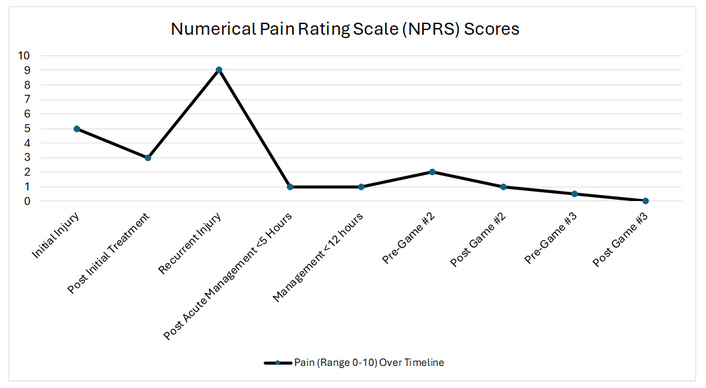
A 23-year-old male Division I basketball player presented with EAMC secondary to a strain of the AM (hamstring portion) during a single-leg landing. The athlete jumped to grab a rebound, and upon landing on the right lower extremity, he was observed with significant right lateral trunk lean and near terminal knee extension with the hip in neutral. This case was complicated by the nature of the event, the conference championship weekend, which called for the athlete to be able to play 3 basketball games in 3 days. The mechanism of injury matched an adductor strain in a closed kinetic chain. Within seconds of the landing, the athlete grabbed for the posteromedial portion of the leg, right at the ischial tuberosity. The athlete was able to bear weight and hopped off the court to be evaluated. Observation revealed a visible and palpable muscle cramp of the AM. The athlete was placed in supine for a static strength test of the hamstring: the straight leg raise (SLR) variation. This was discontinued due to the increased intensity of symptoms reported by the athlete. Sciatic nerve flossing in supine, with manual compression of the attachment at the ischial tuberosity. The athlete was observed with a lack of sweat (this is an athlete who typically sweats profusely). Symptoms included a local cramping sensation, with tenderness to palpation. Symptoms were worsened with prolonged contraction of the hamstring or adductors during strength testing, and with passive leg raise strength testing. Subjectively, the athlete reported the symptoms were reduced and tolerable, electing to continue play. The irritability of the symptoms remained constant. The athlete returned to play and had a recurrence of injury after about 10 minutes. The athlete reported the same symptoms and presentation but reported the intensity of the discomfort to be 10× worse. The athlete was removed from play for the remainder of the competition.
Within 5 hours of the injury, the athlete was treated with trigger point dry needling (TrP-DN) of the AM (hamstring portion). The athlete was also treated with muscle energy techniques, sciatic nerve flossing, active release technique, and reciprocal inhibition via quad isometrics. The athlete completed multiple rounds of 10–15-minute-long duration low-load stretching in the supine position, with both heels placed on a wall near 90 degrees of hip flexion. Kinesiology tape was placed above and below the site of cramping, along with down the belly of the hamstrings. Compression shorts were worn over top. The athlete reported a significant decrease in pain and an increase in function post TrP-DN. Later that night, within 12 hours of injury, the athlete completed a second round of the manual therapy and therapeutic exercise techniques noted above. From initial onset to the 12-hour mark, the athlete was placed on a rehydration regimen with electrolyte replacement beverages and water. The next morning, the athlete reported feeling local stiffness in the AM region, with some residual muscle soreness. No other complaints were noted.
TrP-DN was performed using a 0.25 × 60 mm needle, piston technique. 3 needles were used, one at a time, in 3 different locations of the AM. All locations formed a triangle pattern, no more than 1 inch away from each other. Each needle was placed and removed before the next needle was placed for TrP-DN. Total of 3 insertions. Multiple local muscle twitch responses were elicited. Hemostasis was applied. No adverse reactions at the time of treatment. The number of repetitions was not standardized; the clinician terminated needling upon cessation of local twitch responses (LTRs). The clinician performing the DN is a physical therapist, board-certified as a sports clinical specialist, with a certification in DN.
The athlete was cleared for participation, with close monitoring of the warm-ups before a final decision. Observation during warm-ups revealed avoidance of single-leg stance weight-bearing on the right lower extremity in some movement patterns. Compensations with increased double-leg movement patterns noted. The athlete was shying away from loading the right lower extremity. The athlete was able to perform all basketball movements and was cleared to play the game. As the game went on, the athlete began to sweat within their normal limits and worried about the right lower extremity less and less as the game went on. The compensation patterns began to fade, and the athlete was able to finish the entire game without reinjury.
After the second game, the athlete reported feeling good once the game got started. A few hours later, he reported similar stiffness and soreness to the morning. The athlete received another round of TrP-DN in the AM, along with the previously mentioned manual therapy, therapeutic exercise, and taping/compression techniques. The athlete again tolerated TrP-DN well with a significant reduction in symptoms and increased function. The morning of the third game, the athlete noted slight tightness and minimal soreness. The athlete was again cleared to play and was able to play game 3 without any compensation, decrease in performance, or increase in symptoms. Upon the conclusion of the tournament, when returned to the university, the athlete did not complain or show signs of continued injury. The pain rating reported by the athlete throughout the timeline of the case is shown in Figure 1.
The diagnostic results of the initial sideline evaluation for the athlete are represented in Table 2. From the results of the sideline evaluation, the differential diagnosis list was made to include EAMC, or AM (hamstring portion) strain. In the brief, approximately 2-minute evaluation, it was concluded that the signs and symptoms fit EAMC. Imaging was not available or used in this case. There were no signs of swelling or bruising. No obvious deformities. The athlete’s symptoms were provoked by prolonged contraction of the AM. The reported cramping sensation was the limiting factor in range of motion and strength testing. Diagnosis was also limited due to no loss of function. Athlete performance of basketball-related tasks was only affected by the presence of the cramping/pain sensation. The lack of functional decline (outside of pain) limited useful outcome measures, as did the time frame in which this case took place.
Diagnostic test results of initial sideline evaluation.
| Test Name | Results | Normal Range | Interpretation |
|---|---|---|---|
| SLR | Production of symptoms at 60 degrees | 80–90 degrees | Reproduction of local pain and decreased tolerance to muscle lengthening. Positive hamstring muscle guarding and decreased range of motion. |
| Supine hamstring MMT | 4+/5 MMT with reproduction of symptoms at > 3 seconds of isometric contraction. | 5/5 MMT, pain-free. | Strength has been preserved, with a reported cramping sensation with prolonged contraction. |
| Sidelying adductor MMT | 4+/5 MMT with reproduction of symptoms at > 3 seconds of isometric contraction. | 5/5 MMT, pain-free. | Strength has been preserved, with a reported cramping sensation with prolonged contraction. |
| Observation | No obvious swelling, deformity, or bruising. Athlete was able to self-ambulate. Palpable muscle knot/cramp in the AM. | No obvious swelling, deformity, or bruising. Athlete was able to self-ambulate. | Local cramping of the hamstring portion of the AM. |
AM: adductor magnus; MMT: manual muscle test; SLR: straight leg raise.
The athlete expressed great satisfaction with the outcome of this case. His motivation to return to play (RTP) was high post initial sideline evaluation, as it was concluded that the injury would not prevent him from returning. Following the recurrent injury, the athlete was slightly discouraged due to not finishing the game. His motivation to play the next 2 games remained high; thus, he was very open to treatments and techniques to facilitate such a quick return. The athlete noted the most helpful intervention was the DN, and the patient showed great compliance with the other adjunctive treatments in this case. The athlete was very happy when cleared to play the 2 contests post initial injury. The athlete expressed great gratitude for the treatment and care provided. The athlete felt good about their athletic performance in the final 2 contest, both leading to team wins, a conference championship, and a bid to the NCAA tournament.
This case report highlights the successful application of DN as an acute intervention for recurrent EAMC in a Division I basketball athlete. The importance of the case lies in the rapid resolution of a ‘tenfold’ increase in symptom intensity, despite the failure of initial manual therapy and the presence of systemic thermoregulatory imbalance, with 3 full contests in 3 days, 24 hours apart. Current clinical practice guidelines for the management of EAMC include gentle stretching, resting in a position of comfort, oral rehydration, and gentle massage. May also include intravenous fluids [11]. DN may provide added value as a complementary strategy due to the mechanisms described below.
TrP-DN provides a unique intervention that can provide physiological change by directly targeting active and latent myofascial trigger points (mTrPs) within the hyperactive muscle [8, 9]. By eliciting an LTR, DN is hypothesized to facilitate an immediate neuromuscular reset of the muscle [9]. The mechanical stimulation of the needle disrupts dysfunctional activity at the motor endplate and triggers an instant and brief refractory period in the hyperactive motor units, effectively breaking the loop of the neuromuscular hyperexcitability [10]. The application of DN within 5 hours of the injury provided a localized ‘neuromuscular reset’ that manual therapy failed to achieve [8]. Insertion of the needle into the active mTrPs in the AM elicits LTRs [8, 9]. These responses are hypothesized to disrupt dysfunctional activity at the motor endplate and trigger a brief refractory period in the hyperactive motor units, effectively breaking the loop of hyperexcitability [8]. DN has been shown to rapidly reduce the concentration of local nociceptive substances, while facilitating oxygenated blood flow to a hypoxic environment like a cramp [5, 9]. The results of this case add to the evidence base supporting this hypothesis. These dual action mechanisms help explain the patient’s significant decrease in pain and immediate restoration of function and performance. The LTR has been shown to rapidly reduce the concentration of local pro-nociceptive substances, such as substance P and calcitonin gene-related peptide, which are often elevated in fatigued, cramped tissue [10]. The DN also brings oxygenated blood flow to the hypoxic environment created by the sustained contraction of the cramp and allows for an acute inflammatory response to promote a positive healing environment, with some noted analgesic effects [8]. These mechanisms may potentially explain the alleviation of EAMC symptoms regarding the neuromuscular control theory.
The use of DN in the acute phase (< 5 hours post-injury) represents a significant clinical deviation from traditional protocols that often reserve needling for sub-acute or chronic conditions. In a highly stochastic environment of Division I basketball tournament play, where recovery windows are limited to 24 hours, DN served as a critical intervention, supported with rehydration and movement-based recovery. Despite the growing use of DN in clinical practice, there remains a significant gap in the literature regarding its application as an acute intervention for the rapid RTP following recurrent EAMC. This case is particularly noteworthy due to the observed systemic thermoregulatory stress, noted as a lack of diaphoresis during play, which likely exacerbated the localized muscular hyperexcitability, and the use of DN within 5 hours of injury. In this case, the athlete was tasked with playing 3 basketball games in 3 days, with about 24 hours between each contest.
A critical consideration in this case is whether the athlete’s rapid recovery was a result of the DN intervention or simply a product of spontaneous resolution. Several clinical factors suggest that the recovery was directly attributable to the intervention. First, the athlete experienced a high-intensity recurrence within ten minutes of returning to play after initial rest and manual stretching. This recurrence, described by the athlete as tenfold more intense than the initial episode, indicates that the underlying neuromuscular drive was not self-limiting and remained in a state of alpha motor neuron hyperexcitability.
Spontaneous recovery from EAMC typically requires significant metabolic rest and the removal of the fatiguing stimulus to allow for the restoration of the balance between muscle spindle and GTO activity [1]. However, this athlete reported an immediate resolution of "grabbing" sensations and functional gait deficits following TrP-DN, despite these symptoms having persisted for four hours post-competition. The mechanical stimulation of the needle into active mTrPs is hypothesized to facilitate an immediate “neuromuscular reset” by eliciting an LTR. This LTR disrupts the dysfunctional activity at the motor endplate and triggers a brief refractory period in hyperactive motor units, effectively breaking the loop of hyperexcitability in a manner that passive rest alone does not achieve [8].
Furthermore, the athlete was able to participate in two additional high-intensity contests within the following 48 hours without any recurrence of symptoms. Given the reported severity of the recurrent spasm and the observed systemic thermoregulatory stress (anhidrosis), a spontaneous recovery that allowed for an immediate return to elite-level performance without residual irritability is highly improbable. The successful outcome in this case supports the use of DN to acutely downregulate the biochemical and neuromuscular drivers of EAMC, providing a faster and more stable resolution than the natural history of the condition would suggest. The findings in this case suggest that including DN in the acute management of EAMC may offer a sooner RTP than manual therapy and rehydration alone.
This case demonstrates that DN is a safe and highly effective intervention for the acute management of recurrent EAMC in elite athletes, performed in conjunction with traditional acute management. By directly addressing the neuromuscular and biochemical drivers of the muscle spasms, clinicians can facilitate a faster and more stable return to competition, versus traditional manual therapy and rehydration alone. The successful resolution of symptoms allowed the athlete to participate in high-stakes competition without a decline in performance or high risk of reinjury. Future research should explore the efficacy of early intervention DN in athletes exhibiting signs of EAMC, potentially exploring immediate intervention and its effect on returning to the same competition. Limitations of this study include a single-patient design, absence of a control condition, possible spontaneous recovery, multimodal interventions, lack of imaging in diagnostics, no use of thermoregulatory measurements, and the possibility of observer bias.
AM: adductor magnus
DN: dry needling
EAMC: exercise-associated muscle cramps
GTOs: Golgi tendon organs
LTRs: local twitch responses
mTrPs: myofascial trigger points
NCAA: National Collegiate Athletic Association
RTP: return to play
TrP-DN: trigger point dry needling
The authors would like to acknowledge the collaborative efforts of the High Point University Sports Medicine and Strength & Conditioning departments. Specifically, the authors thank Will Sullivan (CSCS, MS) for his integral role in rehydration efforts that contributed to this athlete’s safe return to competition.
TW: Conceptualization, Investigation, Writing—original draft, Writing—review & editing. QH: Writing—review & editing. Both authors read and approved the submitted version.
The authors declare that there are no conflicts of interest.
All investigating authors/participants are certified by the Collaboration Institutional Training Initiative (CITI Program) for human subject research, ethics compliance, responsible conduct of research, and biomedical-basic research. This study was granted exemption by the Institutional Review Board of High Point University, IRB-FY2026-111. This study complies with the Declaration of Helsinki.
Informed consent to participate in the study was obtained from the participant.
Informed consent to publication was obtained from the participant.
The datasets that support the findings of this case report are available from the corresponding author upon reasonable request.
Not applicable.
© The Author(s) 2026.
Open Exploration maintains a neutral stance on jurisdictional claims in published institutional affiliations and maps. All opinions expressed in this article are the personal views of the author(s) and do not represent the stance of the editorial team or the publisher.
Copyright: © The Author(s) 2026. This is an Open Access article licensed under a Creative Commons Attribution 4.0 International License (https://creativecommons.org/licenses/by/4.0/), which permits unrestricted use, sharing, adaptation, distribution and reproduction in any medium or format, for any purpose, even commercially, as long as you give appropriate credit to the original author(s) and the source, provide a link to the Creative Commons license, and indicate if changes were made.



View: 617
Download: 14
Times Cited: 0