Original Article


Affiliation:
1Department of Health Policy, London School of Economics and Political Sciences, WC2A 2AE London, United Kingdom
ORCID: https://orcid.org/0000-0002-7348-2333

 ,
,
Affiliation:
2College of Medicine, Mohammed Bin Rashid University of Medicine and Health Sciences (MBRU), Dubai Health, Dubai 505055, United Arab Emirates
ORCID: https://orcid.org/0009-0005-0145-0075
,
Affiliation:
3Midwestern University GME Consortium, Canyon Vista Medical Center, Sierra Vista, AZ 85635, United States
ORCID: https://orcid.org/0000-0001-8792-7463
,
Affiliation:
2College of Medicine, Mohammed Bin Rashid University of Medicine and Health Sciences (MBRU), Dubai Health, Dubai 505055, United Arab Emirates
Email: nelbasy03@gmail.com
ORCID: https://orcid.org/0009-0003-4648-9577
 ,
,
Affiliation:
4Department of Management, Marketing and Quality Assurance in Pharmacy, National University of Pharmacy of the Ministry of Health of Ukraine, Kharkiv 61002, Ukraine
5Ludwig Boltzmann Institute Digital Health and Patient Safety, Medical University of Vienna, 1090 Vienna, Austria
ORCID: https://orcid.org/0000-0003-1578-7398
,
Affiliation:
5Ludwig Boltzmann Institute Digital Health and Patient Safety, Medical University of Vienna, 1090 Vienna, Austria
6Department of Biotechnology and Nutrigenomics, Institute of Genetics and Animal Biotechnology of the Polish Academy of Sciences, 05-552 Magdalenka, Poland
7Department of Biochemistry, Saveetha Medical College and Hospital, Saveetha Institute of Medical and Technical Sciences, Chennai 602 105, Tamil Nadu, India
8Patient Safety & Digital Health (PaDiH) Group, Fakultät Medizin/Zahnmedizin, Danube Private University, Krems-Stein 3500, Austria
ORCID: https://orcid.org/0000-0003-2545-0967
,
Affiliation:
9Psychiatry, Al Amal Psychiatric Hospital, Emirates Health Services, Dubai 2299, United Arab Emirates
ORCID: https://orcid.org/0000-0002-0701-7628
Explor Digit Health Technol. 2026;4:101183 DOI: https://doi.org/10.37349/edht.2026.101183
Received: August 21, 2025 Accepted: November 04, 2025 Published: January 20, 2026
Academic Editor: Stamatios Papadakis, University of Crete, Greece
Aim: This study aims to evaluate the outreach achieved by psychiatry-related posts using the hashtag #YouthMentalHealth, highlighting how social media platforms can shape public discourse on adolescent mental health.
Methods: We utilized the Fedica research analytics tool to characterize posts containing #YouthMentalHealth from January 10, 2018, to January 10, 2023. This analysis examined the #YouthMentalHealth activity timeline, identifying the number of posts containing the hashtag and the geographical distribution to assess the effectiveness of hashtag campaigns.
Results: The #YouthMentalHealth movement resulted in 58,000 posts shared by around 25,000 X users, generating 292.7 million impressions (views). The top three countries from which most posts containing #YouthMentalHealth were shared included the United States (35.14%), Canada (29.15%), and the United Kingdom (14.37%). The three largest contributor groups were management companies (20.6%), educational advocacy organizations (17.5%), and social advocacy groups (14%).
Conclusions: This first-of-its-kind study explores the impact and utilization of #YouthMentalHealth globally, reporting trends and patterns from digital media platforms. By mapping the hashtag’s global footprint, the study offers novel insights into how digital advocacy can amplify youth mental health awareness and connect multidisciplinary stakeholders. These findings contribute to emerging frameworks in digital psychiatry by underscoring the role of social media as a complementary tool for mental health promotion and community engagement, while illuminating diverse strategies to aid the psychiatric community in effectively addressing the mental health needs of adolescents.
The World Health Organization (WHO) estimates that one in seven young people aged 10–19 years experiences a mental health condition, contributing to 13% of the global disease burden within this age demographic [1].
In the 21st century, the rapid rise of digital technology and social media has significantly impacted the mental health outcomes of young people, with X (formerly known as Twitter) serving as a significant platform for public discourse related to advocacy, social support, and knowledge dissemination.
Current frameworks for understanding and addressing youth mental health are outdated and require revision. With social media now serving as one of the primary means of reaching young people, evaluating its role in shaping awareness and delivering interventions is crucial. The rise of digital addiction, increasingly recognized as a significant issue in recent decades, further emphasizes how deeply digital platforms influence youth behavior and well-being [2]. Prior research has even shown a link between digital addiction and outcomes such as academic performance, underscoring the broader impact of excessive digital engagement [3].
Understanding how key stakeholders use social media platforms like X to communicate about mental health becomes increasingly important in this context. Healthcare professionals, policymakers, politicians, mental health advocates, and academics use X to engage in dialogue, share expert opinions, and shape public perceptions of mental health [4]. As such, it is essential to analyze how these interactions emerge and shape into trends in digital environments. Academic research has shown that online discourse on mental health may foster a safe space for community-driven engagement or serve as an active tool to spread disinformation [5, 6].
The #YouthMentalHealth hashtag is a primary way to encourage dialogue and conversations, strengthen positive interactions, and promote collective community action to galvanize public opinion on youth mental health. The need for in-depth academic investigations into the significance of hashtags has been explored by studies on other hashtags, such as #GlobalHealth [7], #physiotherapy [8], and #PsychTwitter [9], among others [10, 11]. These studies examined the relevant stakeholders’ perceptions and patterns of use of the X platform among relevant stakeholders in relation to global health and mental health issues. Moreover, previous research has shown that hashtag analysis can reveal specific tactics that can boost engagement several-fold, underscoring the value of analyzing social media patterns for informing future campaigns relevant to public health or biomedical science communication [12]. Supporting the insistence on data-driven investigation, the approach exemplifies the ongoing shift toward data-driven health-related research and digital innovation noted in recent literature, leveraging big data analytics in diverse domains with biomedical significance [13, 14]. Despite this growing literature, no prior study has comprehensively examined the #YouthMentalHealth movement on a global scale or quantified its reach and stakeholder composition. This study uniquely contributes to closing that gap by providing the first large-scale, five-year analysis of psychiatry-related digital discourse on X focused specifically on youth mental health. By integrating social media analytics with theoretical frameworks in digital health communication, our work advances current understanding of how multi-sector stakeholders mobilize online advocacy to shape youth mental health narratives. In this context, our research aims to explore the influence, outreach, and effectiveness of hashtag campaigns targeting #YouthMentalHealth over a five-year period on X, highlighting the discourse’s major influencers, geographic spread, and sociodemographic trends during the COVID-19 pandemic.
Social media communication and public health frameworks inform this research. We draw on the Social Ecological Model to interpret multi-level engagement (individual vs. organizational participation) in the #YouthMentalHealth discourse, and Uses & Gratifications theory to explain stakeholder motivations. This theoretical framing extends beyond description, enabling us to hypothesize how different actors [individuals, Non-Governmental Organizations (NGOs), governments] utilize the hashtag for various purposes (e.g., awareness, advocacy, support). By situating our analysis within a theoretical framework, we ensure that the findings contribute to a broader understanding of digital health communication, rather than merely presenting raw metrics [15].
With youth mental health being as critical a problem as it is, social media has become a key mental health promotion and advocacy arena [9]. Our study’s insights are applicable, informing stakeholders on how to harness platforms like X to support youth well-being. We align our analysis with global initiatives, such as the Lancet Commission’s #MyMindOurHumanity campaign, which mobilizes young people worldwide to openly discuss mental health [16]. By connecting our findings to such efforts, this study offers actionable insights into which digital engagement strategies most effectively resonate with youth audiences and promote sustained awareness, marking a significant step toward evidence-based digital psychiatry and online advocacy optimization. We demonstrate practical contributions, such as identifying which engagement strategies on X resonate most with youth, rather than providing a purely descriptive snapshot.
We intentionally did not pre-specify formal hypotheses given the study’s exploratory nature. Instead, our analysis focuses on characterizing patterns and associations in the data. Establishing causality was beyond our scope, as we aimed to descriptively map global engagement with #YouthMentalHealth rather than to test specific cause-and-effect hypotheses.
The #YouthMentalHealth hashtag was examined to assess connections between psychiatry and the broader youth mental health community through “X posts” on education, research, resources, events, or opportunities associated with advancing youth mental healthcare. Other forms of hashtag engagement included retweeting content, commenting on tweets, and participating in community discussions.
We utilized the Fedica research analytics tool to analyze tweets containing #YouthMentalHealth over 5 years, from January 10, 2018, to January 10, 2023. Fedica [17] is a social media analytics platform that compiles publicly available data from various platforms, including X. Social media users typically utilize it to monitor their accounts, track audience engagement, and identify trends to enhance their online presence. The platform provides descriptive metrics, including engagement rates, retweets, likes, mentions, and follower growth. Data are obtained through aggregating publicly accessible social media information, primarily via platform APIs, and presented in a format suitable for analysis. For this study, Fedica was used to extract and analyze all posts containing the hashtag #YouthMentalHealth, without restrictions on language, user location, or other parameters. The aggregated dataset was subsequently exported to Microsoft Excel for further interpretation and analysis.
It allows for detailed examination of post-performance, providing metrics on engagement rates, retweets, likes, and mentions. A sentiment analysis was also conducted on the usage of the hashtag, classifying sentiments into “positive”, “negative”, and “neutral” categories.
Our search criteria automatically excluded posts outside this date range or without the hashtag. We applied no additional language or geographic filters to ensure a global sample. Because the data were obtained from a public analytics tool, any tweets from protected or private accounts were inaccessible and thus not included. We have documented these inclusion/exclusion criteria to facilitate the replicability of our approach.
The primary outcome measures for achieved outreach and awareness were the number of posts and impressions. “Outreach” refers to reaching out to X, while “awareness” refers to bringing relevant information and knowledge to the X community. Furthermore, this analysis also included parameters such as the content of these posts (e.g., links, mentions of other accounts, images), prominent influencers, post languages, and geolocation trends. “Major influencers” impact or influence how others behave regarding youth mental health topics [18].
This analysis focused on the #YouthMentalHealth activity timeline, identifying the number of posts containing the hashtag, the demographics of the users sharing it, and the geographical distribution of these posts. This analysis helps to assess the effectiveness of hashtag campaigns, offering insights into how well the hashtag resonates with the audience and its potential impact on public discourse. By combining these features, Fedica provided a comprehensive view of social media activity.
The data were collected and analyzed using the Fedica social media analytics platform (Fedica, formerly known as Tweepsmap). We relied on its built-in features to obtain metrics like post counts, impressions, user locations, and contributor categories. We have specified all relevant parameters (hashtag, date range, and platform features used) to ensure reproducibility. The output from Fedica was cross-verified by exporting summary data and examining it with Microsoft Excel (Microsoft Corp., Redmond, WA; Office 365 version) to calculate percentages and generate figures. All figures in the manuscript were produced from data derived from Fedica. Researchers aiming to replicate this study can use the same hashtag and timeframe with Fedica or a similar analytics tool, or retrieve the data via the official X API and analyze it with statistical software, to achieve comparable results.
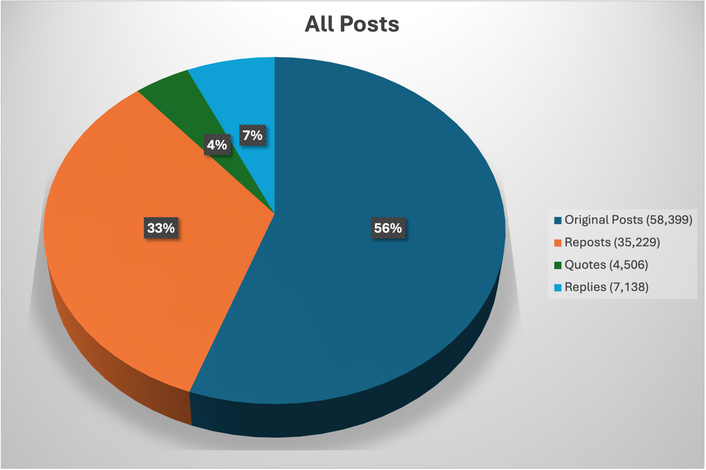
There were 58,399 posts posted by 24,719 users, achieving a total maximum reach of 292.7 million views with the following engagement of 7,138 Replies, 35,229 Reposts, 101,328 Likes, and 4,506 Quotes (Figure 1).
Accounting for the percentage distribution of #YouthMentalHealth posted, the three largest identified groups of contributors were management companies/corporates (20.6% of all tweets), educational institutions (17.5% of all tweets), and social groups. Management groups are defined as for-profit companies that use social media as a means of branding and marketing. Such companies can include pharmacology and tech firms that post on youth mental health. Educational institutions are organizations that follow structured or formal learning processes, such as schools, universities, and academies. Social groups are considered non-profit, community-based groups that use social media to advocate for their campaigns, student support initiatives, or institutional perspectives on youth mental health. This category may include NGOs, community networks, advocacy movements, and informal collectives formed around shared social or health concerns. Healthcare stakeholders are the next largest group (contributing to 9.3% of all tweets). These data were derived from Fedica, with classifications based on users’ X biographies.
As shown in Figure 2, the geographic distribution of users posting tweets containing #YouthMentalHealth reveals that the majority are from the United States (54.3%), followed by Canada (10.4%), the United Kingdom (4.9%), India (2.9%), Kenya (1.2%), Nigeria (0.5%), and South Africa (0.45%). This data was based on the country where the accounts were registered.
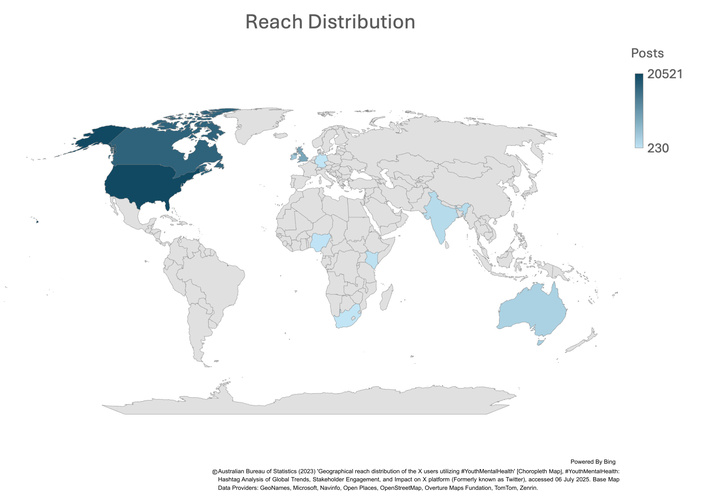
Geographical reach distribution of the X users utilizing #YouthMentalHealth throughout the study. Powered By Bing Australian Bureau of Statistics (2023) ‘Geographical reach distribution of the X users utilizing #YouthMentalHealth’ [Choropleth Map], #YouthMentalHealth: Hashtag Analysis of Global Trends, Stakeholder Engagement, and Impact on X platform (Formerly known as Twitter), accessed 06 July 2025. Base Map Data Providers: GeoNames, Microsoft, Navinfo, Open Places, OpenStreetMap, Overture Maps Fundation, TomTom, Zenrin.
The top ten countries accounted for approximately 95% of all #YouthMentalHealth posts, indicating that engagement with the hashtag was highly concentrated in a few regions, as seen in Table 1. This dominance by a handful of countries suggests an uneven global participation, likely reflecting differences in social media usage and mental health campaign activity across countries.
Top ten country-wide distribution of #YouthMentalHealth posts.
| Serial no. | Country | Posts | Percentage (%) |
|---|---|---|---|
| 1 | United States | 20,521 | 35.14% |
| 2 | Canada | 17,022 | 29.15% |
| 3 | United Kingdom | 8,392 | 14.37% |
| 4 | Ireland | 3,747 | 6.42% |
| 5 | Australia | 2,714 | 4.65% |
| 6 | India | 1,588 | 2.72% |
| 7 | Kenya | 743 | 1.27% |
| 8 | Nigeria | 295 | 0.51% |
| 9 | South Africa | 268 | 0.46% |
| 10 | Germany | 230 | 0.39% |
The professions or institutional affiliations of influencers which use the hashtags that generate the most posts using #YouthMentalHeath include a Canadian NGO focused on working on mental health issues with 770 posts (1.3% of all posts), a child psychiatrist with 671 posts (1.1% of all posts), followed by youth mental health advocates with 602 posts (1% of all posts). The hashtags most commonly associated with #YouthMentalHealth were #MentalHealth, #youth, and #COVID19.
Figure 3 illustrates a consistent increase in #YouthMentalHealth activity from 2018 to 2023, with a notable spike in 2021 and a peak in 2023, accompanied by a significant rise over time. About 2,000 posts were published in 2018, a comparatively small number compared to the other observed years. In 2019, there was a notable increase, with about 9,000 posts. The growth level was consistent with 2019 and 2020. However, starting in 2021, there was a significant rise, with posts reaching just below 15,000 and rising somewhat over 15,000 in 2022. The most significant spike occurred in 2023, when there were approximately 25,000 posts, the most in the study period’s history.
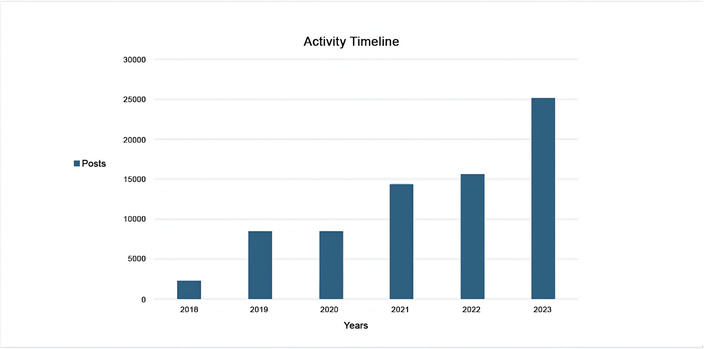
Trends in #YouthMentalHealth activity (2018–2023). The X-axis represents the years over which the posts were shared, while the Y-axis depicts the number of posts.
A sentiment analysis of social media posts using the hashtag #YouthMentalHealth, as conducted on Fedica, revealed that the majority of posts (86%) were neutral in tone. In comparison, 8% expressed positive sentiment and 6% expressed negative sentiment (Figure 4).
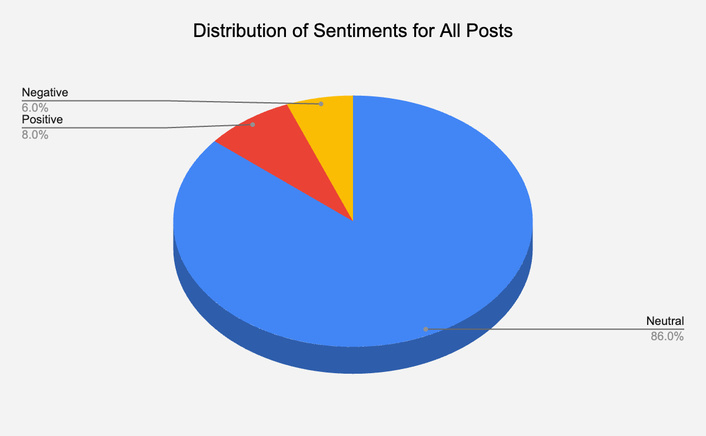
Distribution of sentiment in social media posts using the hashtag #YouthMentalHealth.
Figure 5 focuses on the activity in 2020 and shows significant fluctuations in the frequency of posts. The line graph shown in Figure 5 displays fluctuations in the total number of posts throughout 2020. May and October experience the most significant spikes, with both months generating approximately 900 posts. August shows a notable decline, with posts falling to about 500, the year’s lowest number. Following the WHO’s March 11 announcement of COVID-19 as a pandemic, the numbers first dropped from January (850) to March (600). Following an erratic pattern, the posts peaked in October before plummeting dramatically to 550 in December, potentially due to the second wave of COVID-19.
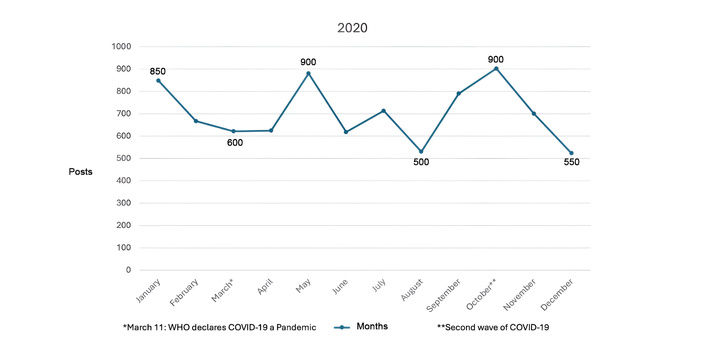
Impact of COVID-19 pandemic (year 1) on online discourse (2020 analysis). The x-axis represents the months of 2020, and the Y-axis represents the number of monthly posts uploaded.
We conducted a five-year longitudinal study to analyze posts on X containing the hashtag #YouthMentalHealth from January 10, 2018, to January 10, 2023. This study utilized the Fedica research analytics tool. The #YouthMentalHealth generated over 58,000 posts shared by around 25,000 X users, collecting 292.7 million impressions across various geographical locations. This demonstrates that the platform has become a significant channel for raising awareness and promoting discussion of this critical issue. As shown in Figure 1, outreach distribution data reveal that engagement levels are not uniform, indicating varying capacities among user groups to drive visibility. This suggests that digital influence within youth mental health advocacy is concentrated among a subset of highly active participants, consistent with network diffusion theory, which posits that information spread on social platforms often depends on central, high-impact nodes. Current techniques for social media analysis, such as data mining and sentiment analysis, have demonstrated promising applications in research, yielding valuable insights for informed decision-making [9].
The #YouthMentalHealth hashtag reflects a broader shift toward open discussions of mental health among young people. Social media can play a pivotal role in normalizing these conversations, thereby reducing the stigma associated with them. Several studies indicate that social media campaigns can significantly influence public perception and behavior regarding mental health [19]. By providing a platform for sharing personal experiences and supportive messages, hashtags like #YouthMentalHealth can contribute to a more accepting and informed society.
Additionally, the extensive reach of #YouthMentalHealth on X, as evidenced by the high number of impressions, highlights its potential as a tool for public health campaigns and mental health advocacy. Notably, the significant involvement of management companies (20.6%), educational advocacy (17.5%), and social advocacy groups indicates a strong organizational interest in youth mental health. These entities likely leverage their resources and networks to amplify messages and drive initiatives to support young people’s mental health. Most of the topics were centered around youth mental health, including discussions on depression, anxiety, and overall well-being.
Young people find social networking sites highly usable, engaging, and supportive, as seen in studies such as Ridout and Campbell 2018 [20]. These online communities offer individuals a platform to challenge stigma by sharing their personal stories and strategies for coping with the daily challenges of living with mental illness. The online information may help gain valuable insights into important healthcare decisions, encouraging them to seek mental health support from trusted and reliable resources.
The top three countries from which the majority of posts containing #YouthMentalHealth were shared, as seen in Table 1, include the United States (35%), Canada (29%), and the United Kingdom (14%). This geographic clustering, which is further emphasized in Figure 2, demonstrates how cultural, linguistic, and infrastructural factors influence digital engagement in mental health advocacy. The concentration in high-income, English-speaking countries may reflect better access to digital infrastructure and established public health advocacy networks, emphasizing the need for capacity building in underrepresented regions to globalize the youth mental health discourse. According to Statista, the United States is the leading country with the highest number of users on X, which may contribute to the high number of posts shared from the country [21]. These findings suggest that these countries actively use X to raise awareness about mental health issues. Consequently, their success underscores the importance of collaboration among government bodies, educational institutions, and the private sector in promoting mental health awareness campaigns [22]. This suggests a proactive approach to utilizing digital platforms to engage the public on key health issues.
When examining the percentage of #YouthMentalHealth posts by country, a notable disparity is observed between countries such as the United States, which accounts for 54.3% of the posts, and others like India and Kenya, which account for 2.9% and 1.2% of the posts, respectively. This disparity may reflect intersectional factors, such as race, gender, socioeconomic status, and disability, which were beyond the scope of this study.
Insights from digital platform analysis can inform targeted mental health interventions. Collaboration between various stakeholders, ranging from individuals to large organizations, on these platforms can lead to innovative solutions and enhanced support systems for young people. For instance, digital tools and apps developed in partnership with educational and social advocacy groups can provide accessible mental health resources tailored to the needs of adolescents [23].
A sentiment analysis of social media posts using the hashtag #YouthMentalHealth revealed that 86% of posts were neutral, 8% were positive, and 6% were negative, as seen in Fedica. As depicted in Figure 4, this distribution suggests that institutional or organizational users predominate in the discourse, prioritizing the sharing of information over emotional expression. This pattern reinforces our theoretical framing under the Social Ecological Model, where organizational-level communication maintains credibility and reach but may limit emotional resonance or peer relatability. The predominance of neutral sentiment suggests that the hashtag is primarily used in an informational or awareness-raising context rather than for emotional expression. This finding is consistent with the composition of contributors, as most posts originated from institutional or professional accounts—such as management companies, educational institutions, and social groups—that typically employ formal, campaign-style messaging.
Research supports this interpretation: social media communications by health organizations and public health campaigns often favor rational or neutral tones to maintain credibility, ensure message clarity, and reach diverse audiences [24, 25]. Similar studies in digital health communication have found that institutional messaging tends to emphasize factual accuracy and professional authority rather than affective engagement [26].
The smaller proportions of positive (8%) and negative (6%) posts further reflect this pattern. Positive content was primarily oriented toward advocacy and encouragement, while negative content expressed frustration about limited access to or quality of mental health services. Overall, the dominance of neutral sentiment indicates that conversations under #YouthMentalHealth are broadly balanced and informative, echoing prior findings that online health discourse is typically dominated by informational rather than emotional communication [27]. Nevertheless, this trend highlights an opportunity to encourage more personalized and emotionally resonant content to enhance engagement and foster a deeper connection with youth mental health initiatives [24].
Our results extend beyond descriptive statistics by highlighting how different stakeholder groups (e.g., advocacy organizations, educational institutions) disproportionately drive the hashtag’s visibility. Moving beyond raw counts to identify key contributors and engagement patterns, we add a novel interpretive layer to the findings. By determining who drives visibility and how engagement unfolds, the findings offer practical insights for strengthening online youth mental health advocacy.
As depicted in Figure 3, the documented surge in post activity from 2018 to 2023, especially during and after the COVID-19 pandemic, is consistent with broader trends in digital engagement. The sustained growth illustrated in Figure 3 underscores a temporal shift toward continuous engagement rather than one-time campaign spikes. This suggests that #YouthMentalHealth has evolved from a short-term awareness initiative into an enduring digital community of practice, reflecting the normalization of online mental health dialogue. In 2020, when the WHO announced the COVID-19 pandemic, the trend of posting about mental health conditions using #YouthMentalHealth gained traction, supporting the hypothesis that the worldwide policies of lockdowns and remote work facilities have potentially influenced a rise in social media engagement and internet usage worldwide [28]. Scientific evidence depicts that digital and social media activity persisted at a high level even after the lockdown was lifted, suggesting how the pandemic influenced users’ digital behavior. This can also be the reason for the initial increase in #YouthMentalHealth-containing posts in 2020 and the subsequent significant spikes starting in 2021 [29]. Another hypothetical explanation for the notable increase in 2023, with approximately 25,000 posts compared to 8,000 in 2020, is the growing reliance on digital platforms for professional networking and collaborative learning [30–32]. These results may also highlight how the pandemic influenced patterns of the public’s virtual interactions in this modern age of communication.
Figure 5 shows an exponential rise in #YouthMentalHealth posts at the onset of the pandemic, highlighting social media’s role as a platform for civic activism and community support. The pattern in Figure 5 highlights how crises catalyze collective digital action. The temporal spikes correspond with phases of heightened uncertainty, illustrating the agenda-setting role of social media in prioritizing youth mental health discussions during emergencies. This demonstrates that digital spaces function not only as outlets for self-expression but also as adaptive infrastructures for public health mobilization. An initial decrease in postings in March 2020 is consistent with the initial announcements of the COVID-19 pandemic, indicating a preliminary shift in attention towards direct and visible effects of COVID-19-related health issues [33]. However, as lockdowns and social restrictions grew more severe, post frequency showed an upward trend by May. This may be due to the reflections on mental health issues, compounded by the social isolation, interrupted education, and unstable socio-economic conditions [34]. Looking at the second part of the year, it marked another wave of the pandemic [35]. The spike in October and November 2020 coincided with heightened social isolation, academic pressure, and uncertainty about the future. A study that examined social media posts from March 2020 to March 2021 also reached a similar conclusion, highlighting how many people associated poor mental health with the COVID-19 pandemic [36]. The study found that mental health-related tweets surged during the initial and secondary waves of the pandemic, which emphasized the public’s heightened concern around psychological well-being during times of increased restrictions and uncertainty [36]. Anxiety, depression, isolation, and stress were the most commonly linked to the COVID-19 pandemic events [36]. This increase in online discussion highlights the heightened consciousness and concerns about the mental health of young people.
Our findings reinforce communication theory insights. The prominence of personal storytelling aligns with social support theory, suggesting that individuals seek communal support and reduce stigma through shared narratives. Meanwhile, the active participation of NGOs and health agencies aligns with agenda-setting theory, suggesting that organizational actors may shape the public mental health agenda on social media [9]. By applying these theories, our analysis provides a conceptual understanding of how hashtag activism operates in the youth mental health space, extending beyond the enumeration of tweets. This study extends current theoretical understanding by being among the first to empirically map multi-level engagement within the #YouthMentalHealth discourse through the lens of both Social Support and Agenda-Setting theories. By integrating these frameworks, our findings contribute to the growing field of digital psychiatry by illustrating how online advocacy ecosystems can mediate public awareness and collective action in youth mental health.
This study offers actionable insights for promoting mental health. The finding that peer-to-peer engagement (e.g., youth sharing personal experiences) drives high retweet activity suggests that campaigns should amplify authentic youth voices. Health organizations can leverage such organic trends by collaborating with influential youth advocates identified in our network analysis. Additionally, the global reach of #YouthMentalHealth (tweets from over 50 countries) underscores the need for international collaboration, such as aligning with the WHO’s recommended multi-sectoral approach for youth mental health online [16]. By outlining these applications, we ensure that the findings provide practical guidance for educators, clinicians, and policymakers seeking to enhance youth mental health through social media. Moreover, these results highlight the potential of social media analytics as a low-cost, data-driven tool for monitoring mental health discourse and informing the design of future awareness campaigns. In doing so, this study offers novel, evidence-based insights into how digital advocacy can be strategically leveraged to enhance mental health communication and engagement across global contexts.
While comprehensive in scope, the study remains primarily descriptive and does not assess how discussion themes evolved. Understanding changes in the focus of discussions (e.g., from general awareness to specific issues, such as suicide prevention) can provide insight into how the movement is progressing and what areas require more attention.
A brief sentiment analysis was included to provide an overview of the tone of discussions. Still, we did not formulate or statistically test a priori hypotheses or employ advanced techniques such as predictive modeling or causal inference methods. This was a deliberate choice to establish foundational insights into global engagement with #YouthMentalHealth. However, this design inherently limits the ability to draw causal conclusions and may constrain the perceived innovation of the results. Accordingly, our findings should be viewed as hypothesis-generating rather than hypothesis-confirming. Future research can extend this work by applying more complex analytical methods to uncover deeper patterns, test causal relationships, and generate predictive insights.
This first-of-its-kind longitudinal study reveals the significant impact of the #YouthMentalHealth hashtag on X (formerly Twitter), highlighting its role in promoting awareness and stimulating public discourse on youth mental health. High engagement from healthcare, educational, corporate, and advocacy sectors illustrates social media’s power to shape perceptions and reduce stigma. By quantitatively mapping global engagement and identifying the main contributors, this study provides novel, data-driven evidence of how digital advocacy ecosystems operate within the mental health domain. Unlike prior descriptive analyses of health-related hashtags, our work integrates communication theory and empirical analytics to capture both the structural and behavioral dimensions of online discourse. These findings contribute to the emerging framework of digital psychiatry by demonstrating how social platforms can be leveraged as tools for large-scale mental health promotion and early intervention. The insights generated have practical relevance, offering guidance for policymakers, clinicians, and advocacy groups to design more targeted, youth-centered campaigns that strengthen community connection and reduce stigma. Future research should build on these findings by exploring longitudinal behavioral outcomes associated with such online engagement and by comparing cross-platform dynamics to better understand how digital spaces can sustainably support global youth mental health efforts.
GDPR: General Data Protection Regulation
NGO: Non-Governmental Organization
WHO: World Health Organization
FAN: Conceptualization, Investigation, Writing—original draft, Writing—review & editing, Supervision. MMAR: Writing—original draft. AGA: Formal analysis. AA: Writing—review & editing. ARK: Writing—review & editing. NEB: Writing—review & editing. OL: Writing—review & editing. All authors read and approved the submitted version.
Atanas G. Atanasov, who is the Editor-in-Chief of Exploration of Digital Health Technologies, had no involvement in the decision-making or the review process of this manuscript. The other authors declare no conflicts of interest.
We extracted de-identified data from the public domain on X; hence, there was no indication of the need to obtain ethical approval and informed consent for the study. We have not identified or revealed any specific stakeholder or public figure name or the contents of the X post, and the study was conducted in strict compliance with General Data Protection Regulation (GDPR) requirements.
Additionally, we confirm that the study protocol was reviewed in accordance with our institutional policies, and it was determined that formal IRB approval was not required, as the study utilized only publicly available, de-identified data. Nevertheless, we adhered to all relevant ethical guidelines for internet research and complied with international data protection standards. In particular, our procedures conformed to the GDPR and the platform’s terms of service to ensure privacy and legal compliance across jurisdictions.
Not applicable.
Not applicable.
The raw data supporting the conclusions of this manuscript will be made available by the authors, without undue reservation, to any qualified researcher.
Not applicable.
© The Author(s) 2026.
Open Exploration maintains a neutral stance on jurisdictional claims in published institutional affiliations and maps. All opinions expressed in this article are the personal views of the author(s) and do not represent the stance of the editorial team or the publisher.
Copyright: © The Author(s) 2026. This is an Open Access article licensed under a Creative Commons Attribution 4.0 International License (https://creativecommons.org/licenses/by/4.0/), which permits unrestricted use, sharing, adaptation, distribution and reproduction in any medium or format, for any purpose, even commercially, as long as you give appropriate credit to the original author(s) and the source, provide a link to the Creative Commons license, and indicate if changes were made.


View: 7277
Download: 187
Times Cited: 0