 Review


Affiliation:
1Hepatogastroenterology Department, Theodor Bilharz Research Institute (TBRI), Giza 12411, Egypt
Email: maged_elghannam@yahoo.com
ORCID: https://orcid.org/0000-0002-3638-5286


 ,
,
Affiliation:
1Hepatogastroenterology Department, Theodor Bilharz Research Institute (TBRI), Giza 12411, Egypt
ORCID: https://orcid.org/0000-0002-4638-0542
,
Affiliation:
1Hepatogastroenterology Department, Theodor Bilharz Research Institute (TBRI), Giza 12411, Egypt
ORCID: https://orcid.org/0000-0002-3844-1122
,
Affiliation:
1Hepatogastroenterology Department, Theodor Bilharz Research Institute (TBRI), Giza 12411, Egypt
ORCID: https://orcid.org/0000-0001-7498-6835
,
Affiliation:
1Hepatogastroenterology Department, Theodor Bilharz Research Institute (TBRI), Giza 12411, Egypt
ORCID: https://orcid.org/0000-0003-3777-7668
,
Affiliation:
2Biostatistics and Demography in the Department of Environmental Research, Theodor Bilharz Research Institute (TBRI), Giza 12411, Egypt
ORCID: https://orcid.org/0000-0001-9956-1147
,
Affiliation:
1Hepatogastroenterology Department, Theodor Bilharz Research Institute (TBRI), Giza 12411, Egypt
3Faculty of Medicine, October 6 University, Giza 12511, Egypt
ORCID: https://orcid.org/0000-0002-1214-6459
,
Affiliation:
1Hepatogastroenterology Department, Theodor Bilharz Research Institute (TBRI), Giza 12411, Egypt
ORCID: https://orcid.org/0000-0002-4860-5231
Explor Dig Dis. 2026;5:1005131 DOI: https://doi.org/10.37349/edd.2026.1005131
Received: April 14, 2026 Accepted: June 10, 2026 Published: August 12, 2026
Academic Editor: Jose C. Fernandez-Checa, Institute of Biomedical Research of Barcelona (IIBB), CSIC, Spain
Climate change (CC) affects our health in ways especially when it comes to liver diseases. Rising temperatures and changing weather patterns are altering the spread and severity of liver diseases. CC can affect health, especially liver diseases, in direct and indirect ways. Hepatic infections such as viral hepatitis and schistosomiasis, metabolic dysfunction-associated steatotic liver disease (MASLD), hepatocellular carcinoma, and acute on chronic liver failure (ACLF) are examples. The movement of infected individuals from areas where diseases are endemic, prompted by ecological disasters, introduces these diseases to previously unexposed regions. CC serves as an early warning for shifts and the necessity to re-evaluate hepatic diseases, which is crucial for health policymakers. Ambient temperature and its variability have a major influence on the pathogenesis of MASLD, demonstrating nonlinear exposure–response relationships. Long-term temperature exposure follows a reverse J-shaped pattern, while temperature variability shows a U-shaped association, with both extremes independently increasing disease susceptibility. Prolonged exposure to cold and fluctuations in temperature could worsen various liver diseases. Gaining a deeper insight into these CC-related risks for our patients and practice is essential to optimize their care both now and in the warmer temperatures ahead. Incorporating climate resilience into public health initiatives may aid in alleviating the growing prevalence of liver diseases linked to CC. Aside from increasing awareness, which should take precedence, there is a pressing need to investigate innovative ways to frame the educational message and eliminate financial incentives that contribute to environmental damage. Common climate strategies for healthcare systems include reducing and managing waste, utilizing cleaner and less energy, offering and endorsing planet-friendly food options, and addressing transportation issues related to accessing healthcare facilities, such as transitioning in-person appointments to virtual consultations when possible, encouraging green-endoscopy practices, and participating in conferences virtually can be beneficial.
The swift industrial and economic growth experienced globally since the Industrial Revolution has been linked to a significant rise in the production of greenhouse gas (GHG), resulting in global warming. This global warming is triggering such drastic climate change (CC) that many consider it a threat to our very existence [1].
CC denotes enduring changes in temperature and weather patterns [2]. In October 2021, the World Health Organization (WHO) [3] recognized CC as “the foremost health challenge confronting humanity”. Since 1900, annual global mean temperatures have increased by 1.1°C, mainly in the past 50 years [4]. By the end of this century, expected warming is expected to reach up to 2.5°C to 2.9°C [5]. The international community must limit the increase in temperature to 1.5°C to prevent disastrous health consequences [6]. Since the Earth functions as an interconnected system, a rise in temperature marks just the start of alterations in one area that can trigger changes in all others. CC is linked to a rise in extreme weather phenomena, such as severe droughts, water shortages, intense wildfires, rising ocean levels, flooding, melting ice caps, devastating storms, and diminishing biodiversity. Human actions have been the primary cause of CC, mainly resulting from the combustion of fossil fuels such as coal, oil, and gas. The pressing need to address the effects of CC is commonly referred to as the climate crisis [7]. GHGs must be cut in half by 2030, and net-zero carbon dioxide (CO2) emissions must be reached by 2050 in order to minimize temperature rise [8, 9]. The costs of doing nothing will be much outweighed by the economic advantages of achieving net-zero GHG emissions [10]. GHGs are substances that produce the greenhouse effect, a phenomenon where heat from the sun is trapped in Earth’s atmosphere and unable to escape into space. CO2 is one of these gases; human activity is responsible for more than 64% of global warming [11]. Because CO2 can linger in the atmosphere for decades without dissipating, its effects on the ecosystem and human health are long-lasting. The majority of gases that cause CC are referred to as short-lived climate pollutants (SLCPs) because, in contrast to CO2, they do not remain in the atmosphere for very long. However, they have a greater warming impact than CO2, which seriously harms the ecosystem. One of these gases, ozone, affects the climate more significantly than previously believed. It remains in the atmosphere for twelve years. Compared to CO2, its warming effect is 81.2 times stronger over a 20-year period and 28 times stronger over a 100-year period [12].
Light outdoor exercise carries a moderate risk of heat stress, with an annual rise of 27.7% compared to 2000 [13], and reduces labor productivity [14, 15] in addition to endangering workers’ health [16]. Up to 512 billion potential work hours were lost in 2023 as a result of heat exposure, which is 49% more than the average from 1990 to 1999. Of these, 63% were lost in the agricultural sector [13]. Nighttime temperatures brought on by CC are linked to both quantity and quality of sleep disturbances [17].
A systematic literature search in PubMed MeSH and Google scholar searches were done. Full-text articles published in English and articles providing an English abstract were reviewed. The following terms were used: “climate change, global warming” OR “climatic change” OR “atmospheric change” OR “meteorological change” AND “health map” OR “emerging disease” OR “reemerging disease” OR “communicable disease” OR “non-communicable disease” OR “infectious disease” OR “endemic disease” OR “epidemic disease”. We also manually examined the reference lists to identify additional relevant studies.
Children and the elderly: Heatwaves pose a serious health risk, particularly to the elderly, small children, and those with underlying chronic renal, respiratory, or cardiovascular conditions [18]. Due to their susceptibility to environmental stressors and undeveloped biological defenses for immunological protection, DNA repair, and detoxification, children under the age of five suffer greatly [19]. Malnutrition in children is predicted to rise by 20% by 2050, impacting an extra 25 million kids. This will seriously impede efforts to reduce malnutrition among children [20]. However, compared to 1990–2000, heat-related mortality among adults over 65 has increased by 85%, above the predicted 38% increase in the absence of temperature changes. These deaths are expected to spike by 370% by 2041–2060 and 683% by 2081–2100 if temperatures rise by 2°C [21].
Women may be twice as likely as men to die from heat-related causes. Food insecurity and mortality rates are significantly greater in low-income households [22]. When food is scarce, women and girls tend to eat last and skip meals. In addition to impeding women’s access to maternity and reproductive health care, CC affects pregnancy outcomes by altering temperature, nutritional status, and infectious illness risk [23].
One significant mechanism for the quick spread of infectious diseases is the movement of impacted workers from endemic contaminated areas as a result of the CC disasters to other virgin areas. Furthermore, it was discovered that untreated and undertreated liver disorders were present in the immigrant population [24]. There are currently 281 million foreign migrants among the more than 1 billion people on the move [25]. “Environmental migrants” are individuals or groups who are compelled to relocate either temporarily or permanently, either domestically or internationally, as a result of unfavorable environmental changes [26]. About 25% of all chronic HBV infections in the region are caused by people who migrate from endemic countries to the European Union/European Economic Area (EU/EEA) [27].
People around the world are unequally affected by CC [28]. Africa, South and Central America, and Asia experienced the highest number of days of health-threatening temperatures attributable to CC. Africa experienced the biggest increase in a heat-related mortality rate since 2000–2005. Recently, Europe had the highest rate of heat-related mortality 2017–2022 [17, 28, 29].
Given the reality of CC, its impact on the development of liver disease is increasingly recognized. It is important to understand the potential impact of CC on our patients and consider what we can do to impact the resultant climate crisis.
Globally, liver diseases are responsible for 2 million deaths annually; however, the number is still growing [30]. CC potentially influences all determinants of liver disease and consequently contributes to the anticipated increase in the global burden of liver disease [31]. CC can affect health directly or indirectly (Figure 1).
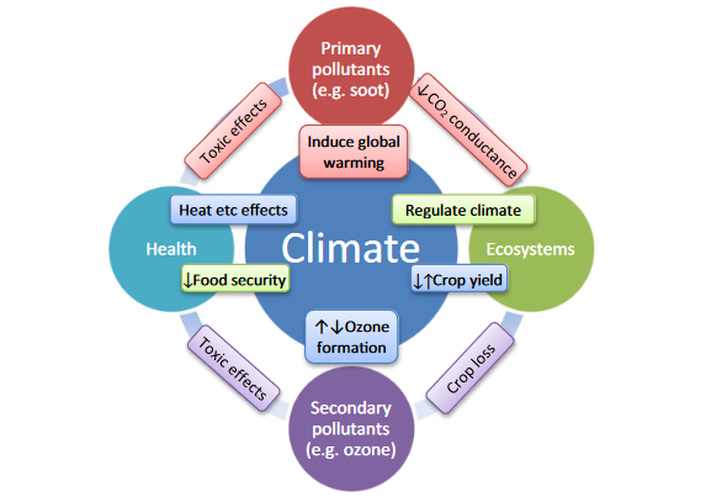
Climate and air quality interactions and direct and indirect effects on health. Reprinted from [32]. © 2017, The Author(s). Distributed under the terms of the Creative Commons CC BY license.
The physiological effects of excessive heat are more likely to affect those with chronic illnesses [33].
Extreme heat physiologically results in hepatic cell necrosis, ischemia, acute liver damage, and, in severe cases, acute liver failure [34].
Mental health is said to be negatively impacted by the climate issue. Alcohol-related viral hepatitis may develop as a result of substance abuse, which has been linked to anxiety and stress [35]. The three most prevalent causes of liver disease are viral hepatitis, alcohol-related liver disease, and metabolic dysfunction-associated steatotic liver disease (MASLD), all of which are vulnerable to the effects of CC. Although the precise processes are yet unknown, air pollution is linked to the development of cirrhosis, chronic liver damage, and steatotic liver disease [36]. Additionally, a possible connection between rising ambient temperatures and biliary tract disease admissions has been found; however, the underlying processes are yet unknown [37].
Conversely, energy use, medical waste, and transportation emissions from healthcare systems—including liver units—contribute significantly to CC [38]. Unused medications at home are estimated to constitute 2 out of 3 prescription medications costs $2–5 billion in the United States alone [39].
The quantity of CO2 we emit as a result of our activities is known as our carbon footprint. The carbon footprint of the healthcare industry contributes significantly to global CO2 emissions—more than 4.4% [40, 41]. About 45% of emissions in endoscopy services are related to staff and patient transportation, and 32% are caused by the manufacture and disposal of medical equipment [42]. 1–2% of all urban waste is made up of healthcare waste (HCW) [43], of which 15% is deemed hazardous. The globe would be headed toward a potentially disastrous 2.7°C warming if the existing policies and practices are maintained [44]. Therefore, efforts to lower GHG emissions are crucial to safeguard people's health, survival, and well-being in every nation and provide immediate and long-term health advantages [45].
Mora and his colleagues in 2022 [46] found that 58% of infectious diseases confronted by humanity worldwide have been at some point aggravated by climatic hazards, and 16% were at times diminished.
The seasonality, transmission resilience, and geographic distribution of VBDs will all be altered by CC [47]. Dengue and Rift Valley hemorrhagic fever are two VBD epidemics that are more likely to occur [48]. Aides, Culex, and Anopheles spp. are among the mosquito species that proliferate quickly due to the CC, which might result in hepatic viral disorders such as dengue, yellow fever, Rift Valley hemorrhagic fever, chikungunya (CHIKV), and Zika [49, 50]. As CHIKV outbreaks moved from the Indian Ocean to Europe, where they were reported in Italy and France, human and vector movements may also have an impact on these viral illnesses [51, 52].
In 2023, 5 million dengue cases were reported worldwide [53]. Due to improved climatic circumstances, greater human movement, and urbanization, the prevalence of dengue has dramatically grown during the past 20 years [54–58]. Every year, severe dengue is thought to kill 40,000 people [59]. Nonetheless, the death rate can be lowered to less than 1% with proper medical care and prompt intervention [53]. Comparable patterns were also noted for the CHIKV and Zika viruses’ propensity for transmission.
Another illustration of the impact of CC is malaria. Increased rainfall and humidity have an impact on mosquito survival and reproduction, which causes infectious sporozoites to develop quickly in the mosquitoes [60]. Both the highlands of Colombia and Ethiopia are examples of increased spread due to high-elevation temperature [61, 62]. Plasmodium falciparum may now spread across an additional 17.1% of the world’s geographical area, while Plasmodium vivax can spread over an additional 21.8%. CC has expanded suitable land for Plasmodium falciparum by 17.1% and Plasmodium vivax by 21.8%. However, in some endemic regions, transmission duration has decreased due to temperatures exceeding parasite survival thresholds [63].
Humans can contract the deadly neurological disease caused by the West Nile virus, which is spread by mosquitoes [64]. The virus is present all over the planet, and in some parts of the world, its range is growing [65]. Between the 1960s and this year, there was a 4.3% increase in the temperature at which the West Nile virus may spread.
A new era of infectious illnesses is upon us, marked by outbreaks of endemic, re-emerging, and emerging pathogens [66]. According to a recent survey, the most urgent and growing infection concerns seen by healthcare personnel in low-resource settings are VBDs (mostly dengue and malaria), TB, and HIV/AIDS, with poverty, socioeconomic factors, and rising treatment resistance as the main causes [67].
Water-borne disease transmission potential is affected by temperature changes and water salinity [68]. As water temperatures rise, they become more suitable for Vibrio vulnificus (V. vulnificus), a gram-negative bacterium that can cause fatal sepsis in patients with chronic illness, particularly liver disease [69]. While this is a low-incidence human pathogen, it has a high fatality rate of 18–50%. As outlined by Archer et al. [70], analysis of a 30-year database of V. vulnificus infections showed cases rising along with the Atlantic coastline and extending northward in a non-linear progression. Vibriosis cases increased by 13.5% from the previous record high in 2022. V. vulnificus can be found in brackish water. Patients with cirrhosis should avoid eating raw seafood (especially oysters) and exposing any open wounds to brackish water.
Hepatitis A and E viral infection incidence was increasingly recorded in China after floods in the year 2010 and is expected to increase by the year 2030 [71]. The ongoing outbreak of hepatitis E infection in South Sudan is a prime example [72].
Fasciola hepatica is a sheep liver fluke that is transmitted to humans after ingestion of raw infected liver. It needs a wet and mild warm climate [73, 74]. Global warming makes the environment more suitable for the growth and survival of the infective stage and intermediate host, increasing the prevalence of infection [75]. Unexpected outbreaks of schistosomiasis and fascioliasis in the UK highlight the northward expansion of tropical parasitic diseases [76, 77].
The consequences of changing land use, an expanding human population, and subsistence livelihoods can interact in unanticipated ways with the impact of CC on schistosomiasis. It is difficult to predict how global CC may affect schistosomiasis [78, 79].
The outbreak of Schistosoma infection among swimmers in the Cavu River in Corsica, a French Mediterranean island, is believed to have been brought on by human movement and subsequent river contamination by parasite eggs that settled locally in vulnerable intermediate host snails and circulated for multiple seasons. The geographic range of schistosomiasis transmission does not include this location. It turns out that Schistosomiasis is hyperendemic in the lower basin of the Senegal River, where it started. As the world warms, there are worries that the range of Schistosomiasis may expand [80].
Schistosoma haematobium is predicted to decline under future climatic conditions in Africa, where appropriate locations are close to the equator [78]. There are worries about the spread of urogenital schistosomiasis into regions with cooler climates, such as the highlands of Ethiopia and South Africa, where the existence of suitable snail species and a lack of access to clean water are anticipated.
Schistosomiasis in China is expected to spread northward by 2100, according to studies conducted throughout Asia. However, this would make the mountainous areas of Sichuan province, where schistosomiasis is already common, unsuitable for snail rearing, hence decreasing the spread of the disease [81].
Nowadays, the northeast of Brazil is where the majority of Schistosomiasis cases in America occur [82]. Warming may increase the number of favorable habitats for transmission in the southeastern region, which is at the climatic margin for snail survival [83].
Because of this, it is anticipated that the spread of schistosomiasis will decline in central tropical Africa as temperatures will rise above the critical thermal maximum of snails. On the edges of the colder range, where temperatures are now too low for transmission, transmission is expected to increase.
The frequency of MASLD has alarmingly increased from 25.5% before 2005 to 37.8% in recent years, with current estimates at 32.4% [84, 85]. Recent evidence reveals that environmental factors play a crucial but underexplored contribution to the pathophysiology of MASLD. MASLD epidemic and the acceleration of the climate crisis go hand in hand, in addition to undernutrition and obesity [86]. Food insecurity in vulnerable locations worsens as a result of CC’s rising impacts on agriculture, society, and the economy [87]. This is expected to induce obesity and contribute to excessive consumption of refined foods, which could raise the global burden of liver disease related to MASLD [88, 89]. A key component of managing liver disease, particularly in people with MASLD, is optimal diet. However, people with cirrhosis frequently suffer from malnutrition, which is particularly prevalent in those who are food insecure [90]. Sedentary behavior is a significant risk factor for MASLD [91]. Provocation of oxidative stress and stimulation of inflammatory responses impair hepatic metabolism and increase hepatic triglycerides and cholesterol, thereby fostering MASLD [92]. Microcystins (a hepatotoxic by-product of blue-green algae, which are increasing due to CC, and which can contaminate drinking water and swimming sites) can lead to progressive MASLD [93] (Figure 2).
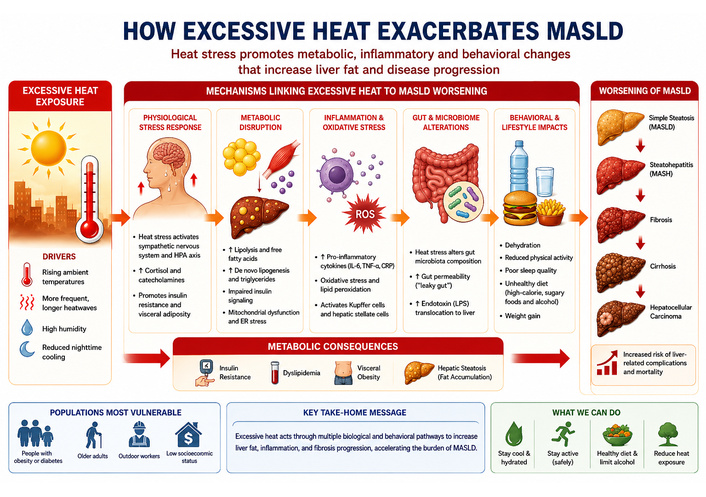
How excessive heat exacerbates metabolic dysfunction-associated steatotic liver disease (MASLD).
A solid argument that ambient temperature variability (TV) functions as a harmful environmental driver of MASLD was recently presented by Wang et al. [94] in a nationwide investigation in 2026, showing nonlinear exposure-response correlations. A U-shaped relationship for TV, where both low and high unpredictability independently increased susceptibility, and a reverse J-shaped curve for long-term temperature exposure, where extreme cold conferred the highest MASLD risk. They were able to place these national findings in China into a larger international perspective by integrating global burden of disease (GBD) data, providing supportive but not causal evidence that comparable patterns may develop across varied climatic zones. They propose that TV could be an independent risk factor for MASLD, especially in areas where extreme and frequent temperature changes are expected [95]. They emphasize that when assessing environmental factors that contribute to liver illness, it is important to take into account both the absolute temperature and its variability. Mechanistically, exposure to cold can cause hepatic de novo lipogenesis [96], whereas television interferes with circadian metabolic cycles, aggravating oxidative stress and inflammation [97, 98]. Due to increased oxidative stress and hepatic inflammation brought on by exercise in unfavorable settings, people with high levels of physical activity were more susceptible to MASLD in extreme weather conditions [99]. The dangers of obesity and MASLD were exacerbated by low TV exposure, which was more strongly linked to MASLD in the obese, whereas high TV exposure was more harmful to normal-weight people [100]. Incorporating environmental variables into MASLD prevention initiatives may help reduce the increasing burden of chronic liver disease by improving early identification and informing tailored therapies meant to mitigate the negative health impacts of CC. They highlight the dual problem of climate adaptation: worldwide initiatives to reduce rising temperatures must coexist with region-specific methods (such as cold mitigation in temperate zones). The growing MASLD pandemic amid CC may be lessened by including temperature resilience into public health systems.
Increased aflatoxin production by fungi in the setting of warming climes is anticipated to be related to increased primary liver cancer rates [101]. Given the increase in liver cancer incidence in the face of decreases in known risk factors in Australia, the possible influence of environmental changes has been investigated. Gan and his colleagues [102] reported higher liver cancer risk in the equatorial region and tropical regions, supporting the relation to CC.
Plastic waste made from fossil fuels is reportedly carcinogenic, and microplastics have been detected in human liver [103]. Pedersen et al. [104] in 2017 reported an association between cancer and elemental components such as sulphur, silicon, nickel, and iron.
Lin et al. [105] reported low temperature and high humidity as risk factors for ACLF. The highest prevalence of ACLF was observed in January, followed by July. Rainfall and temperature change did not affect the incidence of ACLF. It’s unclear if weather variations directly cause ACLF pathology or if they have an impact on a secondary factor that raises the occurrence of ACLF. Temperature and humidity measurements may not fully account for the impacts of other seasonal elements, such as vitamin D and melatonin from exposure to light [106]. Hepatocyte dysfunction has been linked to hyperthermia, which can also cause mitochondrial dysfunction and decreased oxidative phosphorylation [107]. A recent multicenter clinical research study found no effect in reducing brain swelling or improving the survival rate of patients with acute liver failure, despite the fact that therapeutic hypothermia has been employed as a method primarily to reduce intracranial hypertension in patients with acute liver failure [108]. Precipitation decreased hospitalization rates, although both hot and cold temperatures raised the risk of bacterial infections.
There is an urgent need to better understand the liver carbon footprint, to allow adaptation and mitigation strategies to be put in place.
Creative solutions to minimize waste-related costs and negative environmental impacts while preserving patient care and scientific advances are a priority. The utmost target to be emphasized is primary prevention and early diagnosis [29, 109]. Ninety per cent of liver disease is potentially preventable in Western populations [110] (Figure 3).
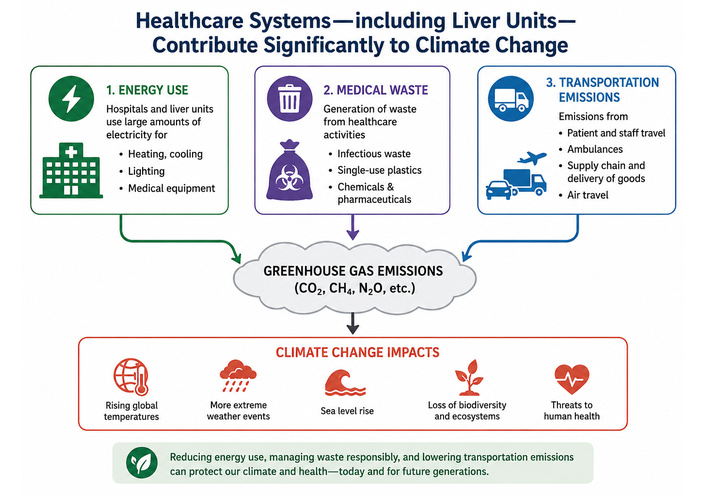
Health care systems, including liver units, contribute significantly to climate change.
A strategy to prevent alcoholic liver disease and reduce hospital admissions is an example of reducing GHG. Recent reports have shown a 4% decrease in alcohol-related hospital admissions, causing a positive environmental impact [111].
In order to lower costs and enhance results in the final year of life, Hudson and his colleagues [112] (2018) advise broader implementation of day-case models of care. They discovered that compared to patients receiving unplanned treatment, a specialized paracentesis service, patients with liver cirrhosis who visited a day case service had nearly 17 fewer hospital bed days.
To develop criteria for patient follow-up and encourage remote contact and use of noninvasive testing is important to decrease GHG emissions.
Plant-based diets, as opposed to red meat and ultra-processed foods, have lower carbon footprints than a typical Western diet and are estimated to be associated with a reduction in GHG emissions by up to 84% [113] and a lower risk of MASLD [114]. Regular exercise reduces the incidence of fatty liver [115]. If one person changed a single trip per day from driving to cycling, this would reduce that individual’s carbon footprint by approximately 0.5 tons over 1 year [116].
Healthcare providers can promote and teach healthy lifestyle practices, including “planetary health diets”, as proposed by the EAT-Lancet Commission: “Food is the single strongest lever to optimize human health and environmental sustainability on earth” [117].
“Greening” operating rooms, which generate up to 30% of a hospital’s total waste and consume 3–6 times more energy per square foot than other parts of the hospital [118], with anesthesia gases making up more than 50% of the carbon footprint of surgical procedures [119].
The concept of a more sustainable future for endoscopy has been well promoted by the “Green Endoscopy Group” [120], motivated by the inconvenient observation that endoscopy is the third highest source of waste in a typical hospital [121]. A typical endoscopic treatment produces 2.1 kg of trash on average [122]. The traditional sustainability philosophy of “reduce, reuse, recycle” must be applied; cutting back on pointless procedures, which can account for up to 56% of upper GI endoscopies and between 23% and 52% of colonoscopies, can drastically reduce carbon footprints [123]. Inappropriate endoscopies produce 3,500–4,700 metric tons of CO2 per year in Italy [124] and 30,804 metric tons of CO2 per year throughout Europe [125]. Rationalizing the usage of specimen pots is another crucial step in lowering the carbon footprint of endoscopy, since the histological processing of tissue samples accounts for 36% of emissions [126].
ESGE suggests against the routine use of single-use devices and proposes using reusable alternatives instead of disposables. Last but not least, any waste should be recycled. In the endoscopy unit of a university hospital, these measures could collectively reduce carbon emissions by 18.4% [126].
In addition to endoscopy, alternative diagnostic techniques include intestinal ultrasound in place of colonoscopies [127]; fecal calprotectin may prevent needless endoscopic procedures if the likelihood of IBD is low, and instruments like FibroScan have less of an impact on the environment than repeated endoscopy and liver biopsies for cirrhosis and varices detection [125]. In order to minimize needless endoscopies, the Baveno VII consensus suggests estimating variceal risk using transient elastography and platelet counts [128].
Globally, the health industry is a major contributor to GHG emissions; in the US, for instance, it is responsible for 8.5% of total carbon emissions [129]. In the US healthcare system, waste is projected to cost about 25% of overall health care spending [130].
Examples of low-carbon alternatives and sustainable services in hepatology include telemedicine “virtual” consultations, which have become more popular since the start of the COVID-19 pandemic and can lead to significant carbon savings [131, 132], and outpatient, unsedated, ultrathin endoscopy, which can be performed during a routine clinic visit [133]. The downscaling of in-hospital liver care in one center resulted in lower patient satisfaction and higher liver-related mortality; thus, enthusiasm for telemedicine needs to be tempered with prudence [134]. To encourage a comprehensive and health-focused response to the dangers posed by CC, much work remains.
Most of the studies dealing with CC and liver diseases are observational, with no confirmed causal mechanism relationship. In most cases, the data are uneven and vary from one region to another. The conclusions vary according to the included personnel characteristics and age group. Also, ethnicity affects the CC effects.
As an early warning system for hepatic health issues, CC may be crucial for health decision-makers. Planning solutions for CC adaptation and mitigation can make use of it. Many hepatic conditions, particularly infectious liver illnesses such as viral hepatitis, MASLD, ACLF, and HCC, could be made worse by prolonged exposure to CC. Clinicians should take into account the movement of infected patients from their endemic locations as a result of their diagnosis, as well as the knowledge that CC is a risk factor for a number of liver illnesses. Apart from increasing awareness, which ought to be the first objective, it is imperative to investigate new ways to frame the educational message and eliminate financial incentives that encourage environmental damage. Reducing and managing waste, using less and cleaner energy, offering and promoting foods that are good for the environment, and handling transportation to and from healthcare facilities are common climate solutions for healthcare systems.
ACLF: acute on chronic liver failure
CC: climate change
CHIKV: chikungunya
GBD: global burden of disease
GHG: greenhouse gas
HCC: hepatocellular carcinoma
MASLD: metabolic dysfunction-associated steatotic liver disease
TV: temperature variability
V. vulnificus: Vibrio vulnificus
VBDs: vector-borne diseases
During the preparation of this work, authors used ChatGPT for the creation of Figure 2. After using ChatGPT, authors reviewed and edited the content as needed and take full responsibility for the content of the publication.
MTE: Conceptualization, Data curation, Methodology, Supervision, Writing—original draft, Writing—review & editing. MHH: Conceptualization, Formal analysis, Visualization, Writing—original draft, Writing—review & editing. YAA: Software, Validation, Writing—original draft, Writing—review & editing. EAT: Methodology, Validation, Writing—original draft, Writing—review & editing. GMEL: Data curation, Supervision, Writing—original draft, Writing—review & editing. HMAT: Methodology, Project administration, Software, Writing—original draft, Writing—review & editing. AAELR: Formal analysis, Visualization, Writing—original draft, Writing—review & editing. MDELT: Data curation, Supervision, Validation, Writing—original draft, Writing—review & editing. All authors read and approved the submitted version.
The authors declare that they have no conflicts of interest.
Not applicable.
Not applicable.
Not applicable.
Not applicable.
Not applicable.
© The Author(s) 2026.
Open Exploration maintains a neutral stance on jurisdictional claims in published institutional affiliations and maps. All opinions expressed in this article are the personal views of the author(s) and do not represent the stance of the editorial team or the publisher.
Copyright: © The Author(s) 2026. This is an Open Access article licensed under a Creative Commons Attribution 4.0 International License (https://creativecommons.org/licenses/by/4.0/), which permits unrestricted use, sharing, adaptation, distribution and reproduction in any medium or format, for any purpose, even commercially, as long as you give appropriate credit to the original author(s) and the source, provide a link to the Creative Commons license, and indicate if changes were made.



View: 700
Download: 18
Times Cited: 0


