Original Article


Affiliation:
1Osakidetza, OSI EEC, Cruces University Hospital, Rheumatology Division, 48903 Barakaldo, Spain
2Medicine and Nursery School, Department of Medicine, University of the Basque Country, Cruces University Hospital, 48903 Barakaldo, Spain
Email: fperezruiz@telefonica.net
ORCID: https://orcid.org/0000-0002-5268-1894


 ,
Affiliation:
3Medicine School, University of Deusto, 48007 Bilbao, Spain
ORCID: https://orcid.org/0009-0009-8687-7527
Explor Musculoskeletal Dis. 2026;4:1007141 DOI: https://doi.org/10.37349/emd.2026.1007141
Received: May 26, 2026 Accepted: September 29, 2026 Published: October 28, 2026
Academic Editor: Tarek Tawfik Amin, Kasr Alainy School of Medicine, Cairo University, Egypt
Aim: To study whether very low serum urate (sUA) levels are associated with increased mortality rate during urate-lowering therapy (ULT).
Methods: This study analyzed data from a bidirectional cohort of gout patients. General variables (age, gender), disease variables (time from onset, number of flares, number of joints involved, tophi, previous and prescribed ULT, sUA levels at baseline and during follow-up), and comorbid conditions such as hypertension, hyperlipidemia, diabetes, chronic renal disease, previous vascular event, along with a comorbidity index were available for analysis. Very low sUA (< 3 mg/dL) was specifically pursued during ULT for patients with the most severe gout, i.e., polyarticular and tophaceous gout.
Results: sUA levels during therapy were available from 1,618 patients with a mean follow-up period of 43.6 months. Univariate survival analysis showed that female gender, age, baseline sUA, sUA during follow-up, polyarticular joint involvement, hypertension, diabetes, previous vascular event, CKD, comorbidity, and tophaceous disease were associated with increased risk of mortality. sUA strata were associated with mortality only in the higher range, outside the therapeutic target. Multivariate survival analysis showed that age, gender, comorbidity, presence of subcutaneous tophi, sUA levels at baseline, and sUA strata during ULT were independently associated with increased risk of mortality. There was no difference between patients with sUA under or over 3 mg/dL but within the therapeutic range (< 6 mg/dL), but there was increased mortality in patients out of the therapeutic range, especially for those over 9 mg/dL.
Conclusions: Very low sUA levels during ULT, at least for a limited period of time during urate-lowering debulking therapy, are not associated with increased mortality in patients with gout, while high sUA (6–8.9 mg/dL) and especially the highest (≥ 9 mg/dL) are associated with increased mortality.
Target serum urate (sUA) levels for the treatment of hyperuricemia in gout have been set below 5–6 mg/dL [1–4]. In the European League Against Rheumatism (EULAR) recommendations, avoidance of sustained sUA levels below 3 mg/dL was recommended because of an association with mortality and neurodegenerative diseases in some epidemiological studies [1]. By contrast, no limitation to reaching very low sUA levels has been included in either the British Guidelines [2], the American College of Rheumatology (ACR) Guidelines [3], or the most recent British National Institute for Health and Care Excellence (NICE) Guideline [4].
This is a matter of controversy, as sUA in the upper and lower ranges have been associated with undesirable clinical outcomes [5], but only for hyperuricemia in longitudinal clinical studies [6] and not clearly in recent epidemiological studies [7].
While in the design of some clinical trials, low sUA levels < 3 mg/dL were a cause for interchanging therapy arms, as it happened in 14% of patients on febuxostat 120 mg/day [8], and even discouraged for long-term exposure [1], no clinical alert has been raised to date during long-term exposure to pegloticase, a medication that, when effective, induces extremely low sUA levels [9].
This study intends to examine whether exposure to low sUA levels, lower than 3 mg/dL as per the definition of hypouricemia, during urate-lowering therapy (ULT) in patients with gout is associated with increased risk of mortality.
This study analyzes data from a bidirectional cohort of patients with gout. Patients were prospectively recruited and followed up from 1995 to 2025, at a university hospital integrated into the public healthcare system, with a reference population of approximately 380,000. This cohort was evaluated and approved by our institutional Clinical Ethics of Investigation Committee (CEIC). Written informed consent was obtained from patients whose data were included in the database.
Follow-up was accomplished at either a hospital gout-dedicated office or by retrieving data from the electronic files that include all active and previous treatments, dosing, and adherence as medication possession ratio, along with comorbid conditions.
Evaluation at baseline included retrospective data including general data, comorbid conditions, and variables specifically related to gout. Variables prospectively retrieved during follow-up included urate-lowering medications, medications for the prophylaxis of gout attacks, and sUA levels during treatment. Mortality was retrieved by automatic informatics communication from the national/country mortality database to the local healthcare system.
Comorbid conditions (hypertension, diabetes, hyperlipidemia, renal function impairment) were defined by a previous diagnosis by a practicing physician, prescription of specifically labelled medications for such comorbid conditions, or fulfilling international definitions at the moment of inclusion in the database; therefore, definitions varied from initiation of the cohort in the nineties and mainly during the first decade of the 21st century [10–15]. It is assured that comorbid conditions included were in accordance with international definitions at the time of entrance in the cohort and that recorded medications were correct with regard to prescriptions. Overall comorbidity is routinely evaluated electronically by our healthcare system using the Kaiser-Permanente Pyramid strata (including ongoing hypertension, diabetes, chronic obstructive lung disease, chronic heart failure, and chronic kidney disease [CKD]) and was available from 2010 onwards [16]. Alcohol intake was considered if daily intake was estimated to exceed 15 g/day. Clinically relevant CKD was defined as estimated glomerular filtration rate (eGFR) < 60 mL/min. Previous ULT was defined as a continuous prescription of any ULT lasting at least 6 months. Gout-related variables specifically included time from the onset of gout symptoms (patient-referred), number of joints ever involved by flares (monoarticular, oligoarticular, and polyarticular distribution), presence of subcutaneous tophi on physical examination, ULT previous to baseline visit and during follow-up, medications for the prophylaxis of gout flares at initiation of ULT, and sUA levels at baseline and during follow-up.
sUA level during ULT was selected when stable levels were reached during follow-up after up-titration of urate-lowering medications. Following a treat-to-target sUA approach, sUA < 3 mg/dL during follow-up was specifically pursued as the therapeutic target when patients showed clinical evidence of severe gout, defined as polyarticular joint involvement, presence of subcutaneous tophi, and radiographic erosions at baseline. ULT was maintained even if sUA < 3 mg/dL until remission of flares over 1 year and absence of subcutaneous tophi were achieved, not quite different from published preliminary gout remission criteria [17]. sUA levels were stratified according to the outcome to be studied (< 3 mg/dL), the therapeutic levels (3–5.9 mg/dL), then 6–8.9 mg/dL and ≥ 9 mg/dL to maintain the same 3 mg/dL range as in previous strata. Hospitalization periods, if any, were not considered for the sUA variable.
Statistical analysis was performed using an institutionally licensed V29.0 IBM SPSS package. Descriptive analysis is shown as mean, median, and interquartile range for continuous variables and as percentages for discrete variables. Mortality risk was evaluated initially using univariate Kaplan-Meier Log-Rank survival analysis (Mantel-Cox test) to select those variables that could be plausibly (p < 0.200) associated with mortality [18, 19]. Selected variables were then tested using multivariate Cox proportional hazards survival analysis in order to ascertain variables that were independently associated with increased risk of mortality. Patients with cancer not considered to be in remission or stable were excluded from analysis.
In December 2025, the database included 1,816 patients; 78 were excluded from analysis due to cancer not considered to be in remission or stable at the moment of first visit. Data on sUA levels during therapy were available from 1,618/1,738 (93.1%) patients at the moment of statistical analysis. Over 99.5% of patients were Caucasian.
Death during a mean follow-up of 43.6 months (24, 12–60) was retrieved from 240/1,618 (14.8%) files. Main causes of death were cardiovascular (136/240, 56.7%), cancer (62/240, 25.8%), infections (29/240, 12.1%), and others (13/240, 5.4%).
Mean age at entrance in the cohort was 63.7 years (64, 54–74), and there were 164 (10.1%) women. The mean time from onset of gout was 6.5 years (4, 1–4); polyarticular involvement was present in 555/1,618 (34.3%), tophaceous disease in 511/1,618 (31.6%), and a previous prescription for ULT medication was retrieved in 725/1,618 (44.8%).
Comorbid conditions were frequent: hypertension (974/1,618, 60.2%), hyperlipidemia (917/1,618, 56.7%), diabetes (403/1,618, 24.9%), CKD (595/1,618, 36.8%), and previous vascular event (491/1,618, 30.3%). Significant alcohol intake was observed in 494/1,618 (30.5%) patients.
Univariate survival analysis showed that female gender, age, baseline sUA, sUA during follow-up, polyarticular joint involvement, hypertension, diabetes, previous vascular event, CKD, comorbidity, and tophaceous disease were associated with increased risk of mortality (Table 1). We found no association between ULT (allopurinol vs. febuxostat vs. benzbromarone) and mortality.
Discrete variables associated with increased risk of mortality in univariate Kaplan-Meier Log-Rank test.
| Variable | Results | Estimated survival (months) | p-value |
|---|---|---|---|
| Gender: male vs. female | 204/1,454 (14.0%) vs. 36/164 (22.0%) | 222 vs. 126 | < 0.001 |
| Age (median 64 years): age ≤ 64 years vs. > 64 years | 35/806 (4.3%) vs. 205/812 (25.2%) | 282 vs. 124 | < 0.001 |
| Subcutaneous tophi: no vs. yes | 125/1,107 (11.3%) vs. 115/511 (22.5%) | 239 vs. 159 | < 0.001 |
| Previous ULT: no vs. yes | 139/893 (15.6%) vs. 101/725 (13.9%) | 176 vs. 222 | 0.120 |
| Hypertension: no vs. yes | 41/644 (6.4%) vs. 199/974 (20.4%) | 275 vs. 152 | < 0.001 |
| Polyarticular gout: no vs. yes | 128/1,063 (12.0%) vs. 112/555 (20.2%) | 247 vs. 150 | < 0.001 |
| Diabetes: no vs. yes | 140/1,215 (11.5%) vs. 100/403 (24.8%) | 242 vs. 149 | < 0.001 |
| Comorbidity strata: 1–2 vs. 3–4 | 24/427 (5.6%) vs. 114/533 (21.4%)* | 318 vs. 147 | < 0.001 |
| Vascular event: no vs. yes | 104/1,127 (9.2%) vs. 136/491 (27.7%) | 245 vs. 121 | < 0.001 |
| CKD: 1–2 vs. 3–5 | 81/1,023 (7.9%) vs. 159/595 (26.7%) | 252 vs. 112 | < 0.001 |
| Baseline sUA strata (median 8.90 mg/dL) | 86/808 (10.6%) vs. 154/810 (19.0%) | 201 vs. 209 | < 0.001 |
| sUA strata (mg/dL) during follow-up | 240/1,618 (14.83%) | - | < 0.001 |
| < 3.0 | 8/72 (11.1%) | 193 | |
| 3.0–5.9 | 155/1,207 (12.8%) | 228 | |
| 6.0–8.9 | 61/294 (20.7%) | 128 | |
| ≥ 9 | 16/45 (35.6%) | 24 |
CKD: chronic kidney disease; sUA: serum urate; ULT: urate-lowering therapy. * Comorbidity data were electronically incorporated in 2010 and were available for only 960 patients.
sUA levels < 3 mg/dL were more commonly observed in patients on febuxostat, benzbromarone, or combined therapy (Table 2). Mean duration of exposure to sUA < 3 mg/dL was 22 ± 12 months (range 6–60, interquartile range 12–24). In patients showing sUA < 3 mg/dL, the presence of tophi, polyarticular, and erosive disease was, as expected because this target was pursued based on severity, very high: 40/72 (55.6%), 35/72 (48.6%), and 41/72 (56.9%), respectively.
Distribution of serum urate (sUA) strata during urate-lowering therapy (ULT) according to urate-lowering medications.
| sUA (mg/dL) | None(n = 163) | Allopurinol(n = 1,039) | Febuxostat(n = 193) | Benzbromarone(n = 206) | Other(n = 17) |
|---|---|---|---|---|---|
| < 3.072/1,618 (4.4%) | 0 | 15(1.4 %)* | 30(15.5%)** | 24(11.7%) | 3(17.6%) |
| 3.0–5.91,207/1,618 (74.6%) | 46(28.2%) | 826(79.5%) | 154(79.8%) | 174(84.5%) | 7(41.2%) |
| 6.0–8.9294/1,618 (18.2%) | 90(55.2%) | 181(17.4%) | 8(4.1 %) | 8(3.9%) | 7(41.2%) |
| ≥ 9.045/1,618 (2.8%) | 27(16.6%) | 17(1.6%) | 1(0.5%) | 0 | 0 |
Chi-square test, p < 0.001. *4/15 patients < 3 mg/dL were on allopurinol combined with benzbromarone; **9/30 patients < 3 mg/dL were on febuxostat combined with benzbromarone.
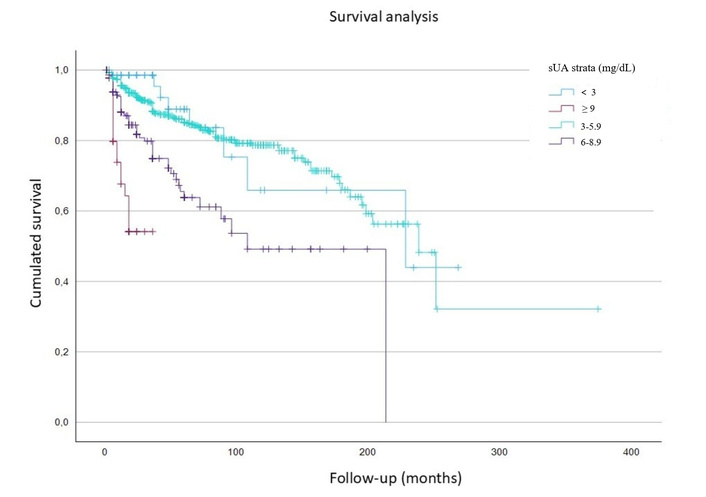
Multivariate survival analysis showed that age, gender, comorbidity, presence of subcutaneous tophi, sUA levels at baseline, and sUA strata were independently associated with increased risk of mortality. sUA levels in the therapeutic range were associated with a lower risk of mortality compared to sUA not in the therapeutic range.
In addition, whereas there was no difference between patients under or over 3 mg/dL but within the therapeutic range, there was a difference between patients out of the therapeutic range but over or under 9 mg/dL (Table 3). This is graphically shown in Figure 1.
Variables independently associated with mortality in multivariate Cox proportional hazard survival analysis.
| Variable | Hazard risk | 95% CIL | p-value |
|---|---|---|---|
| Age (per year) | 1.074 | 1.054–1.095 | < 0.001 |
| Gender (female) | 2.155 | 1.269–3.649 | 0.004 |
| Higher comorbidity | 2.141 | 1.345–3.408 | < 0.001 |
| Tophi (SC) | 1.506 | 1.051–2.158 | 0.026 |
| sUA at baseline (per mg/dL) | 1.216 | 1.094–1.351 | < 0.001 |
| sUA strata (follow-up) | |||
| < 3.0 mg/dL | 0.523 | 0.391–0.702 | 0.004 |
| 3.0–5.9 mg/dL | 0.412 | 0.277–0.612 | < 0.001 |
| ≥ 9.0 mg/dL | 2.010 | 1.086–3.070 | 0.026 |
| 6.0–8.9 mg/dL | 1.0 | ||
CIL: confidence interval limits; SC: subcutaneous; sUA: serum urate; ULT: urate-lowering therapy.
Epidemiological studies showed an association of both high and low sUA levels with increased risk of mortality, but low sUA shows a similar association, defining a J-shaped mortality curve [20]. This association may not indicate a causality relationship, as hypouricemia is commonly associated to debilitating and potentially lethal diseases, as solid cancer, uncontrolled severe diabetes, liver failure, and severe neurologic diseases [21, 22]. Mortality associated to hypouricemia has been recently investigated, finding no association in women, and all-cause and diabetes-related mortality among hypouricemic diabetic men [7]. Also, no association between low sUA levels and cardiovascular mortality was retrieved from a systematic review and dose-response meta-analysis of cohort studies of over a million participants [23]. The variability of results in epidemiological studies may be explained by differences in population morbidities, but especially by the fact that the very low sUA level index may precede the finding of a yet undiagnosed severe comorbid condition associated by itself with increased risk of mortality, such as cancer, severe diabetes, liver failure, and severe neurologic disorders.
Genetically determined disorders, such as familial hypouricemia type 1 and type 2 due to knock-out of renal tubular transporters URAT1 and Glut 9, respectively [24], and xanthinuria [25], in which affected subjects show very low sUA levels from birth, are not associated with premature mortality or poor cardiovascular outcomes.
The controversy raises to whether this epidemiological association between very low sUA and mortality would suggest to avoid low sUA target during ULT [26] or not [27]. Very low sUA are associated with the fastest reduction of urate deposits, and reaching such levels would be useful to rapidly deplete urate deposition in patients with severe gout [28]. Contrary to what would be expected based on sUA levels, urate-lowering medications that induce low or very low sUA levels, such as febuxostat and pegloticase, showed the highest probability of reduction of major adverse cardiovascular events (MACEs) and all-cause mortality, respectively [29]. Also, there was no difference in the rate of cardiovascular events in patients responding to pegloticase, showing very low sUA levels, compared to non-responders [30].
We previously reported that failure to achieve therapeutic sUA levels was associated to increased mortality [18], but we did not explore very low sUA (< 3 mg/dL) or very high sUA (> 9 mg/dL) at that time. Exposure to sUA < 3 mg/dL was not associated with increased mortality in this bidirectional prospective follow-up cohort after adjustment for other variables. Very low (< 3 mg/dL) sUA levels were more frequently achieved with febuxostat [9], benzbromarone [31], and combined therapy with allopurinol plus benzbromarone [32] and febuxostat with benzbromarone [33].
Although we also reported the association between low sUA levels and mortality in a general population [34], it should not be assumed that low sUA is the cause, but a biomarker of higher risk of mortality due to coexisting comorbid conditions [35].
This is a very large, individual, prospectively followed-up cohort, thus reducing the risk of interpersonal bias. Compared to epidemiological studies, the cohort includes clinical variables regarding gout severity (number of flares, presence of tophi, distribution of joint involvement) and treatment (medications, doses) that are lacking in most databases used for epidemiological studies. Also, a naturalistic approach for ULT was intended, treating to target sUA and even achieving the lowest sUA levels for the most severely diseased patients in order to rapidly debulk urate deposits.
Evidently, there are some limitations. Exposure to sUA < 3 mg/dL (debulking period) was limited in time and not intended during the whole period of treatment. Although corrected for comorbidity, patients with the most severe or unstable diseases could be more prone to involuntary non-adherence to ULT (hospital inpatient periods, for example) that are not captured by the electronic adherence system, and that could be theoretically associated with high sUA levels and also with mortality. Also, definitions of comorbid conditions during a very long recruitment period may induce some noise in the variables.
In conclusion, exposure to very low sUA levels during ULT, at least limited to the debulking period, was not associated with increased mortality. By contrast, it was similar to that observed for the sUA therapeutic range, and lower than that observed in patients showing sUA levels out of the therapeutic range.
CKD: chronic kidney disease
sUA: serum urate
ULT: urate-lowering therapy
To the patients who shared their data through all these years.
FPR: Conceptualization, Investigation, Data curation, Formal analysis, Funding acquisition, Writing—original draft, Writing—review & editing, Visualization. NPH: Data curation, Formal analysis, Writing—original draft, Writing—review & editing, Visualization. Both authors read and approved the submitted version.
FPR is or has been an advisor for Crystalyx, Protalix, and SOBI; speaker for Menarini and Spanish Foundation for Rheumatology. FPR, who is the Editor-in-Chief of Exploration of Musculoskeletal Diseases, had no involvement in the decision-making or the review process of this manuscript. The other author declares no conflicts of interest.
The study was approved by the Ethics Committee of OSI EEC at Cruces University Hospital (registry number CEIC-E03/45) and complied with the principles of the Declaration of Helsinki.
Informed consent to participate in the study was obtained from the participants, or their legal guardians if applicable.
Not applicable.
The datasets for this study can be obtained on request from the first author, if approval is provided by the Ethics Committee.
This study has been partially funded by Cruces Rheumatology Association (ARC, grant 01/2025). The funders had no role in study design, data collection and analysis, decision to publish, or preparation of the manuscript. FPR is a member of ARC, but took no part in funding decisions.
© The Author(s) 2026.
Open Exploration maintains a neutral stance on jurisdictional claims in published institutional affiliations and maps. All opinions expressed in this article are the personal views of the author(s) and do not represent the stance of the editorial team or the publisher.
Copyright: © The Author(s) 2026. This is an Open Access article licensed under a Creative Commons Attribution 4.0 International License (https://creativecommons.org/licenses/by/4.0/), which permits unrestricted use, sharing, adaptation, distribution and reproduction in any medium or format, for any purpose, even commercially, as long as you give appropriate credit to the original author(s) and the source, provide a link to the Creative Commons license, and indicate if changes were made.



View: 86
Download: 4
Times Cited: 0