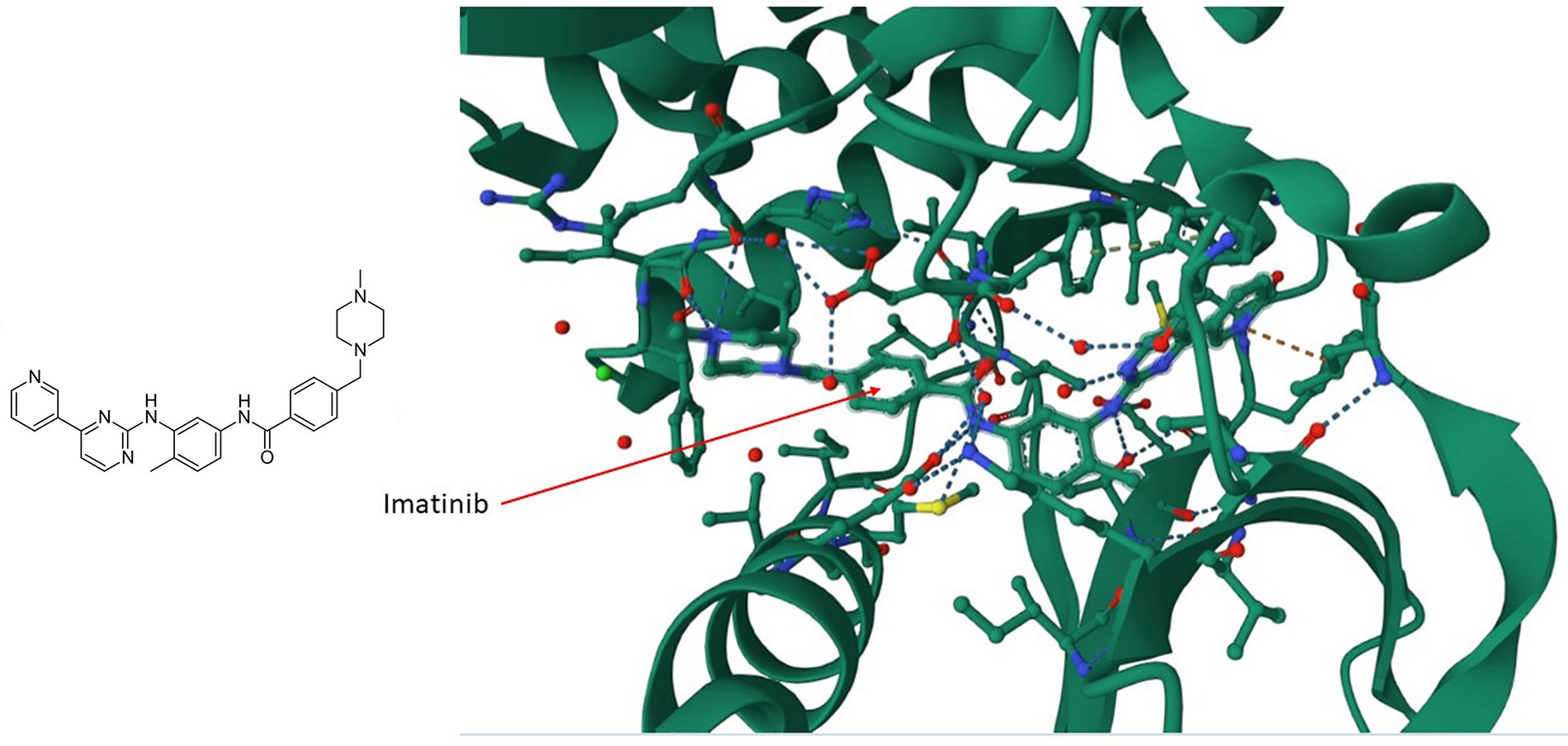
The imatinib/c-ABL complex (PDB code of c-ABL: 6hd6). Imatinib’s chemical structure is shown on the left panel whereas in the right panel, imatinib (shown by the arrow) is situated within a hydrophobic cleft of the c-ABL kinase. It forms interactions with multiple amino acids, including ASP159, HIS139, and PHE160, within a disordered domain. For additional insights, refer to the accompanying text
NAP: Conceptualization, Funding acquisition, Methodology, Investigation, Formal analysis, Supervision, Writing—original draft, Writing—review & editing. CL: Writing—review & editing, Validation. PP and MP: Visualization, Resources, Data curation. All authors read and approved the submitted version.
Conflicts of Interest
The authors declare that they have no conflicts of interest.
Ethical approval
Not applicable.
Consent to participate
Not applicable.
Consent to publication
Not applicable.
Availability of data and materials
Data are available in the supplementary materials excel file.
Funding
This work was supported by a Hopkins-Libra Foundation fellowship to NAP. The funders had no role in study design, data collection and analysis, decision to publish, or preparation of the manuscript.
Chothia C, Janin J. Principles of protein-protein recognition.Nature. 1975;256:705–8. [DOI] [PubMed]
Lo Conte L, Chothia C, Janin J. The atomic structure of protein-protein recognition sites.J Mol Biol. 1999;285:2177–98. [DOI] [PubMed]
Jones S, Thornton JM. Principles of protein-protein interactions.Proc Natl Acad Sci U S A. 1996;93:13–20. [DOI] [PubMed] [PMC]
Buchwald P. Small-molecule protein-protein interaction inhibitors: therapeutic potential in light of molecular size, chemical space, and ligand binding efficiency considerations.IUBMB Life. 2010;62:724–31. [DOI] [PubMed]
Ofran Y, Rost B. Protein-protein interaction hotspots carved into sequences.PLoS Comput Biol. 2007;3:e119. [DOI] [PubMed] [PMC]
Coleman RG, Sharp KA. Protein pockets: inventory, shape, and comparison.J Chem Inf Model. 2010;50:589–603. [DOI] [PubMed] [PMC]
Levitt M, Park BH. Water: now you see it, now you don’t.Structure. 1993;1:223–6. [DOI] [PubMed]
Persson BA, Jönsson B, Lund M. Enhanced protein steering: cooperative electrostatic and van der Waals forces in antigen-antibody complexes.J Phys Chem B. 2009;113:10459–64. [DOI] [PubMed]
Bitencourt-Ferreira G, Veit-Acosta M, de Azevedo WF Jr. Van der Waals potential in protein complexes.Methods Mol Biol. 2019;2053:79–91. [DOI] [PubMed]
Xu D, Tsai CJ, Nussinov R. Hydrogen bonds and salt bridges across protein-protein interfaces.Protein Eng. 1997;10:999–1012. [DOI] [PubMed]
De S, Krishnadev O, Srinivasan N, Rekha N. Interaction preferences across protein-protein interfaces of obligatory and non-obligatory components are different.BMC Struct Biol. 2005;5:15. [DOI] [PubMed] [PMC]
Bahadur RP, Chakrabarti P, Rodier F, Janin J. A dissection of specific and non-specific protein-protein interfaces.J Mol Biol. 2004;336:943–55. [DOI] [PubMed]
Rodier F, Bahadur RP, Chakrabarti P, Janin J. Hydration of protein-protein interfaces.Proteins. 2005;60:36–45. [DOI] [PubMed]
Tsai CJ, Xu D, Nussinov R. Structural motifs at protein-protein interfaces: protein cores versus two-state and three-state model complexes.Protein Sci. 1997;6:1793–805. [DOI] [PubMed] [PMC]
Tang S, Li J, Huang G, Yan L. Predicting protein surface property with its surface hydrophobicity.Protein Pept Lett. 2021;28:938–44. [DOI] [PubMed]
Stevens JM, Armstrong RN, Dirr HW. Electrostatic interactions affecting the active site of class sigma glutathione S-transferase.Biochem J. 2000;347:193–7. [PubMed] [PMC]
Sheinerman FB, Norel R, Honig B. Electrostatic aspects of protein-protein interactions.Curr Opin Struct Biol. 2000;10:153–9. [DOI] [PubMed]
Norel R, Sheinerman F, Petrey D, Honig B. Electrostatic contributions to protein-protein interactions: fast energetic filters for docking and their physical basis.Protein Sci. 2001;10:2147–61. [DOI] [PubMed] [PMC]
DeLano WL, Ultsch MH, de Vos AM, Wells JA. Convergent solutions to binding at a protein-protein interface.Science. 2000;287:1279–83. [DOI] [PubMed]
Bogan AA, Thorn KS. Anatomy of hot spots in protein interfaces.J Mol Biol. 1998;280:1–9. [DOI] [PubMed]
Thorn KS, Bogan AA. ASEdb: a database of alanine mutations and their effects on the free energy of binding in protein interactions.Bioinformatics. 2001;17:284–5. [DOI] [PubMed]
Wells JA. Additivity of mutational effects in proteins.Biochemistry. 1990;29:8509–17. [DOI] [PubMed]
Ma B, Wolfson HJ, Nussinov R. Protein functional epitopes: hot spots, dynamics and combinatorial libraries.Curr Opin Struct Biol. 2001;11:364–9. [PubMed] [PMC]
Guney E, Tuncbag N, Keskin O, Gursoy A. HotSprint: database of computational hot spots in protein interfaces.Nucleic Acids Res. 2008;36:D662–6. [DOI] [PubMed] [PMC]
Luque I, Freire E. Structural stability of binding sites: consequences for binding affinity and allosteric effects.Proteins. 2000;4:63–71. [DOI] [PubMed]
Ma B, Shatsky M, Wolfson HJ, Nussinov R. Multiple diverse ligands binding at a single protein site: a matter of pre-existing populations.Protein Sci. 2002;11:184–97. [DOI] [PubMed] [PMC]
Keskin O, Ma B, Nussinov R. Hot regions in protein–protein interactions: the organization and contribution of structurally conserved hot spot residues.J Mol Biol. 2005;345:1281–94. [DOI] [PubMed]
Luitz MP, Zacharias M. Role of tyrosine hot-spot residues at the interface of colicin E9 and immunity protein 9: a comparative free energy simulation study.Proteins. 2013;81:461–8. [DOI] [PubMed]
Li X, Keskin O, Ma B, Nussinov R, Liang J. Protein-protein interactions: hot spots and structurally conserved residues often locate in complemented pockets that pre-organized in the unbound states: implications for docking.J Mol Biol. 2004;344:781–95. [DOI] [PubMed]
Lawrence MC, Colman PM. Shape complementarity at protein/protein interfaces.J Mol Biol. 1993;234:946–50. [DOI] [PubMed]
Maeda MH, Kinoshita K. Development of new indices to evaluate protein-protein interfaces: assembling space volume, assembling space distance, and global shape descriptor.J Mol Graph Model. 2009;27:706–11. [DOI] [PubMed]
Kalosidis NI, Mantsou A, Papanikolaou NA. From driver mutations to driver cancer networks: why we need a new paradigm.Cancer Stud. 2018;2:1–11.
Cheng F, Zhao J, Wang Y, Lu W, Liu Z, Zhou Y, et al. Comprehensive characterization of protein-protein interactions perturbed by disease mutations.Nat Genet. 2021;53:342–53. [DOI] [PubMed] [PMC]
Xu J, Richard S. Cellular pathways influenced by protein arginine methylation: implications for cancer.Mol Cell. 2021;81:4357–68. [DOI] [PubMed] [PMC]
Li B, Kong X, Post H, Raaijmakers L, Peeper DS, Altelaar M. Proteomics and phosphoproteomics profiling of drug-addicted BRAFi-resistant melanoma cells.J Proteome Res. 2021;20:4381–92. [DOI] [PubMed] [PMC]
Qiu Y, Wang Y, Chai Z, Ni D, Li X, Pu J, et al. Targeting RAS phosphorylation in cancer therapy: mechanisms and modulators.Acta Pharm Sin B. 2021;11:3433–46. [DOI] [PubMed] [PMC]
Wang S, Ramamurthy D, Tan J, Liu J, Yip J, Chua A, et al. Post-translational modifications of fumarase regulate its enzyme activity and function in respiration and the DNA damage response.J Mol Biol. 2020;432:6108–26. [PubMed] [PMC]
Lin X, Kulkarni P, Bocci F, Schafer NP, Roy S, Tsai MY, et al. Structural and dynamical order of a disordered protein: molecular insights into conformational switching of PAGE4 at the systems level.Biomolecules. 2019;9:77. [DOI] [PubMed] [PMC]
Ramsdale R, Jorissen RN, Li FZ, Al-Obaidi S, Ward T, Sheppard KE, et al. The transcription cofactor c-JUN mediates phenotype switching and BRAF inhibitor resistance in melanoma.Sci Signal. 2015;8:ra82. [DOI] [PubMed]
Kemper K, de Goeje PL, Peeper DS, van Amerongen R. Phenotype switching: tumor cell plasticity as a resistance mechanism and target for therapy.Cancer Res. 2014;74:5937–41. [DOI] [PubMed]
Lee RJ, Marais R. Cancer: tumours addicted to drugs are vulnerable.Nature. 2017;550:192–3. [DOI] [PubMed]
Kong X, Kuilman T, Shahrabi A, Boshuizen J, Kemper K, Song JY, et al. Cancer drug addiction is relayed by an ERK2-dependent phenotype switch.Nature. 2017;550:270–4. [DOI] [PubMed] [PMC]
Hennessy BT, Smith DL, Ram PT, Lu Y, Mills GB. Exploiting the PI3K/AKT pathway for cancer drug discovery.Nat Rev Drug Discov. 2005;4:988–1004. [DOI] [PubMed]
Hao T, Peng W, Wang Q, Wang B, Sun J. Reconstruction and application of protein–protein interaction network.Int J Mol Sci. 2016;17:907. [DOI] [PubMed] [PMC]
Ivanov AA, Revennaugh B, Rusnak L, Gonzalez-Pecchi V, Mo X, Johns MA, et al. The OncoPPi Portal: an integrative resource to explore and prioritize protein–protein interactions for cancer target discovery.Bioinformatics. 2018;34:1183–91. [DOI] [PubMed] [PMC]
Nussinov R, Tsai CJ, Jang H. Anticancer drug resistance: an update and perspective.Drug Resist Updat. 2021;59:100796. [DOI] [PubMed] [PMC]
Liu Z, Zou H, Dang Q, Xu H, Liu L, Zhang Y, et al. Biological and pharmacological roles of m6A modifications in cancer drug resistance.Mol Cancer. 2022;21:220. [DOI] [PubMed] [PMC]
Pérot S, Sperandio O, Miteva MA, Camproux AC, Villoutreix BO. Druggable pockets and binding site centric chemical space: a paradigm shift in drug discovery.Drug Discov Today. 2010;15:656–67. [DOI] [PubMed]
Ulucan O, Eyrisch S, Helms V. Druggability of dynamic protein-protein interfaces.Curr Pharm Des. 2012;18:4599–606. [DOI] [PubMed]
Eyrisch S, Medina-Franco JL, Helms V. Transient pockets on XIAP-BIR2: toward the characterization of putative binding sites of small-molecule XIAP inhibitors.J Mol Model. 2012;18:2031–42. [DOI] [PubMed]
van der Lee R, Buljan M, Lang B, Weatheritt RJ, Daughdrill GW, Dunker AK, et al. Classification of intrinsically disordered regions and proteins.Chem Rev. 2014;114:6589–631. [DOI] [PubMed] [PMC]
Vener C, Banzi R, Ambrogi F, Ferrero A, Saglio G, Pravettoni G, et al. First-line imatinib vs second- and third-generation TKIs for chronic-phase CML: a systematic review and meta-analysis.Blood Adv. 2020;4:2723–35. [DOI] [PubMed] [PMC]
Pettersen EF, Goddard TD, Huang CC, Meng EC, Couch GS, Croll TI, et al. UCSF ChimeraX: structure visualization for researchers, educators, and developers.Protein Sci. 2021;30:70–82. [DOI] [PubMed] [PMC]
van Erp NP, Gelderblom H, Guchelaar HJ. Clinical pharmacokinetics of tyrosine kinase inhibitors.Cancer Treat Rev. 2009;35:692–706. [DOI] [PubMed]
Hari SB, Perera BGK, Ranjitkar P, Seeliger MA, Maly DJ. Conformation-selective inhibitors reveal differences in the activation and phosphate-binding loops of the tyrosine kinases Abl and Src.ACS Chem Biol. 2013;8:2734–43. [DOI] [PubMed] [PMC]
Panjarian S, Iacob RE, Chen S, Engen JR, Smithgall TE. Structure and dynamic regulation of Abl kinases.J Biol Chem. 2013;288:5443–50. [DOI] [PubMed] [PMC]
Townsend PA, Kozhevnikova MV, Cexus ONF, Zamyatnin AA, Soond SM. BH3-mimetics: recent developments in cancer therapy.J Exp Clin Cancer Res. 2021;40:355. [DOI] [PubMed] [PMC]
Ivarsson Y, Jemth P. Affinity and specificity of motif-based protein-protein interactions.Curr Opin Struct Biol. 2019;54:26–33. [DOI] [PubMed]
Gfeller D, Michielin O, Zoete V. Shaping the interaction landscape of bioactive molecules.Bioinformatics. 2013;29:3073–9. [DOI] [PubMed]
Daina A, Michielin O, Zoete V. SwissTargetPrediction: updated data and new features for efficient prediction of protein targets of small molecules.Nucleic Acids Res. 2019;47:W357–64. [DOI] [PubMed] [PMC]
Szklarczyk D, Kirsch R, Koutrouli M, Nastou K, Mehryary F, Hachilif R, et al. The STRING database in 2023: protein-protein association networks and functional enrichment analyses for any sequenced genome of interest.Nucleic Acids Res. 2023;51:D638–46. [DOI] [PubMed] [PMC]
Zhou Y, Zhou B, Pache L, Chang M, Khodabakhshi AH, Tanaseichuk O, et al. Metascape provides a biologist-oriented resource for the analysis of systems-level datasets.Nat Commun. 2019;10:1523. [DOI] [PubMed] [PMC]