Original Article


Affiliation:
1Department of Health Psychology, Open Universiteit, 6419 AT Heerlen, the Netherlands
Email: Tessi.hengst@ou.nl
ORCID: https://orcid.org/0000-0003-4992-8320


 ,
,
Affiliation:
1Department of Health Psychology, Open Universiteit, 6419 AT Heerlen, the Netherlands
ORCID: https://orcid.org/0000-0002-5160-7086
,
Affiliation:
2Department of Management Science, Open Universiteit, 6419 AT Heerlen, the Netherlands
ORCID: https://orcid.org/0000-0003-1738-914X
,
Affiliation:
3Department of Pulmonology, Zuyderland Medical Center, 6419 PC Heerlen, the Netherlands
Affiliation:
4Department of Pulmonology, Canisius Wilhelmina Hospital, 6532 SZ Nijmegen, the Netherlands
Affiliation:
3Department of Pulmonology, Zuyderland Medical Center, 6419 PC Heerlen, the Netherlands
ORCID: https://orcid.org/0000-0003-2883-9441
,
Affiliation:
5Department of Outpatient Division, Amsterdam UMC, 1105 AZ Amsterdam, the Netherlands
6Department of Medical Psychology, Amsterdam UMC, 1105 AZ Amsterdam, the Netherlands
7Department of Digital Health, Amsterdam Public Health Research Institute, 1105 AZ Amsterdam, the Netherlands
ORCID: https://orcid.org/0000-0003-0376-3161
,
Affiliation:
1Department of Health Psychology, Open Universiteit, 6419 AT Heerlen, the Netherlands
ORCID: https://orcid.org/0000-0001-9209-6449
Explor Digit Health Technol. 2026;4:1011101 DOI: https://doi.org/10.37349/edht.2026.1011101
Received: November 10, 2025 Accepted: May 14, 2026 Published: August 13, 2026
Academic Editor: Atanas G. Atanasov, Medical University of Vienna, Austria
Aim: Telemonitoring apps are increasingly prescribed as part of self-management for patients with Chronic Obstructive Pulmonary Disease (COPD), yet patients still make minimal use of these apps. This research investigates explanatory factors associated with the behavioral intention to use and actual use of COPD telemonitoring apps among users and non-users.
Methods: A cross-sectional study was conducted among 200 COPD patients from two Dutch hospitals. Eligible participants (≥ 18 years, diagnosed with COPD, ≥ 2 outpatient pulmonology visits in 2023) were identified through the electronic health record and invited by mail. Participants completed a self-administered questionnaire assessing demographics, disease severity, literacy, facilitating conditions, and app-related factors, based on the Unified Theory of Acceptance and Use of Technology 2 (UTAUT2), the Technology Acceptance Model (TAM), and the Reasoned Action Approach (RAA). Behavioral intention was analyzed using hierarchical multiple regression, and use was analyzed using binomial logistic regression.
Results: Intention was explained by performance expectancy (coefficient = 0.760, p ≤ 0.001), self-efficacy (coefficient = 0.207, p = 0.009), and alignment with personal norms and values (coefficient = 0.163, p = 0.006). Use was explained by self-efficacy (OR = 1.992, p = 0.023), social influence (OR = 1.642, p = 0.039), personalization (OR = 0.628, p = 0.039), and intention to use (OR = 3.459, p ≤ 0.001). App users showed significantly higher digital literacy, performance expectancy, and fewer symptoms compared to non-users. Users also experienced significantly higher importance of social influence and alignment with norms and values than non-users. Demographic variables and disease severity were no significant predictors of behavioral intention and use.
Conclusions: Optimizing the app and the supportive role of the healthcare professional, enhancing digital and health literacy, and hybrid care ensures that patients can benefit from both traditional care and the advantages of remote monitoring.
Digital health technologies are increasingly integrated in healthcare to enhance patient participation and self-management, improve efficiency and care delivery, and promote information and (preventive) treatment [1]. This also includes chronic disease management, such as management of Chronic Obstructive Pulmonary Disease (COPD) [2, 3]. COPD is a progressive, incurable lung disease characterized by symptoms like breathlessness, chronic cough, fatigue, and decreased exercise capacity [4], representing the third leading cause of death worldwide [5]. However, treatment is possible, particularly during the earlier stages of the disease [6]. Because worsening of symptoms or exacerbations are unpredictable and show considerable variability in terms of frequency, treatment is focused on preventing deterioration and exacerbations, managing symptoms, and relieving the overall disease burden [4].
Self-management is essential in COPD care [7–10] and refers to “the individual’s ability to manage the symptoms, treatment, physical and psychosocial consequences, and lifestyle changes inherent in living with a chronic condition” [11]. Telemonitoring apps are increasingly used as part of COPD self-management, allowing patients to monitor their health data from home with a measurement device or an app [12]. In the European Union, telemonitoring apps are considered medical devices as they are prescribed and implemented into the medical care trajectory under the supervision of a healthcare professional [13]. Here, the healthcare professional receives a signal from the telemonitoring system when the patient’s condition is deteriorating. This allows healthcare professionals to monitor a larger population and intervene at the right time, potentially preventing hospital admissions and improving quality of life [8, 14]. Besides, telemonitoring offers patients more insight into their health and enables timely information, such as educational lessons on coping with their disease or self-management guidance for patients to take action when deteriorating. Given these benefits, the use of telemonitoring apps is recommended.
However, despite its benefits and growing importance in routine COPD care, COPD patients still make minimal use of these apps [15, 16], whilst they are a vulnerable patient population (individuals with a low socio-economic position (SEP), a higher disease burden and additional barriers to the adoption of digital health technology). The primary objective of this study is therefore to identify the factors explaining the behavioral intention and use of telemonitoring apps among COPD patients, and the support desirable to facilitate this use.
Telemonitoring app use could be explained by theoretical models focused on technology adoption, such as the Unified Theory of Acceptance and Use of Technology 2 (UTAUT2) and the Technology Acceptance Model (TAM) [14]. The UTAUT2 states that performance expectancy, effort expectancy, social influence, facilitating conditions, hedonic motivation, price value, and habit determine behavioral intention and technology adoption [17], whereas TAM states that technology acceptance is determined by perceived usefulness and perceived ease of use [18]. Here, adoption-related factors of TAM and UTAUT2 also overlap with social cognitive factors from more general behavioral explanatory models, such as the Reasoned Action Approach (RAA). In the RAA, background factors determine beliefs, which in turn determine the attitude, perceived norm, and perceived behavioral control, influencing the behavioral intention and use [19]. Herewith, the behavioral intention leading to behavior conforms with UTAUT2 and TAM, as well as the concept of attitude (TAM) and social background factors (UTAUT2). These models thus provide a framework of the factors that are important in technology use and an indication of the factors that might be important for telemonitoring app adoption.
Moreover, several factors are found to influence mHealth use for COPD in previous studies [8, 14]. Facilitative factors are improved self-management, improved disease understanding and management, a positive attitude toward mHealth, contact with healthcare professionals, feedback on self-management behavior, perceived ease of use, and mHealth safety. Barriers to using mHealth apps for self-management are patients’ preference for personal contact, a lack of digital and health literacy, poor infrastructure (e.g., possession of a mobile device), and avoidance of confrontation with their illness. Adoption is also expected to be influenced by demographic factors, as individuals with a low SEP have an increased risk of chronic diseases such as COPD [9], while often facing barriers to accessing and using digital healthcare, including low health literacy skills [20, 21], decreased access to digital infrastructure, and decreased digital skills [22]. As a result, people with a low SEP are less likely to use digital health services [12]. Nonetheless, prior research has mainly focused on qualitative insights, by which a knowledge gap remains regarding quantitative studies that systematically examine the determinants of the behavioral intention and use of telemonitoring apps among the vulnerable COPD population.
To explore these factors, the first step is to examine differences between users and non-users of telemonitoring apps in terms of demographics, literacy levels, and health status. Building on previous studies [14, 23–25] and theoretical models (UTAUT2, TAM, and RAA), a list of variables has been established that are expected to influence the use of telemonitoring apps. Identifying the determinants of behavioral intention and use is essential for increasing the usage of telemonitoring apps and supporting patients where needed. The theoretical model is shown in Figure 1.
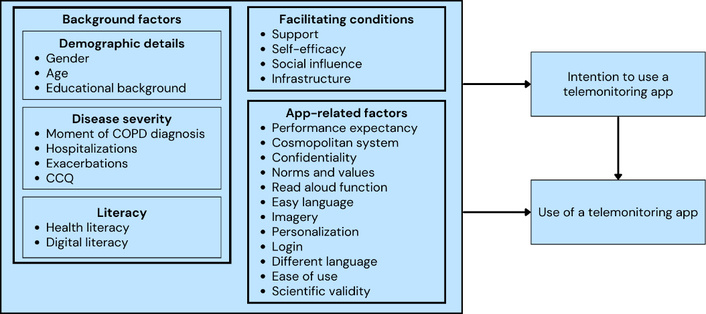
Theoretical model explaining the behavioral (intention to) use of telemonitoring apps.
A cross-sectional quantitative study was performed. We obtained ethical approval from a Medical Ethics Committee (see ‘Declarations’ section). Data collection took place through a paper-based survey at two major teaching hospitals in the Netherlands: the Canisius Wilhelmina Hospital (CWZ) in Nijmegen and the Zuyderland Medical Center (ZU) in Heerlen.
We identified all patients aged over 18 years with a COPD diagnosis and at least 2 outpatient clinic contacts with the pulmonologist in 2023 through the electronic health records of the hospitals (871 patients at CWZ and 3,416 patients at ZU). We excluded patients not residing in the Netherlands. Table 1 shows an overview of the study population.
Overview of the study population (COPD patients, CWZ & ZU hospitals, Netherlands, 2024).
| Hospital | Study population | Users | Non-users |
|---|---|---|---|
| ZU | n = 3,416 | n = 115 (3.4%) | n = 3,301 (96.6%) |
| CWZ | n = 871 | n = 213 (24.5%) | n = 658 (75.5%) |
| Total | N = 4,287 (100%) | n = 328 (7.7%) | n = 3,959 (92.3%) |
Since hierarchical multiple regression was the primary analysis method for this study, an a priori power analysis was conducted for the full regression model including 25 predictors (16 in block 1 and 9 in block 2). A minimum sample size of 151 participants was required (α = 0.05, power = 0.80). This calculation was performed using Daniel Soper’s a priori sample size calculator for multiple regression [26]. Assuming a 25% response rate, a total of 604 COPD patients needed to be invited to participate in the study (302 patients per hospital). To enable comparison between users and non-users, the sampling strategy aimed at an equal number of users and non-users. At CWZ, this was possible: we mailed 151 users (70.9% of the CWZ users, 50% of the CWZ sample) and 151 non-users (22.9% of the CWZ non-users, 50% of the CWZ sample). At ZU, the number of users was substantially lower. Therefore, all 115 users (100% of ZU users, 38.1% of the ZU sample) were written to, supplemented by 187 non-users (5.7% of the ZU non-users, 61.9% of the ZU sample). Accordingly, we assigned random numbers to the patients in the Excel software (by using the ASELECT function) and selected the required number of participants top-down.
In the questionnaire, we defined a telemonitoring app as an app on a smartphone or tablet in which the user (i.e., the COPD patient) answers questions about their COPD (e.g., symptom severity) and uploads biomedical data (e.g., blood saturation). A telemonitoring app may contain educational, self-management, communication (e.g., direct contact with a health care provider, the possibility to ask clarifying questions, or receiving appropriate advice), and self-learning components (e.g., online lessons on exacerbations and exercises). In this study, we assessed the general use of telemonitoring apps, but it is important to note that the Thuismeten app (developed by Luscii Healthtech B.V., Amsterdam, the Netherlands) is the only prescribed medical device at both hospitals. This app has been implemented in the majority of hospitals across the Netherlands, making it the most widely adopted app for COPD telemonitoring [27].
The questionnaire (Supplementary material 1) included demographic variables, digital and health literacy, and self-assessed disease severity (i.e., moment of COPD diagnosis, number of hospitalizations and exacerbations in the last year, and the Clinical COPD Questionnaire (CCQ)). The variables were derived from validated constructs within UTAUT2, TAM, and RAA and were operationalized using items adapted from validated instruments, ensuring construct and content validity. The CCQ is a widely used and validated measurement tool which has demonstrated good construct validity and reliability to measure the symptoms and mental and physical state of COPD patients [2, 28]. The CCQ consists of 10 items measured on a 7-point Likert scale ranging from ‘never’ (1) to ‘always’ (7) and from ‘not at all limited’ (1) to ‘completely limited or not possible’ (7). In the present study, the CCQ showed good internal consistency (Cronbach’s α = 0.854). The higher the CCQ score, the poorer the health status. Health literacy was assessed using one item from the validated Set of Brief Screening Questions (SBSQ), identified by Chew et al. [29] as an effective question for detecting inadequate health literacy among patients. This item has demonstrated adequate face and construct validity in previous studies. Digital literacy was measured by 2 self-assessment items rated on a 5-point Likert scale ranging from ‘very inconvenient’ (1) to ‘very convenient’ (5). The items showed acceptable internal consistency (r = 0.728).
Behavioral intention indicates the extent to which a person intends to start or continue using a telemonitoring app. This was measured using two items on a 5-point Likert scale (r = 0.862). Accordingly, use indicates whether a person is using a telemonitoring app when filling in the questionnaire. This was assessed by one binary (yes/no) item. Based on UTAUT2, TAM, and RAA, as well as previous literature [23–25], the intention to use a telemonitoring app is explained by 25 independent variables (see Figure 2 and Supplementary material 3). The use of a telemonitoring app, in term, is explained by 26 independent variables by adding the factor intention to use as an independent variable to the model (see Supplementary material 4). All items were measured on a 5-point Likert scale. The complete questionnaire can be found in Supplementary material 1, an overview of definitions and operationalizations of all factors proposed to relate to (intentional) use can be found in Supplementary material 2, and the determinants can be found in Supplementary material 3 and Supplementary material 4.
We conducted a pilot questionnaire among three experts (i.e., a nursing specialist, a pulmonary nurse, and a pulmonologist) and two low SEP people (i.e., a COPD patient and a lower-educated elderly person), and made minor revisions (i.e., simplifying questions and adding explanations where necessary) to improve clarity and ensure face validity. The principal investigators at ZU and CWZ prepared a list of the patients who met the in- and exclusion criteria, from which the executive researcher drew a random sample. We then mailed an envelope containing the information letter, consent form, questionnaire, and return envelope to the sample. We sent a reminder letter after two weeks. For patients who had already participated, a copy of the signed consent form was attached. Patients who returned only the questionnaire were contacted to complete the consent process (n = 7). The final sample consisted of 200 participants, by which no additional sample was needed.
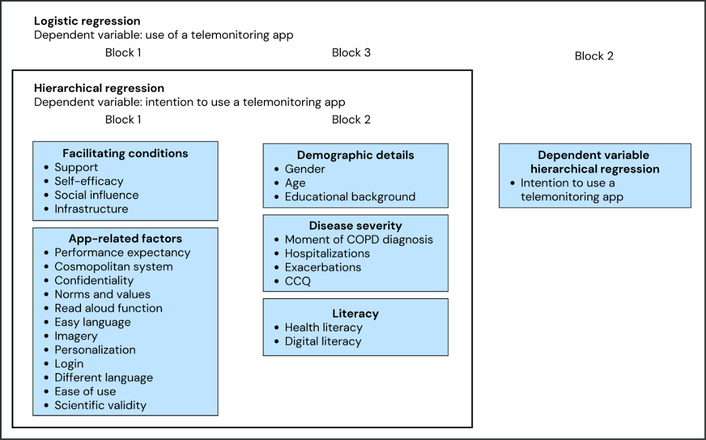
Data were processed using IBM SPSS Statistics for Windows (version 29.0.2.0, IBM Corp., Armonk, NY, USA) [30]. The final data file was corrected for outliers and scales were assembled. Descriptive statistics were then computed for all key variables. Correlations were calculated to explore univariate associations between all relevant factors and the dependent variables. Independent samples t-tests and chi-square tests compared users and non-users in telemonitoring app use. For the t-test analyses, a p-value lower than 0.01 was considered significant to correct for multiple testing, while for the regression analyses a p-value lower than 0.05 was used as the conventional significance threshold. Consecutively, a backward two-block hierarchical multiple regression with pairwise deletion examined the determinants of the intention to use a telemonitoring app. Predictors were introduced in order of their expected degree of influence on the dependent variable. The first block included 16 app-related factors, followed by 9 background factors in the second block. To examine the determinants of the use of a telemonitoring app, a three-step backward binomial logistic regression was conducted, adding intention to use a telemonitoring app as a separate block between the first and the last block. An overview of the regression model can be found in Figure 2. Finally, the responses to the open-ended questions on motivation to use the app (questions 32, 33, 34) and form of support (question 35, 36, 37, and 38) were categorized and counted to identify motivations to use the app and support needs.
Between January 8th and March 6th of 2024, a total of 604 COPD patients were invited to participate, of which 218 patients responded (36.1%). After excluding 18 patients due to missing informed consent forms, a total of 200 complete questionnaires were included in the dataset (N = 200, 33.1%). An overview of the participants is shown in Table 2.
Overview of the study participants (COPD patients, CWZ & ZU hospitals, Netherlands, 2024).
| Hospital | Sample | Users | Non-users |
|---|---|---|---|
| ZU | n = 108 (54.0% of total) | n = 60 (55.6% of ZU) | n = 48 (44.4% of ZU) |
| CWZ | n = 92 (46.0% of total) | n = 61 (66.3% of CWZ) | n = 31 (33.7% of CWZ) |
| Total | N = 200 (100%) | n = 121 (60.5%) | n = 79 (39.5%) |
The sample consisted of 90 (45%) males and 110 (55%) females, with a mean age of 68.3 years (± 8.25), ranging from 40 to 87 years. Of the participants, 65 participants (32.7%) had a low education level, 100 (50.3%) had a medium education level, and 34 (17.1%) had a high education level (1 missing). The mean CCQ was 3.41 (± 0.97). Most participants had a COPD diagnosis for over two years (n = 181, 90.5%) and had not been hospitalized in the past year (n = 135, 67.5%). Furthermore, 86 participants (43.2%) had more than one exacerbation, 51 participants (25.6%) had one exacerbation, and 62 participants (31.2%) had no exacerbations in the past year (1 missing). Besides, 144 participants (72.0%) used a saturation measurement tool, and 56 (28.0%) did not. On average, participants did 12.96 saturation measurements a month (± 12.81), with a minimum of 1 and a maximum of 60.
In terms of device ownership, most participants owned a smartphone (n = 180, 90%), or a tablet (n = 100, 50.0%) and had a Wi-Fi (n = 177, 88.5%) or mobile internet (n = 121, 60.5%) connection. Notably, 9 participants (4.5%) reported not owning any mobile device, and one participant (0.5%) had no access to the internet. The mean score for digital literacy was 3.39 (± 0.86) and 4.19 (± 0.86) for health literacy. Overall, 121 participants (60.5%) used a telemonitoring app, and 79 participants (39.5%) did not. The average intention to use a telemonitoring app was 4.21 (± 1.15), with higher scores among users (M = 4.71, ± 0.55) than among non-users (M = 3.39, ± 1.39).
Independent-sample t-tests showed that users had significantly higher digital literacy (Mdif = –0.453, 95% CI [–0.678, –0.228]) and performance expectancy (Mdif = –0.643, 95% CI [–1.076, –0.209]) than non-users of a telemonitoring app. Moreover, it was found that users had significantly fewer symptoms than non-users (Mdif = 0.476, 95% CI [0.112, 0.837]) and that users experienced significantly more importance of social influence (Mdif = –0.609, 95% CI [–0.915, –0.303]) and alignment with norms and values (Mdif = –0.742, 95% CI [–1.097, –0.387]) than non-users. Fisher’s exact test showed no statistically significant association between the moment of COPD diagnosis and the use of a telemonitoring app (p = 0.212). Moreover, a chi-square test showed no significant association between education level and the use of a telemonitoring app (χ2(2) = 0.394, p = 0.82). An overview of the results can be found in Table 3.
Results of the independent samples t-tests for differences between users and non-users of a telemonitoring app (CWZ & ZU hospitals, Netherlands 2024).
| Variable | Users | Non-users | Test statistics | P2 | ||
|---|---|---|---|---|---|---|
| M | SD | M | SD | |||
| Age (years) | 67.87 | 7.71 | 68.16 | 9.12 | t(187) = 0.235 | 0.815 |
| Hospital admissions | 1.57 | 0.90 | 1.41 | 0.86 | t(187) = –1.200 | 0.232 |
| Exacerbations | 2.42 | 1.17 | 2.25 | 1.16 | t(188) = –0.947 | 0.345 |
| CCQ | 3.33 | 0.86 | 3.57 | 1.12 | t(120.955) = 1.591 | 0.114 |
| Symptoms1 | 3.42 | 0.92 | 3.90 | 1.37 | t(110.239) = 2.617 | 0.010 |
| Functional state | 3.67 | 1.10 | 3.66 | 1.27 | t(189) = –0.072 | 0.943 |
| Mental state | 2.44 | 1.56 | 2.74 | 1.33 | t(189) = 1.338 | 0.183 |
| Health literacy | 4.31 | 0.76 | 4.06 | 0.92 | t(184) = –2.033 | 0.043 |
| Digital literacy | 3.62 | 0.75 | 3.17 | 0.78 | t(188) = –3.976 | < 0.001 |
| Support | 8.06 | 1.66 | 7.70 | 1.67 | t(185) = –1.432 | 0.154 |
| Self-efficacy | 4.59 | 0.64 | 4.15 | 1.06 | t(125) = –1.892 | 0.061 |
| Social influence | 3.56 | 0.98 | 2.95 | 1.05 | t(180) = –3.929 | < 0.001 |
| Infrastructure | 2.45 | 1.20 | 2.26 | 1.22 | t(179) = –0.984 | 0.326 |
| Performance expectancy | 4.41 | 0.58 | 3.77 | 0.83 | t(124) = –2.933 | 0.004 |
| Cosmopolitan system1 | 4.09 | 0.93 | 3.68 | 1.26 | t(110.410) = –2.331 | 0.022 |
| Confidentiality1 | 3.98 | 0.84 | 3.63 | 1.21 | t(105.709) = –2.108 | 0.037 |
| Norms and values1 | 3.86 | 0.91 | 3.12 | 1.30 | t(106.625) = –4.142 | < 0.001 |
| Read-aloud function 30.1 | 2.29 | 1.23 | 2.74 | 3.88 | t(179) = 1.126 | 0.262 |
| Easy language 30.2 | 3.64 | 1.18 | 3.27 | 1.33 | t(182) = –1.966 | 0.051 |
| Imagery 30.3 | 3.04 | 1.18 | 2.85 | 1.23 | t(178) = –1.048 | 0.296 |
| Personalization 30.4 | 3.35 | 1.24 | 3.41 | 1.11 | t(177) = 0.329 | 0.743 |
| Login 30.9 | 3.68 | 1.18 | 3.43 | 1.33 | t(179) = –1.275 | 0.204 |
| Different languages1 30.10 | 1.88 | 1.26 | 1.64 | 1.06 | t(158.428) = –1.346 | 0.180 |
| Ease of use1 30.5 | 4.06 | 0.97 | 3.78 | 1.18 | t(118.880) = –1.659 | 0.100 |
| Scientific validity1 | 4.15 | 0.92 | 3.74 | 1.28 | t(107.814) = –2.328 | 0.022 |
1 A non-equality test was used as the assumption of homogeneity of variances was violated, as assessed by Levene’s test for equality of variances. 2 A p-value < 0.01 is considered significant to correct for multiple testing.
Spearman and Pearson correlations were used to gain insight into the relationship between the independent variables and the dependent variables, behavioral intention and use, respectively. An overview of the significant correlations can be found in Table 4, and the complete correlation tables can be found in Supplementary material 5. Behavioral intention showed a moderate positive correlation with support and a strong correlation with both self-efficacy and performance expectancy. The use of the telemonitoring app was moderately correlated with self-efficacy and strongly correlated with performance expectancy and behavioral intention.
Significant Rs correlations between relevant variables (COPD patients, CWZ & ZU hospitals, Netherlands, 2024).
| Variable category | Variable | Intention | Use |
|---|---|---|---|
| Background factors | Digital literacy | 0.287** | 0.278** |
| Health literacy | 0.227** | 0.148* | |
| Facilitating conditions | Support | 0.329** | † |
| Self-efficacy | 0.561** | 0.460** | |
| Social influence | 0.237** | 0.281** | |
| Infrastructure | 0.178* | † | |
| App-related factors | Performance expectancy | 0.722** | 0.477** |
| Cosmopolitan system | 0.284** | 0.184* | |
| Confidentiality | 0.220** | 0.169* | |
| Norms and values | 0.396** | 0.319** | |
| Ease of use | 0.221** | † | |
| Easy language | 0.178* | † | |
| Login | 0.197** | † | |
| Different languages | 0.159* | † | |
| Scientific validity | 0.244** | 0.185* | |
| Dependent variable association | Intention to use | - | 0.556** |
† indicates no significance. * Correlation is significant at the 0.05 level. ** Correlation is significant at the 0.01 level.
A two-step hierarchical multiple backward regression was performed. All the assumptions for the regression were met. The second (final) model was statistically significant (R2 = 0.603, F(3, 173) = 87.524, p < 0.001, adjusted R2 = 0.596) and explained 60.3% of the variance (adjusted R2 = 0.596). The analysis revealed that performance expectancy (coefficient = 0.760, p ≤ 0.001), self-efficacy (coefficient = 0.207, p = 0.009), and norms and values (coefficient= 0.163, p = 0.006) were explanatory for the intention to use a telemonitoring app. Higher performance expectancy and self-efficacy increased the intention to use a telemonitoring app. Moreover, the more the app aligns with personal norms and values, the higher the intention to use a home monitoring app. Full regression details are shown in Table 5.
Results of the hierarchical multiple regression, predicting behavioral intention among COPD patients in CWZ & ZU hospitals (2024).
| Variable | Model 1 | Model 2 | ||||||
|---|---|---|---|---|---|---|---|---|
| B | SE | β | p | B | SE | β | p | |
| Performance expectancy | 0.760** | 0.094 | 0.561 | ≤ 0.001 | 0.760** | 0.093 | 0.561 | ≤ 0.001 |
| Self-efficacy | 0.207* | 0.079 | 0.165 | 0.010 | 0.207* | 0.079 | 0.165 | 0.009 |
| Norms and values | 0.163* | 0.058 | 0.159 | 0.006 | 0.163* | 0.058 | 0.159 | 0.006 |
This regression employed a two-step hierarchical approach. The first model of the regression included the app-related factors, while the second model also included the background factors. The second (final) model explained 60.3% (R2) of the variance in intentional telemonitoring app use. VIF: range 1.013–2.281; Tolerance: range 0.438–0.979. * p < 0.05, ** p < 0.001.
Second, a three-step binomial logistic regression was performed. All the assumptions were met. The logistic regression was statistically significant (χ2(4) = 69.039, p ≤ 0.001), correctly classified 80.1% of cases, and explained 46.4% (Nagelkerke R2) of the variance in telemonitoring app use. Intention (OR = 3.459, p ≤ 0.001), self-efficacy (OR = 1.992, p = 0.023), and social influence (OR = 1.642, p = 0.039) were positively associated with use, whereas a higher perceived value of personalization of the app (OR = 0.628, p = 0.039) was associated with a reduction of the likelihood of using a telemonitoring app (see Table 6).
Results of the logistic regression, predicting the use of a COPD telemonitoring app among COPD patients in CWZ & ZU hospitals (2024).
| Variable | B | SE | p | Odds ratio | 95% CI for odds ratio | |
|---|---|---|---|---|---|---|
| Lower | Upper | |||||
| Self-efficacy | 0.689 | 0.303 | 0.023 | 1.992 | 1.101 | 3.605 |
| Social influence | 0.496 | 0.240 | 0.039 | 1.642 | 1.025 | 2.631 |
| Personalization | –0.465 | 0.225 | 0.039 | 0.628 | 0.404 | 0.977 |
| Intention | 1.241 | 0.286 | ≤ 0.001 | 3.459 | 1.976 | 6.057 |
Open-ended questions revealed that the motivation to use a telemonitoring app was mainly related to the feeling of control provided by the app. Of the 116 users who had filled in the open question, 65 (56.0%) appreciated the fact that doctors and nurses could intervene quickly with deteriorating health values and the short lines of communication between the patient and the health care provider. In addition, 23 participants appreciated having insight into their health status themselves (19.8%). Telemonitoring gave 16 patients (13.8%) a good sense of safety and security. Lastly, 24 patients (20.7%) indicated using the app because the doctor recommended it, and 6 patients (5.2%) indicated that using the app reduced their number of hospital visits.
All participants (N = 200) were asked about the support needed and received when downloading and/or using a telemonitoring app (completed by 178 participants, 22 missing). Of these 178 participants, 98 participants (55.1%) reported that they needed support downloading and/or using a telemonitoring app, and 88 participants (89.8% of participants needing support) reported that they had received it. Multiple responses were possible; therefore, percentages may exceed 100%. Most participants received support from the nurse (n = 52, 59.1% of participants receiving support), followed by the app developer’s help page (n = 25, 28.4%), family or friends (n = 24, 27.3%), a hospital email or letter (n = 15, 17.0%), the pulmonologist (n = 5, 5.7%), or the telephone help desk (n = 2, 2.3%). Participants were subsequently asked whether they would like to (continue to) receive support with downloading and/or using telemonitoring apps in the future (completed by 184 participants, 16 missing). Of these, 60 participants (32.6%) indicated they would like future support. In an open question (filled in by 40 participants), participants expressed a preference for written instructions (n = 7, 17.5%) a phone help desk (n = 7, 17.5%), relatives (n = 6, 15.0%), personal guidance in the hospital (n = 20, 50.0%), explanations from the pulmonary nurse (n = 3, 7.5%) or by receiving the necessary equipment (n = 1, 2.5%). Participants were also asked whether they believed they could receive support from relatives and from the hospital when using a telemonitoring app. Support from relatives was assessed by 189 participants (11 missing). Of these, 9 participants (4.8%) believed they would definitely not receive support, 5 participants (2.6%) probably not, 30 participants (15.9%) maybe, 50 participants (26.5%) probably, and 95 participants (50.3%) definitely receive support from relatives. Perceived support from the hospital was assessed by 188 participants (12 missing). Of these, 7 participants (3.7%) believed they would definitely not receive support, 7 participants (3.7%) probably not, 48 participants (25.5%) maybe, 88 participants (46.8%) probably, and 38 participants (20.2%) definitely receive support from the hospital.
This cross-sectional quantitative study provided insight into the factors influencing COPD patients’ behavioral intention and use of a telemonitoring app. Five hypotheses were tested to explore differences between users and non-users based on demographic and health-related variables. No significant differences in age, education level, and health literacy were found, rejecting hypotheses one, two, and three. However, users had significantly higher digital literacy levels, aligning with prior research [31]. On the one hand, there is a possibility that higher digital literacy levels are related to higher intention and use of telemonitoring apps (as also indicated by the nonparametric correlations), confirming hypothesis four. On the other hand, the results may indicate that pulmonologists or pulmonary nurses mainly invited patients with higher digital literacy to use a telemonitoring app, suggesting a role for healthcare professionals in the adoption of telemonitoring apps. Finally, users reported fewer COPD symptoms than non-users, despite expectations of greater disease severity among users. Although differences in CCQ symptoms were clinically relevant (> 0.4), no significant differences were found in terms of the number of hospitalizations, exacerbations, and the overall CCQ, rejecting hypothesis five.
Next, it was investigated which factors are explanatory of behavioral intention and use of a telemonitoring app. The regression analyses had relatively high explained variance, which is indicative that the right concepts were included. Performance expectancy and self-efficacy were important for both the behavioral intention and use. Here, users had a significantly higher performance expectancy than non-users. These results align with the theoretical framework and previous literature and suggest that perceived easiness and effectiveness are important requirements for patients in telemonitoring apps. Moreover, in line with previous literature, digital literacy was found to be a facilitator for the use of a telemonitoring app [14, 23, 24], also reflected in the significant difference between the user and non-user groups. The perceived importance of alignment with norms and values, social influence, and personalization were also found to be facilitators for adopting and using mHealth in a previous literature review [23].
Notably, a higher perceived value of personalization of the app was associated with a smaller likelihood of using a telemonitoring app, which contrasts a previous study [25] reporting a facilitating role of personalization. A possible explanation for this finding may lie in the context of the app studied. In this case, the distinction between an app personalized by healthcare staff and an app allowing patients to configure settings according to their own preferences. The Thuismeten telemonitoring app is configured by healthcare providers using a protocol (e.g., mild, moderate, or severe COPD, also known as the COPD GOLD phases) and hospital data (e.g., age and gender) to refine the app for individual patients. This is in line with previous recommendations to tailor the app to personal and disease-related characteristics [25, 32]. As a result, patients get access to a telemonitoring app personalized to their specific medical needs, by which patients may no longer feel the need to further adjust the app to their liking. These findings suggest that the role of personalization may differ between prescribed telemonitoring apps and voluntary health apps. Moreover, the results might also be explained by the method of measuring reasons to use the app. These reasons were questioned in one block of items. As the app studied can only be used with a prescription, this prescription of the healthcare professional might have outweighed the other reasons asked for in the questionnaire, such as the importance of personalization. In addition, it is notable that there were no concerns about confidentiality in the current study, whereas the Dutch eHealth monitor [12] reported this to be the largest barrier to the use of apps for health. This difference may be due to the context: while the eHealth monitor focuses on general health apps in the home setting, a telemonitoring app is specifically used within the hospital context. Healthcare professionals can influence patient attitudes toward healthcare apps, as patients trust care professionals due to their experience and knowledge which might in turn reduce their concerns about confidentiality [33]. Given that the telemonitoring app is a medical tool validated by the hospital and prescribed by a healthcare professional as part of the care pathway, with settings based on clinical considerations, concerns about confidentiality might be less prominent.
Accordingly, participants’ motivation for using a telemonitoring app was studied. In line with previous research, it was found that participants like to have insight into their health status for improved disease understanding and management [8, 10, 14]. Here, it was notable that only a small proportion of participants used a telemonitoring app to reduce the number of hospital visits. There even was a noticeable fear that using the app would replace hospital care. This was especially noticeable during the data collection period, with patients calling anxiously in response to the survey invitation, expressing fear that hospital check-ups would be canceled by participation in the telemonitoring program. This aligns with earlier findings Ramachandran et al. [14] that patients prefer personal contact and care. However, it was also stated that eHealth does actually facilitate direct contact with the health coach [24]. Hence, the results might suggest that there should be a combination of traditional (offline) care and digital care (i.e., hybrid care), as previously found [8, 23]. In this regard, it is important to emphasize in the communication to COPD patients that telemonitoring does not replace hospital appointments, but merely shifts the personal check-ups to the moments when the patient needs it most.
Finally, more insight was gained into desired support. Most participants needed help downloading and/or using a telemonitoring app, particularly from nurses, relatives, and online helpdesks. The results emphasize the importance of support in the onboarding process in which the patient becomes familiar with the concept of self-management from home and the telemonitoring app, prompting several theoretical and practical implications.
The current study faces three limitations. First, this cross-sectional study examined explanatory factors at one point in time. As a result, the cause-effect relationship could not be recognized which limits the ability to infer (reverse) causality between the identified factors and the behavioral intention or use of telemonitoring apps. Although associations were observed between the variables, intention, and use, longitudinal studies are needed to confirm whether these factors consistently predict behavior over time.
Second, the sampling strategy may have introduced bias. Although the study sample was deliberately balanced between users and non-users by design, this does not reflect the study population where only 7.7% were telemonitoring app users. Although this ensures that the facilitators and barriers apply for both users and non-users of a telemonitoring app, it also introduces a potential sampling bias that may limit the generalizability of the findings to the broader COPD population. Nonetheless, this sampling approach allowed us to capture key differences between both groups.
Third, participants were asked about telemonitoring app in general. However, the involved hospitals both use the Thuismeten app for telemonitoring COPD patients. While this enhances the internal consistency of the findings, it may limit their external applicability to other telemonitoring platforms. Here, the findings should also be interpreted within the context of the Dutch healthcare system. Moreover, the current study focused on the user perspective (i.e., the COPD patient) in assessing (intentional) use. However, it would also be relevant to extend the current insights into the entire telemonitoring system, also considering the perspective of the healthcare professional and the cooperation between the hospital and the patient.
This study supports the use of behavioral models UTAUT2 and TAM as explanatory frameworks for the use of telemonitoring apps for COPD self-management—in line with Ramachandran et al. [14] and Li et al. [16] as performance expectancy and self-efficacy appeared to be predictive of the intention to use, and self-efficacy, social influence, and intention appeared to be explanatory for actual use. Moreover, similarities with the RAA were found as behavioral beliefs (e.g., performance expectancy) and perceived behavioral control appeared to be predictive of the intention to use a telemonitoring app. Hence, the theoretical models UTAUT2, TAM, and RAA could be helpful when predicting and explaining the behavioral intention and use of telemonitoring apps among COPD patients. This also underlines the theoretical model used in the current study.
The results suggest several practical implications and guidelines for enhancing the adoption. As performance expectancy and self-efficacy play a significant role in both the intention and use of a telemonitoring app, it turns out to be important for COPD patients to possess the appropriate skills and consider the app useful and easy, by which they might consider themselves (more) capable of using it effectively. To support this, app developers could integrate asynchronous remote learning resources into the app, such as instructional videos and written manuals, as previously recommended in the literature [10, 34]. Additionally, intuitive design could be integrated to accommodate users with lower digital literacy or self-efficacy.
Healthcare professionals also have an important role as they prescribe telemonitoring apps to patients. Hence, to translate these insights into routine clinical practice, healthcare institutions should standardize support processes. This may include an onboarding protocol (e.g., personal guidance on how to start using the app, installing the app, demonstrating app functionalities, and practicing entering measurements and digital consultations) and support pathways (e.g., indicating where and how patients can seek help). In this regard, it is recommended that hospitals establish a physical help desk to support patients according to their indicated needs, in line with Alkureishi et al. [34].
Efforts could also be made to enhance awareness, social influence, and self-efficacy by caregivers actively encouraging app use, providing personal guidance, and being available for questions during consultations. A focus on the lower-educated patient population is warranted, as these people appear to have lower digital and health literacy. However, vulnerable groups may not be reached by help desks due to the high threshold of visiting such facilities. It is therefore advised to also provide support in social infrastructures such as public libraries [34, 35]. This is considered more accessible and embedded for vulnerable populations, thereby reducing barriers to knowledge, resources, and training. Moreover, it is a good development that, according to the Dutch Integral Care Agreement [36], by 2025 digital skills will be an integral part of Dutch health education, with a focus on user-friendliness in general and specifically for people with low health- and digital skills.
Nonetheless, when COPD patients are monitored remotely, they should still be able to visit the hospital at short notice in case of deteriorating values or a support need. This is something that is currently hampered by a lack of capacity. By including a larger portion of the patient population in telemonitoring and thereby only inviting patients with deteriorating health values, capacity is potentially created to accommodate people immediately. Hence, by addressing the key barriers, a larger portion of the COPD patient population can benefit from digital healthcare. This, in turn, will facilitate a smoother transition toward hybrid care, where digital monitoring and in-person healthcare services complement each other effectively. Here, standardized onboarding procedures combined with support structures may facilitate wider and more equitable implementation of telemonitoring across healthcare institutions and countries.
The theoretical models UTAUT2, TAM, and RAA were found to provide an important basis for explaining the behavioral intention and use of telemonitoring apps among COPD patients. The study identified high performance expectancy, self-efficacy, and alignment of the app with personal norms and values as key facilitators related to behavioral intention. Additionally, high intention, self-efficacy, and social influence were found to be key facilitators related to the use of a COPD telemonitoring app. Personalization was negatively associated with telemonitoring app use, suggesting that clinically-guided personalization may reduce the need for patient-driven personalization in telemonitoring app adoption. No background variables, such as demographic variables and disease severity, were found to be related. In addition to efforts to make the app accessible and user-friendly, it is essential to provide sufficient guidance during the onboarding phase. This support, combined with seamless integration of hybrid care, ensures that patients can benefit from both regular hospital care and the advantages of remote monitoring.
CCQ: Clinical COPD Questionnaire
COPD: Chronic Obstructive Pulmonary Disease
CWZ: Canisius Wilhelmina Hospital
RAA: Reasoned Action Approach
SEP: socio-economic position
TAM: Technology Acceptance Model
UTAUT2: Unified Theory of Acceptance and Use of Technology 2
ZU: Zuyderland Medical Center
The supplementary materials for this article are available at: https://www.explorationpub.com/uploads/Article/file/1011101_sup_1.pdf.
This study was registered in OSF (https://doi.org/10.17605/OSF.IO/SW6C4).
TH: Conceptualization, Data curation, Formal analysis, Investigation, Methodology, Project administration, Writing—original draft. LL: Conceptualization, Methodology, Supervision, Writing—review & editing. DD: Supervision, Writing—review & editing. PP: Resources, Data curation, Writing—review & editing. AvV: Resources, Data curation, Writing—review & editing. MdK: Resources, Data curation, Writing—review & editing. SO: Methodology, Writing—review & editing. CB: Conceptualization, Methodology, Project administration, Supervision, Writing—review & editing. All authors read and approved the submitted version.
TH, LL, DD, CB, PP, MdK, AvV and SO declare that there is no conflict of interest with respect to the research, authorship, and/or publication of this article. DD is one of the founders of Luscii Healthtech B.V. which develops and distributes the telemonitoring app Thuismeten. However, as this study focuses on the empirical factors that explain (intention to) use telemonitoring apps, DD was involved in this study as a professor at the faculty of Management Sciences at the Open Universiteit rather than as founder of LUSCII Healthtech B.V. Findings were honestly presented and were not influenced by DD’s interference.
Ethics approval was obtained on October 25th, 2023 from the Medical Ethics Committee of the Zuyderland Medical Center (METC-Z) in the Netherlands (METCZ20230088). All procedures were conducted in accordance with the ethical standards of the 2013 Declaration of Helsinki.
Informed consent to participate in the study was obtained from all participants.
Not applicable.
The participants of this study did not give written consent for their data to be shared publicly, so due to the sensitive nature of the research supporting data is not available.
No funding was received for this research.
© The Author(s) 2026.
Open Exploration maintains a neutral stance on jurisdictional claims in published institutional affiliations and maps. All opinions expressed in this article are the personal views of the author(s) and do not represent the stance of the editorial team or the publisher.
Copyright: © The Author(s) 2026. This is an Open Access article licensed under a Creative Commons Attribution 4.0 International License (https://creativecommons.org/licenses/by/4.0/), which permits unrestricted use, sharing, adaptation, distribution and reproduction in any medium or format, for any purpose, even commercially, as long as you give appropriate credit to the original author(s) and the source, provide a link to the Creative Commons license, and indicate if changes were made.



View: 696
Download: 21
Times Cited: 0